


Routine floor maintenance often falls apart when pet hair, loose crumbs, and tracked-in grit scatter across multiple floor surfaces faster than an upright cleaner can be retrieved from the closet. Automated floor care machines promise hands-off maintenance, yet knowing what to look for in a robot vacuum cleaner determines whether a unit operates independently or constantly requires rescue from rugs and tight furniture gaps. Modern robotic platforms vary dramatically in how they navigate rooms, manage tangled fibers, and hold collected dust. Identifying the mechanical differences between basic bump sensors and advanced mapping lasers helps ensure reliable performance across everyday home layouts.
Flooring transitions between tile, plush rugs, and polished wood demand specific airflow dynamics and brush designs to prevent surface scattering or stall errors. While households managing deep liquid spills might look into hard floor vacuum mop combos for targeted manual scrubbing, an autonomous robotic vacuum cleaner delivers continuous, scheduled maintenance across wide floor areas. Evaluating dustbin capacity, brush roll maintenance, suction metrics, and app automation enables homeowners to select a unit tailored to their layout. The right balance of hardware features eliminates daily sweeping chores while preserving floor finishes and keeping indoor air cleaner.
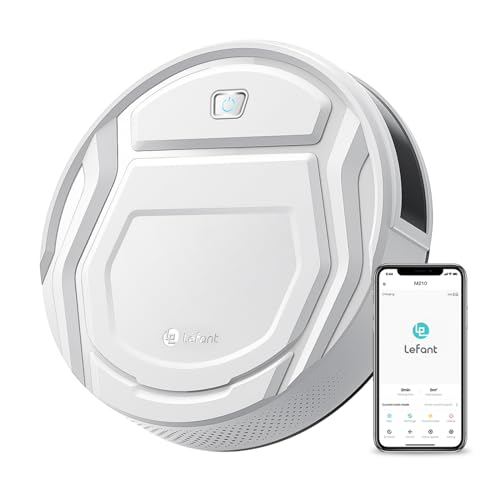
Pros
- Brushless suction port prevents pet hair tangles, reducing maintenance headaches
- Compact 2.99-inch low-profile body easily navigates underneath low-clearance furniture
- Lithium iron phosphate battery provides up to 120 minutes of runtime in low suction mode
- Smart control flexibility with the companion Lefant App plus Alexa and Google Assistant voice integration
- Equipped with 6D anti-collision infrared sensors to help detect obstacles and prevent jamming
Cons
- Lacks a motorized roller brush, which limits deep agitation on medium and high-pile carpets
- Manufacturer explicitly advises against using the zigzag cleaning mode on carpet
- Maximum 120-minute battery life applies specifically to the low suction running mode
The Lefant M210 is an entry-level robotic vacuum designed primarily for routine dry debris removal across hard floors and low-profile living areas. Standing out with its compact frame and roller-free pickup design, this cleaner is well-suited for pet owners, apartment dwellers, and busy households looking for automated daily maintenance without the chore of untangling hair from a traditional motorized brush roll.
Floor cleaning is handled through a brushless suction port paired with a digital motor. Because there is no rotating brush roll underneath, pet hair, dirt, and dust travel straight into the collection bin, significantly lowering hair wrap issues. The cleaner supports six distinct operating modes, including zigzag, random, spot, edge, scheduled timed cleaning, and manual control via the Lefant App. While the unit handles daily debris on hard surfaces effectively, the manufacturer explicitly notes that zigzag mode should not be used on carpets, making it primarily a hard-floor specialist with light area-rug utility.
Measuring approximately 11 inches in diameter and 2.99 inches in height, the Lefant M210 features a notably slim build that allows it to glide under low-clearance bed frames, couches, and entertainment centers where upright vacuums cannot reach. Navigation is guided by upgraded FreeMove Technology 3.0, which utilizes 6D built-in anti-collision infrared sensors to detect potential trapping points and adjust travel paths before the vacuum becomes wedged.
Daily operation and scheduling are managed through Wi-Fi pairing with the dedicated Lefant App, which also lets users adjust suction levels, direct manual movement, and integrate voice commands through Amazon Alexa or Google Assistant. Power is supplied by a lithium iron phosphate battery that delivers up to 120 minutes of runtime when operated in low suction mode. When cleaning cycles end or battery power dwindles, the vacuum automatically returns to its base for self-charging. Routine maintenance centers on sliding out and emptying the internal dustbin and keeping sensor windows clean.
Buyers should be aware of practical operational boundaries before purchasing. Because this model relies exclusively on pure suction without brush-roll bristles, it will not provide deep mechanical agitation on thick carpets or dense area rugs. In addition, reaching the full 120-minute battery benchmark requires operating in low suction mode, meaning higher power settings will yield shorter run times.
For pet owners and households with primarily hard floors seeking an affordable, low-profile robotic vacuum that reduces hair-clearing maintenance, the Lefant M210 offers dependable practical value. Its balance of smart scheduling, voice compatibility, and anti-tangle suction makes it an appealing everyday helper for keeping dust bunnies and shed fur under control.
The key feature of the Lefant M210 for pet households is its brushless suction inlet. Traditional robot vacuums rely on bristle or rubber roller brushes that inevitably collect tangled pet hair, requiring scissors or specialized tools to cut free after every cleaning session. By eliminating the roller brush entirely, this robot pulls loose fur, whiskers, and dander straight into the dustbin.
This brushless layout makes the machine especially effective along hard surfaces such as tile, vinyl, and sealed wood floors where pet hair floats and gathers in room corners. However, without rotating bristles to agitate carpet fibers, pet owners with deep carpet piles should view this vacuum as a hard-floor surface maintainer rather than a deep carpet extractor.
Setup and daily controls run through the companion Lefant App, which allows users to schedule automated floor cleaning, switch power modes, and guide the cleaner manually. Compatibility with Amazon Alexa and Google Assistant adds hands-free voice convenience for starting or stopping cycles.
To navigate living spaces without constant manual rescue, the cleaner relies on FreeMove Technology 3.0. A series of 6D anti-collision infrared sensors monitor the vacuum's surroundings, detecting low furniture skirts, table legs, and tight spaces. The system adjusts trajectory automatically to reduce collisions and prevent the robot from getting stuck beneath household items.

Pros
- Simultaneous vacuum and mop design handles dry debris and surface wiping in a single cleaning cycle
- Compact 2.99-inch height fits under low couches and furniture where upright vacuums cannot reach
- Includes a physical remote control alongside app and voice options, ideal for quick adjustments without a phone
- Solid manufacturer-rated 5000Pa suction lifts stubborn pet hair from low- and medium-pile carpeting
- Self-charging dock ensures the vacuum returns automatically to replenish its battery
Cons
- Relies on sensor-based zig-zag pathing rather than interactive LiDAR or camera-based room mapping
- Mopping functionality uses a passive damp pad without active mechanical scrubbing or automatic carpet lift
- The maximum 150-minute runtime specification is based solely on low-power quiet mode operation
The Tikom G8000 Max is a dual-function robotic vacuum and mop engineered to deliver automated floor care for busy homeowners, apartment renters, and multi-pet households. By uniting a manufacturer-specified 5000Pa suction rating with an integrated mopping attachment, the device addresses everyday surface dirt, tracked-in outdoor grit, and shedding pet hair across hard surfaces and carpets alike. For shoppers seeking regular floor maintenance without pushing a heavy upright machine every day, this automated platform serves as a convenient daily cleaning tool.
Cleaning versatility centers on its dual-action hardware layout, housing a 450 ml dustbin for dry debris and a 300 ml water reservoir for damp wiping. When running, the robot vacuums up loose dirt while simultaneously dragging a moist microfiber cloth across bare floors to trap fine surface dust. The vacuum offers four specialized operating patterns: a systematic Zig-zag pattern for broad coverage, an Edge setting for room perimeters and baseboards, a concentrated Spot mode for localized dry spills, and Manual steering via remote or app. Large climbing wheels enable smooth transitions over standard floor dividers between hard surfaces and low- to medium-pile carpets.
The physical build of the G8000 Max emphasizes access and low-profile maneuverability. Standing at just 2.99 inches tall with a 12.6-inch diameter, it easily clears the clearance gap beneath low-profile couches, platform beds, and entertainment stands where debris accumulates out of sight. Navigation relies on integrated anti-collision sensors and anti-drop cliff detection, helping the unit steer around baseboards and refrain from tumbling down stairwells. Control options are notably flexible: users can direct routines through a mobile application, link to voice control, press the physical buttons on the top housing, or rely entirely on the dedicated handheld remote, making it accessible for households that prefer not to manage smartphone pairing.
Routine setup and daily maintenance are refreshingly straightforward. The vacuum docks itself autonomously whenever battery reserves run low, keeping it topped up for the next scheduled session. Emptying the 450 ml dustbin requires releasing the rear module and dumping contents directly into the household trash, while the 300 ml water tank can be refilled at any sink. Maintaining pickup performance involves periodically checking the rotating brush roll for pet hair wrap, clearing the side brushes, and removing the mop pad to wash and dry between wet cleaning passes.
Prospective buyers should remain mindful of practical operational limits. The G8000 Max does not feature laser-guided LiDAR or visual camera mapping, meaning it cannot construct digital room layouts, save floor plans, or enforce digital no-go boundaries within the mobile app. Additionally, the mopping module is a passive water-wicking plate rather than an oscillating scrubber, and it lacks an automated lift mechanism, so the water tank and pad should be detached before sending the robot across carpeted rooms. Furthermore, the listed 150-minute maximum runtime applies strictly to low-power quiet mode and will naturally decrease at higher suction settings.
For households looking for an affordable, capable automated cleaner to maintain hard floors, tile, and low- to medium-pile rugs, the Tikom G8000 Max delivers dependable everyday functionality. Its balance of high listed suction power, ultra-slim furniture clearance, dual vacuum-and-mop capability, and multiple control methods makes it a practical purchase for keeping busy living spaces consistently tidy.
The Tikom G8000 Max features a manufacturer-rated 5000Pa suction system engineered to tackle daily pet hair, dirt, and kitchen crumbs. Its combination floor module incorporates a 450 ml dry dust collection bin paired with a 300 ml water reservoir, facilitating simultaneous dry sweeping and damp floor wiping in one continuous path.
Surface compatibility extends across hard floor surfaces including tile, sealed hard floors, and vinyl, alongside area rugs and short- to medium-pile carpeting. Integrated large-diameter wheels provide smooth climbing capability over interior door thresholds, allowing the cleaner to navigate between disparate room surfaces without getting hung up.
Navigational guidance is managed through built-in anti-collision sensors and anti-fall cliff detection modules that monitor walls, chair legs, and drop-offs such as stair landings. The robot utilizes four selectable navigation routines: an organized Zig-zag sweep for maximum room coverage, an Edge mode targeting baseboards, a concentrated Spot mode for small messy zones, and Manual control.
System operation is supported across four distinct control channels: a smartphone mobile app, voice-assistant integration, direct push-button operation on the cleaner chassis, and an included physical remote control. The physical remote offers straightforward, immediate control without requiring Wi-Fi pairing or smartphone accounts.
Power management is anchored by an automated self-charging function that directs the robot vacuum back to its docking base whenever the battery runs low. In low-power quiet mode, the machine delivers a manufacturer-listed runtime of up to 150 minutes, providing ample working time for typical household floor plans.
Regular maintenance involves unlatching and emptying the 450 ml dry bin, detaching the mopping cloth for routine washing, and refilling the 300 ml clean water reservoir as needed. Periodic cleaning of the main agitator roll and side sweeping brushes helps prevent hair binding and preserves consistent pickup performance over time.

Pros
- Self-emptying station with two 2.5L dust bags significantly minimizes daily dustbin maintenance
- Listed 6000Pa suction delivers strong pickup power for pet hair and debris on tile, hardwood, and carpet
- Compact 2.99-inch low-profile chassis easily navigates underneath low couches and clearance furniture
- Precise LiDAR navigation supports multi-floor mapping, no-go zones, and custom room schedules
- Dual-band Wi-Fi connection maintains steady communication across both 2.4G and 5G household networks
Cons
- Requires manual removal of the mop bracket to switch between hard-floor mopping and carpet deep cleaning
- The 250ml internal dustbin and 300ml water tank are relatively compact and require frequent attention during extended mopping runs
- The auto-empty dock handles dry debris extraction but does not wash or dry the mopping pad
The Lefant M2 Plus is an automated robot vacuum and mop combo built for homeowners, apartment renters, and pet owners looking to reduce manual floor-care chores. Operating as a hybrid system, it is designed to sweep, vacuum, and damp-mop hard surfaces such as hardwood and tile, while also handling debris on low-to-medium pile carpets. For multi-surface households dealing with daily pet shedding, crumbs, and entrance dirt, this unit offers an accessible way to keep common living areas clean without requiring constant manual oversight.
Cleaning capability centers on a listed 6000Pa hyper suction motor paired with three adjustable power settings. The robot utilizes an onboard 250ml dustbin alongside a 300ml electronically controlled water tank featuring three flow levels. When working on hard floors, it sweeps loose dirt into the intake while trailing a damp pad to pick up fine residual dust. When encountering carpets, built-in detection technology serves two distinct purposes: it actively avoids area rugs when the mop holder is connected to prevent wet fabrics, and automatically boosts suction to maximum power once the mop holder is removed to lift embedded pet hair from carpet fibers.
Hardware design sets the M2 Plus apart from many standard LiDAR machines. At 11 inches in diameter and just 2.99 inches tall, it features a lower profile than traditional turret-topped robot vacuums, allowing it to navigate beneath low-clearance sofas, coffee tables, and bed frames where pet hair frequently gathers. Navigation is driven by a 360-degree LiDAR system that quickly maps rooms and supports multi-floor layouts. This is paired with a 190-degree PSD sensor array capable of identifying household obstacles as close as 1.6 inches away, reducing rough collisions with baseboards and furniture legs even in dim lighting.
Everyday maintenance is streamlined by the included auto-empty station. After completing a cleaning cycle, the robot docks and evacuates dry debris into a 2.5L dust bag, which the manufacturer states can hold up to 75 days of waste depending on household shedding and usage frequency. The package includes two bags to start. Connected controls run through the Lefant mobile app, with support for both 2.4GHz and 5GHz Wi-Fi bands to prevent connection drops. Users can set up virtual no-go zones, merge or split rooms, trigger spot cleaning, or run basic operations via Amazon Alexa and Apple Watch integrations.
Prospective buyers should keep practical limitations in mind before purchasing. While the dock manages dry dustbin evacuation, it does not clean or dry the mop pad, meaning users must manually detach, rinse, and air-dry the cleaning cloth after mopping runs. Furthermore, transitioning from mopping hard floors to vacuuming carpets requires manually snapping off the mop module so the robot can safely climb onto rugs. The onboard 140-minute stated runtime provides ample coverage for small-to-midsize layouts, but very large homes may require recharge cycles during extensive deep-cleaning sessions.
For households seeking strong vacuum suction, dependable mapping, and low-profile clearance without the high cost of all-in-one washing stations, the Lefant M2 Plus presents a very practical package. Its 6000Pa motor, intelligent carpet detection, dual-band Wi-Fi reliability, and hands-free self-emptying base make it an efficient daily maintenance partner for busy families and pet-friendly homes.
The Lefant M2 Plus delivers thorough routine floor care through a multi-stage cleaning mechanism. Its listed 6000Pa suction motor provides substantial lifting power across three selectable speeds, allowing users to dial down the power for quiet daytime sweeping or crank it up for high-traffic entryways. The 3-in-1 system uses sweeping side brushes to pull edge debris into the direct suction pathway, effectively gathering dog hair, kitchen crumbs, and tracked-in litter on both hardwood and tile floors.
Mopping operations are supported by a 300ml water tank that feeds water evenly across the dampening pad. With three adjustable flow rates in the app, users can match the moisture output to their specific floor type, preventing excessive wetness on sealed wood surfaces while providing enough dampness to lift light surface footprints on ceramic tile. When the mopping attachment is detached, the carpet sensor activates an automatic suction boost to maximize agitation and lift hair lodged within carpet fibers.
Mapping and spatial awareness on the M2 Plus rely on an advanced 360-degree LiDAR setup integrated into a compact 2.99-inch chassis. The robot quickly scans rooms upon its first departure, generating accurate multi-floor floorplans that allow homeowners to customize cleaning routines level by level. Through the companion app, users can define specific rooms, create custom cleaning schedules, split or merge zones, and set restricted no-go zones to keep the machine away from pet bowls or cable clusters.
Obstacle avoidance is augmented by PSD technology featuring a 190-degree forward detection angle. This sensor system detects nearby items down to 1.6 inches away, allowing the robot to skirt around chair legs, shoes, and dropped toys without harsh bumper impacts. Because LiDAR and PSD sensors do not rely exclusively on ambient light, the M2 Plus can map and clean efficiently in fully dark rooms or during overnight cleaning schedules.
Routine upkeep on the Lefant M2 Plus is centered on its bag-compatible auto-empty station. After finishing its route, the robot aligns with the base, which uses strong suction to pull debris from the 250ml onboard bin into a 2.5L sealed dust bag. The manufacturer estimates each bag can hold up to 75 days of debris, keeping airborne dust safely contained and making it especially convenient for allergy-conscious households. Two disposal bags are provided in the box.
Long-term maintenance still requires periodic hands-on care for the wet components and moving parts. The reusable mopping pad should be removed and hand-washed or machine-washed after every damp mopping cycle to prevent mildew and sour odors. Owners should also periodically check the side brushes for tangled hair, rinse the internal washable dustbin filter, and ensure the 300ml water tank is emptied when not in active use to maintain reliable pump operation.

Pros
- Bagless self-emptying base avoids the recurring cost of proprietary disposal bags
- True HEPA dock filtration captures fine dust, dander, and allergens down to 0.3 microns
- 360-degree LiDAR navigation operates reliably in both daylight and dark rooms
- Matrix Clean multi-pass pattern delivers thorough coverage on high-traffic floor areas
- Up to 120-minute runtime with automated Recharge and Resume for whole-home coverage
Cons
- Bagless canister dumping can disperse airborne dust if emptied quickly indoors
- Operates as a dry-only robot vacuum without wet mopping or liquid scrubbing features
- At 4.1 inches tall, the top LiDAR dome may restrict clearance under low couches or cabinets
The Shark AV2501S AI Ultra Robot Vacuum is an automated dry-floor cleaner designed for busy households, active pet owners, and multi-surface homes requiring hands-off daily maintenance. Equipped with a self-emptying base that stores debris for up to 30 days, this model addresses the common chore of constantly dumping miniature on-board robot bins. For homeowners with shedding pets or high-traffic entryways, having an automated machine that docks and self-clears debris brings meaningful convenience to standard cleaning routines.
Under the hood, Shark utilizes a multi-surface cleaning system engineered to pick up dirt and debris across all floor types. Rather than relying on a single straight-line pass, the manufacturer integrates Matrix Clean Navigation, which commands the robot to vacuum in a precise grid pattern, passing over messes multiple times. Coupled with Shark suction and a self-cleaning brushroll designed to actively shed pet hair, the vacuum is configured to manage fine dust, dander, and tracked-in grit without requiring immediate manual intervention after every run.
A primary highlight of this system is the bagless, self-emptying base station. Unlike competing designs that rely on recurring purchases of disposable dock bags, this station uses an easy-dump collection bin paired with true HEPA filtration. Shark claims the base filter captures and seals 99.97% of dust and allergens down to 0.3 microns, which makes it particularly attractive for allergy-conscious households. Measuring 13.7 inches wide by 4.1 inches tall and weighing 14.42 pounds as a total package, the hardware feels solid, though the 4.1-inch clearance requires some planning around low couches and bed frames.
Day-to-day operation is coordinated by 360-degree LiDAR vision, which quickly maps the home and navigates around everyday obstacles in bright daylight or total darkness. Through Wi-Fi pairing with Amazon Alexa or Google Assistant, users can initiate on-demand sessions or schedule daily cycles. The onboard battery supports up to 120 minutes of runtime, and when the battery depletes mid-cycle, the Recharge and Resume protocol sends the unit back to the dock before returning to complete the unfinished zones. Maintenance involves periodically washing the bagless canister, checking the side brushes, and servicing the washable base filters.
While the automated emptying dock saves considerable time, the bagless mechanism means dumping the collection canister can occasionally disperse a small puff of dust, which might bother sensitive users. In addition, this model is purely a dry robot vacuum; it does not support wet mopping, liquid extraction, or scrubbing. Homeowners with exceptionally low furniture should also verify vertical clearance, as the top-mounted LiDAR dome increases total robot height compared to non-mapping or camera-only alternatives.
For households seeking reliable automated vacuuming without ongoing consumable bag costs, the Shark AV2501S AI Ultra represents a strong balance of navigation intelligence and debris management. Its combination of methodical matrix grid cleaning, pet-hair-focused brush design, and HEPA-filtered self-emptying makes it a dependable choice for keeping both carpet and hard floors consistently tidy between deeper cleaning sessions.
The Shark AV2501S utilizes 360-degree LiDAR vision to scan and map floor plans accurately upon its initial cleaning runs. Because LiDAR relies on light detection and ranging rather than optical cameras, the vacuum navigates effectively in both well-lit rooms and total darkness without losing its spatial coordinates.
In addition to basic pathing, Shark equips this model with Matrix Clean Navigation. Instead of a single back-and-forth track, the robot can execute overlapping passes in a grid pattern. This methodical coverage helps ensure that high-traffic corridors, entryways, and pet resting zones receive focused vacuum agitation rather than quick, single sweeps.
Pet hair management is a core design focus for the Shark AI Ultra system. The robot features a self-cleaning brushroll engineered to clear hair wrap during operation, minimizing the chore of cutting tangled pet fur off the roller bar between cleaning cycles.
Complementing the brushroll is the self-empty base station equipped with true HEPA filtration. The manufacturer states that this filtration setup captures 99.97% of dust and allergens down to 0.3 microns, trapping fine dander and tracked-in outdoor particles inside the sealed dock rather than recirculating them into living spaces.
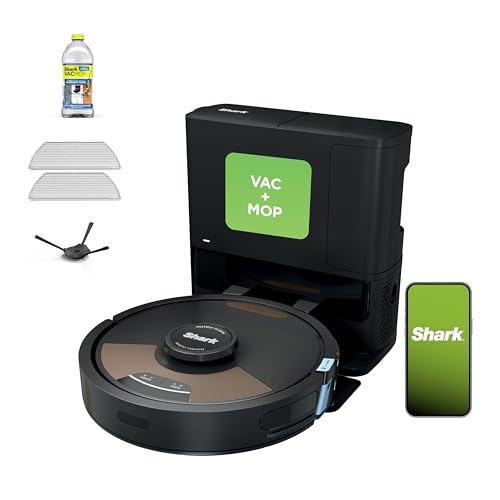
Pros
- Bagless self-emptying base stores up to 60 days of debris with zero disposable bag costs.
- Sonic mopping scrubs hard floors while the suction system lifts dry crumbs and dirt simultaneously.
- True HEPA filtration in the base traps fine dust and allergens down to 0.3 microns.
- CleanEdge air blasts pull stubborn edge dirt directly into the central vacuum path.
Cons
- Mopping pads and fluid tanks still require manual refilling, removal, and washing between runs.
- Dumping the bagless base container into a trash bin can release some dust into the air.
- Manufacturer specifications do not state the exact battery runtime or water tank capacity.
The Shark Matrix Plus 2-in-1 Robot Vacuum and Mop (model AV2613WA) provides automated floor care tailored for busy households, families, and pet owners managing both carpets and hard floors. Engineered to handle routine household messes, this unit vacuums dry debris like crumbs and tracked-in soil while providing sonic mopping across hard surfaces. Its central convenience feature is the self-emptying base station, which holds up to 60 days of debris and eliminates the ongoing expense of buying replacement vacuum bags. Households looking for automated daily maintenance will appreciate having both mopping and vacuuming integrated into one machine.
Cleaning coverage relies on two primary systems: Matrix Clean and CleanEdge Detect. During Matrix Clean cycles, the robot moves in a precision grid layout, taking multiple passes over the same area to lift embedded dirt. According to manufacturer comparisons against single-pass cleaning on level loop sand, this multi-pass grid provides 30 percent better carpet cleaning. For baseboards and tight perimeters, CleanEdge Detect uses corner recognition and blasts of air to blow trapped debris away from walls directly into the cleaning path, resulting in 50 percent better edge cleaning compared to models with the feature turned off. On hard floors, the sonic mopping system scrubs surface stains while the vacuum removes loose grit at the same time.
The robot docks at a bagless self-empty station finished in a black and brass design. Rather than relying on disposable dust bags, the dock features a clear bagless bin that empties directly into the trash. The base incorporates True HEPA filtration and an Anti-Allergen Complete Seal, which captures and seals 99.97 percent of dust and allergens down to 0.3 microns based on manufacturer specifications. With total package dimensions of 21.4 by 14.96 by 5.69 inches and a weight of 16.95 pounds, the dock and robot maintain a manageable footprint in standard living spaces.
Everyday operation is designed around minimal hands-on effort for dry floor care. After vacuuming cycles, the base evacuates the robot dustbin automatically, allowing users to go up to two months before dumping the main canister. If the robot runs low on power in large floor plans, the Recharge and Resume system automatically guides it back to the dock and resumes the cleaning cycle right where it left off. However, mopping does require active attention: users must fill the liquid reservoir before damp cleaning runs and remove, wash, and dry the mop pad afterward to keep it fresh.
Buyers should consider a few realistic operational boundaries before purchasing. Because the self-empty base is bagless, dumping the collected debris into a trash can may release a light puff of fine dust, which allergy-sensitive users should keep in mind. Furthermore, the product specifications do not list explicit battery runtime in minutes or fluid tank volumes, meaning total cleaning area per charge will depend on home layout, carpet thickness, and debris levels. Users must also manage mopping pad installation manually depending on floor transition needs.
The Shark Matrix Plus AV2613WA is a practical, value-conscious automated cleaner for homes with mixed carpets and hard floors. Its combination of grid-based Matrix Clean, corner air blasts, sonic mopping, and sealed HEPA dock filtration delivers dependable everyday maintenance. If you want a hands-off robotic floor cleaner that tackles both sweeping and light scrubbing without ongoing bag purchases, this model serves as a capable household companion.
Matrix Clean technology directs the robot in a precise grid pattern across the room rather than standard single-pass linear lines. By making multiple passes over debris, the robot agitates and lifts embedded dust, pet hair, and crumbs from carpets and hard floors. Shark states that this multi-pass grid delivers 30 percent better carpet cleaning performance compared to single-pass models tested on level loop sand.
To solve edge-cleaning issues along baseboards, CleanEdge Detect actively senses room perimeters and corners. The system deploys targeted blasts of air to blow trapped particles out from walls and directly into the vacuum intake. Manufacturer data shows this active air-assist technology delivers 50 percent improved edge cleaning compared to operating with CleanEdge switched off.
The docking station included with the AV2613WA functions as both an automatic charging dock and a self-emptying dust hub. At the end of a vacuuming run, the dock evacuates the internal bin of the robot and stores up to 60 days of household debris. The bagless collection bin eliminates the need to buy proprietary replacement bags, significantly lowering long-term ownership costs.
Air quality containment is handled by a True HEPA filter fitted inside the self-emptying base. Paired with Shark Anti-Allergen Complete Seal technology, the dock captures and holds 99.97 percent of dust and fine particles down to 0.3 microns. This keeps evacuated debris securely contained inside the base rather than venting fine particles back into the room during the self-empty cycle.
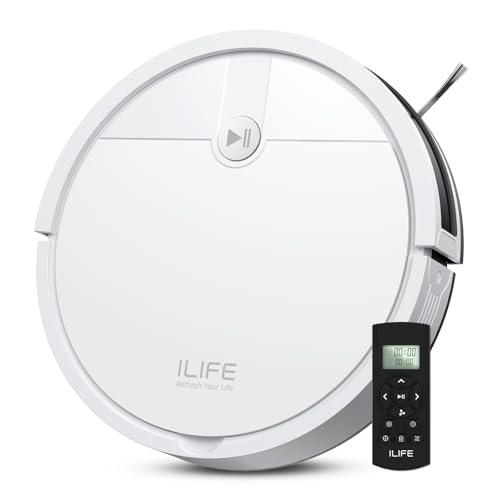
Pros
- Direct suction port prevents pet hair tangles, significantly reducing brush-roll untangling maintenance
- Slim 2.99-inch height fits under low-clearance furniture where standard uprights cannot reach
- Generous runtime of up to 120 minutes with automatic return-to-dock recharging
- Simple operation via remote control or one-button touch without requiring home Wi-Fi or app setup
- Multi-surface cleaning covers hardwood, laminate, tile, stone, and low pile rugs
Cons
- Suction-only design lacks a motorized rotating brush roll, making it unsuitable for medium or high-pile carpeting
- Operates without smart digital mapping or app-based boundaries, relying instead on infrared sensors and remote scheduling
- Dry-cleaning only vacuum with no wet mopping or liquid spill pickup capabilities
The ILIFE V2 is an automated dry vacuum cleaner designed primarily for apartment dwellers, busy pet parents, and homeowners seeking hands-off floor care for bare surfaces and low pile flooring. Measuring 12.2 inches in diameter and only 2.99 inches tall, this compact robotic cleaner focuses on everyday dust, loose dirt, and shedding pet hair. Rather than relying on complicated mobile apps, the V2 offers straightforward control through an included remote control or a physical one-touch button on the cleaner itself, making it an approachable option for first-time robot vacuum buyers.
Cleaning pickup relies on a direct, tangle-free suction port rather than a motorized bristle brush roll. For households with dogs and cats, this design eliminates the tedious chore of cutting wrapped hair and tangled fur off an agitator bar. The vacuum effectively gathers surface dirt, tracked-in litter, crumbs, and hair across hardwood, tile, laminate, natural stone, and low pile carpets. Because the unit is equipped with auto clean, edge clean, and spot clean modes, users can target stubborn localized spills or send the robot along wall baseboards where dust bunnies routinely accumulate.
With a compact profile weighing approximately 7.1 pounds, the robot maneuvers smoothly under coffee tables, nightstands, and low sofas where standard stick or upright vacuums struggle to reach. Navigation is guided by built-in infrared sensors that detect furniture, walls, and sudden drop-offs like staircases. While the V2 does not utilize laser room mapping, its collision-avoidance and drop-off sensors provide the situational awareness needed to move through rooms without constantly bumping hard into baseboards or tumbling down steps.
Day-to-day operation is streamlined by preset routine scheduling and a solid battery life. The manufacturer specifies up to 120 minutes of continuous cleaning on a single full charge, which is plenty of time to cover common living spaces before power depletes. When the battery runs low, the robot automatically returns to its floor charging dock to replenish itself. Maintenance involves pulling out the internal dry dustbin to empty collected debris and occasionally wiping down the external infrared sensors to ensure clear navigation.
Prospective buyers should keep realistic performance boundaries in mind before purchasing. Because the ILIFE V2 uses a bristle-free suction port, it relies solely on airflow rather than mechanical agitation. As a result, it is not built to pull deeply embedded grit out of plush or high-pile carpets. Furthermore, it does not support smart home app pairing, interactive virtual no-go zones, or wet-mopping tasks. Floor areas should be kept relatively clear of loose cables and thick floor rugs to ensure unobstructed movement throughout the cleaning cycle.
For households with predominantly hard floors such as wood, tile, laminate, or stone, the ILIFE V2 delivers dependable and low-maintenance everyday value. Pet owners tired of clearing tangled hair from traditional brush rolls will appreciate the direct suction system. Supported by a 12-month warranty and U.S.-based customer support, this robot vacuum serves as a practical, hassle-free helper for daily sweeping and pet hair maintenance.
Pet hair management is one of the most frustrating aspects of floor care because long strands and thick undercoats quickly choke standard spinning brush rolls. The ILIFE V2 addresses this issue by utilizing a dedicated tangle-free suction port. Because there is no central rotating roller beneath the chassis, dog and cat hair travels straight into the suction pathway and directly into the dustbin without binding or wrapping around mechanical parts.
This tangle-free suction channel performs especially well on flat, rigid surfaces like hardwood, tile, laminate, and stone. Pet dander, loose fur tumbleweeds, dry kibble, and stray litter are gathered smoothly during regular passes. While it easily collects surface hair on low pile carpets and flat-woven rugs, homes with heavy carpet shedding may still need an upright with a motorized brush roll for deep fiber agitation. For routine daily sweeping, however, the direct suction mechanism saves considerable maintenance time.
Efficient coverage in budget-friendly robot vacuums depends on smart sensor integration and reliable power. The ILIFE V2 features integrated infrared anti-collision and anti-fall sensors that identify physical obstacles and edge drops. These sensors assist the vacuum in slowing down near furniture legs and turning away from stairwells, protecting both your furnishings and the machine itself during unsupervised runs.
The internal battery supports up to 120 minutes of runtime on a single charge, allowing the vacuum to clean multiple rooms before needing more power. When the battery level drops, the unit automatically navigates back to its charging dock to recharge. Homeowners can also program the machine to start automatic daily sweeps using the preset scheduling function, ensuring floors are maintained consistently even when no one is home.

Pros
- Auto-empty dock with a 4L dust bag provides extended hands-free debris collection for up to 120 days
- Strong 6000Pa listed suction with automatic carpet boost handles mixed-surface cleaning effectively
- 360-degree LiDAR mapping quickly saves up to 4 distinct floor plans with customizable no-go zones
- App-controlled 3-level suction and 3-level water regulation allow tailored cleaning for different room requirements
Cons
- Mopping cloth must be manually detached whenever you want to prevent damp contact on carpets during vacuuming
- Manufacturer does not specify the battery capacity or runtime per charge in the product data
- The internal water reservoir capacity is not explicitly stated in the listing specifications
The TRDIOL Robot Vacuum and Mop is an automated cleaning system designed for busy households, pet owners, and multi-story homes seeking regular floor maintenance with minimal hands-on intervention. Equipped with an auto-empty charging dock housing a 4-liter dust bag, the station is designed to collect and hold up to 120 days of dry household debris. This makes it an appealing choice for homeowners and apartment dwellers who want steady crumb and pet-hair pickup on hardwood, tile, and carpeted floors without having to empty a small onboard dustbin after every cycle.
Everyday debris removal relies on the robot vacuum's 6000Pa maximum suction output, which can be tailored across three selectable power levels depending on the room. An automatic carpet boost feature detects carpeted surfaces and increases suction output to help loosen embedded particles and pet fur. Agitation is managed through a dual anti-tangle design that pairs a tangle-resistant main roller brush with a flexible side brush for perimeter sweeping. On hard floors, the wet mopping function works simultaneously with the vacuum to lift light footprints and minor stains, with three app-managed water flow settings to control moisture levels.
Navigation is handled by a 360-degree smart LiDAR sensor that quickly maps your living area to plan efficient, organized cleaning paths instead of wandering randomly. The system can store up to four separate floor maps, making it practical for multi-level houses where the unit must be moved between stories. Inside the companion app, users can establish virtual walls and customized no-go zones to keep the cleaner away from pet dishes, electrical wiring, or children's play areas. Routine start, stop, and scheduling commands can be managed through the mobile app or via voice commands using Amazon Alexa and Google Assistant.
Maintaining the system is centered on the auto-empty base, which pulls collected dust, hair, and grit directly into the sealed 4L bag whenever the machine returns to dock. This enclosed transfer reduces direct exposure to loose airborne dust during routine emptying. Day-to-day upkeep involves rinsing the mopping cloth after wet cycles, refilling the water tank when mopping is needed, and detaching the cloth when only dry vacuuming is desired. While the main brush is engineered to reduce tangles, pet owners should still inspect the roller and side brush periodically to ensure smooth operation.
Despite its versatile feature list, this robotic cleaner has a few practical boundaries to keep in mind. The product specifications do not detail exact battery capacity or single-charge runtime, leaving the exact square-foot coverage per battery cycle unstated. Furthermore, because the mopping module relies on a standard attached cleaning cloth rather than high-speed sonic vibration or spinning pads, it is intended for routine dust and minor surface spots rather than heavy, dried-on grime. Users must also manually remove the mopping cloth when transitioning to carpet-only cycles to avoid dragging damp fabric across rugs.
For households seeking strong 6000Pa suction, multi-floor LiDAR mapping, and months of hands-free docking convenience at an accessible price point, the TRDIOL Robot Vacuum and Mop provides a well-rounded feature set. It is particularly well matched for homes with hardwood, tile, and carpets where daily pet hair shedding and high-traffic dirt demand consistent, automated attention. Buyers looking for straightforward boundary management, multi-level map saving, and reduced dustbin chores will appreciate its practical day-to-day functionality.
The TRDIOL robotic cleaner uses a 360-degree LiDAR laser scanner to create an accurate layout of your home before setting out on systematic cleaning runs. This mapping method allows the robot to clean in structured rows rather than relying on random bounce patterns, minimizing repeated passes and helping ensure consistent coverage across open floor plans and along room perimeters.
For multi-story living spaces, the unit supports saving up to four unique floor plans in memory. When moved upstairs or to another level, the system recognizes the layout without needing to rescan from scratch. Within the mobile smartphone app, users can define virtual boundaries, set no-go zones around pet bowls or nursery spaces, and direct the cleaner to specific rooms on custom cleaning schedules.
The auto-empty base station simplifies regular vacuum maintenance by automatically evacuating debris from the robot into a 4-liter dust bag after each cleaning run. Designed to hold up to 120 days of accumulated debris under standard household conditions, this system significantly reduces the need for frequent bin emptying and keeps collected pet hair and dust safely contained inside a sealed bag.
General mechanical upkeep involves periodically checking the anti-tangle roller brush and side brush for caught threads or fibers. When using the mopping function, users should remove and wash the mopping cloth after cleaning to prevent odors and maintain damp wiping performance. Because the mopping module does not lift automatically on carpets, detaching the cloth is recommended when scheduling dry-only vacuuming runs across carpeted rooms.


Pros
- Bagless 60-day self-empty base eliminates the need to buy disposable replacement bags.
- Sonic mopping scrubs at 100 passes per minute to agitate stuck-on surface grime on hard floors.
- True HEPA base filtration captures 99.97% of microscopic particles down to 0.3 microns.
- 360-degree LiDAR navigation provides quick mapping, room customization, and reliable night or day operation.
- CleanEdge Detect system actively blows dust out of baseboards and wall corners into the vacuum path.
Cons
- Requires manual intervention to install, remove, and wash the mopping pads between wet and dry cycles.
- Dumping the bagless dock bin into an indoor trash can may release a small cloud of dust.
- Includes only a 12-ounce starter bottle of cleaning solution, requiring future purchases of compatible formula.
The Shark Matrix Plus Robot Vacuum & Mop Combo (AV2610WA) is designed for busy households, pet owners, and multi-surface homes that need an automated solution for both dry debris and surface grime. Combining strong vacuum suction for carpets with active sonic mopping for hard floors, this robotic cleaner aims to reduce daily maintenance by handling routine floor care on a scheduled grid. With an XL self-emptying base that stores up to 60 days of dust without requiring disposable replacement bags, it offers particular appeal to budget-conscious families who dislike ongoing consumable costs.
Cleaning capability centers around two distinct technologies: Matrix Clean and high-speed sonic mopping. On carpets and hard floors, the robot operates in a cross-directional matrix pattern to make multiple passes over stubborn dirt, providing up to 30% better carpet pickup than standard single-pass cleaning based on manufacturer tests. When wet mopping hard floors, the integrated sonic pad scrubs at 100 vibrations per minute to lift dried-on spills. Through the companion smartphone app, users can initiate targeted Matrix Mop cycles on specific high-traffic zones, delivering up to 50% improved stain cleaning compared to prior base models.
For households with shedding pets and allergy concerns, the robot is equipped with a self-cleaning brushroll designed to actively prevent pet hair wrap while digging deep into carpet fibers. Fine particles and dander pulled into the base are sealed with True HEPA filtration, which captures 99.97% of dust and allergens down to 0.3 microns. Along perimeter baseboards, the CleanEdge Detect system deploys focused air blasts alongside corner recognition to blow trapped dust directly into the vacuum intake path, delivering up to 50% better edge pickup than Shark robots without this feature active.
Navigation is driven by 360-degree LiDAR vision, enabling the robot to create accurate floor plans of your home quickly and operate reliably in bright daylight or pitch darkness. The mobile app allows homeowners to designate specific cleaning zones, adjust passes, and adapt to room rearrangements over time. When the battery runs low during extensive cleaning runs, the unit automatically recharges at the dock and resumes cleaning at the exact point it paused. The base itself is bagless, meaning dirt bins are simply unlatched and emptied into the trash, while the included microfiber mopping pads can be washed and reused.
While the Shark AV2610WA offers automated floor care, it does have practical limitations that buyers should keep in mind. Because the self-emptying base is bagless, opening and dumping the canister into an indoor trash can may create a slight plume of dust, which sensitive individuals may prefer to do outside. Additionally, while the robot vacuums and sonic-mops hard floors, users must still monitor the water and solution levels in the tank and routinely swap or wash the reusable mopping pads between damp cycles. The package also only includes a 12-ounce starter bottle of Shark VACMOP solution, meaning specialized solution must eventually be replenished.
Overall, the Shark Matrix Plus AV2610WA represents a balanced, highly capable floor-care appliance for homes with a mix of carpeting and hard flooring. Its combination of 360-degree LiDAR mapping, bagless 60-day dirt capacity, True HEPA dock filtration, and active scrubbing pads makes it well suited for pet owners, parents, and apartment or single-family dwellers who want hands-off daily floor maintenance without expensive ongoing bag subscriptions.
The Shark Matrix Plus utilizes 360-degree LiDAR vision technology to scan and map living spaces with high precision. This laser-guided system functions independently of ambient light, allowing the robot to map floor plans accurately and avoid obstacles during both daytime and nighttime cleanings. Homeowners can use the interactive smartphone app to view rooms, set specific cleaning zones, and execute targeted Matrix Clean or Matrix Mop cycles.
In addition to mapping precision, the robot incorporates intelligent recharge-and-resume logic. If a cleaning session exceeds the robot's single-charge capacity, it automatically navigates back to the XL dock, replenishes its battery, and returns directly to the spot where it paused to finish the job. This ensures thorough multi-room coverage without missing entire sections of large floor plans.
Managing pet hair and fine allergens is a primary strength of the Shark AV2610WA cleaning system. The robot is fitted with a specialized self-cleaning brushroll engineered to extract hair and dander from carpets and hard floors while continuously clearing itself to minimize annoying hair wraps around the core mechanism.
Once debris is vacuumed, the self-empty base evacuates the robot's internal dust cup into an XL bagless holding canister equipped with True HEPA filtration. This filtration standard captures and traps 99.97% of airborne particles, dust, and pet allergens down to 0.3 microns, preventing fine dirt from blowing back into household air during dock evacuation cycles.

Key Factors in Evaluating Robot Vacuum Cleaners
Choosing an automated cleaner requires matching specific robotic hardware to your household layout, flooring materials, and pet population. Modern models range from simple low-profile units with direct suction to complex hybrid docks that empty dust and wash mopping pads automatically. Understanding how navigation sensors, brush rollers, airflow pathways, and containment bases interact allows you to pick an appliance that functions reliably without constant intervention.
Navigation Technology and Home Mapping Capabilities
Navigation systems dictate how systematically a robot covers a room and whether it avoids obstacles cleanly. Entry-level units frequently utilize infrared sensors and mechanical bumper switches to travel in bounce patterns or simple back-and-forth zig-zag passes. Models like the Lefant M210 use multi-directional infrared sensors to detect drop-offs and furniture legs, which works well in open floor plans. However, bounce and sensor-only systems cannot store interactive floor maps, meaning they cannot accept no-go boundaries or clean specific rooms on demand.
Advanced models incorporate 360-degree LiDAR or optical vision sensors to scan room perimeters and construct digital layouts. LiDAR turrets, featured on cleaners like the Shark AV2501S AI Ultra and Lefant M2 Plus, measure distances accurately in both daylight and complete darkness. These laser measurements allow the software to generate multi-floor maps, divide living spaces into distinct zones, and follow precise cleaning paths with minimal overlap. Precision mapping also allows users to draw virtual boundaries around fragile decor, cable tangles, and pet feeding bowls directly inside mobile apps.
Suction Power and Floor Surface Adaptability
Suction strength in robotic vacuums is commonly measured in Pascals (Pa), representing the pressure differential generated by the internal digital motor. Basic robot vacuums deliver sufficient airflow to lift fine dust, breadcrumbs, and surface pet hair from bare hardwood or tile. Higher-tier units, such as the Tikom G8000 Max rated at 5000Pa or the TRDIOL combo rated at 6000Pa, provide the deep pull required to extract heavy debris from carpet pile. Suction ratings provide a general baseline of motor performance, but real-world cleaning also depends heavily on airflow velocity and seal quality against the floor.
Surface adaptation features allow automated cleaners to adjust motor output depending on the flooring beneath them. Several intelligent units feature automatic carpet boost technology, which senses the resistance of carpet pile and increases suction to maximum output. When the cleaner rolls back onto smooth linoleum or hardwood, the motor drops back to lower power settings to conserve battery life and reduce operating noise. Homes with mixed flooring benefit substantially from automated throttle adjustments because low suction often leaves debris trapped deep inside carpet fibers.
Brushroll Mechanics and Pet Hair Tangle Management
Brushroll configuration represents one of the most critical factors for homes managing shedding animals and long hair. Traditional bristled roller brushes agitate carpets effectively, but long strands wrap tightly around the cylinder and require frequent manual cutting. To combat this issue, compact cleaners like the Lefant M210 and ILIFE V2 feature a brushless suction port that pulls hair directly into the intake without a roller. This tangle-free intake design eliminates hair wrapping entirely, making it practical for hard surface cleaning, though it lacks the carpet agitation of motorized bristles.
For homes with extensive wall-to-wall carpeting, self-cleaning motorized brushrolls offer a balanced solution. Systems engineered with anti-hair-wrap fins, such as those found on the Shark Stratos and Shark Matrix models, actively direct wrapped strands into the suction airflow during operation. While robotic vacuums provide steady routine hair pickup, households managing stubborn muddy tracks or deep animal accidents still frequently rely on pet stain vacuum equipment for intensive spot extraction. A well-designed brushroll system minimizes roller jams and maintains consistent airflow during daily runs.
Dust Collection and Self-Emptying Dock Stations
Dust collection capacity determines how frequently an owner must interact with the cleaning machine. Standard standalone robot vacuums carry small internal dustbins, typically holding between 250 and 500 milliliters of dry debris. In homes with multiple shedding pets, small internal containers can fill completely before a cleaning cycle finishes, causing debris to drag across floors. Emptying an internal bin daily remains manageable, but it requires regular attention and can release clouds of dust back into the room during manual disposal.
Self-emptying charging bases resolve this bottleneck by evacuating the robot dustbin into a larger storage chamber upon docking. Stations like the TRDIOL auto-empty dock utilize 4-liter sealed dust bags rated to hold up to 120 days of accumulated debris, while the Lefant M2 Plus provides up to 75 days of hands-off collection. Bagged bases keep allergens contained during replacement, while bagless self-emptying docks, such as the Shark AV2610WA base, eliminate ongoing consumable costs entirely. Selecting between bagged and bagless docks depends on whether a household prioritizes zero recurring expenses or sealed dust disposal.
Filtration Systems and Indoor Air Quality

Air filtration within robotic vacuums prevents fine particulates, dander, and pollen from exhausting back into home air during cleaning. Entry-level units typically incorporate pleated sponge or mesh filters that capture visible dust but allow microscopic particles to pass through. Basic filters require regular tapping over trash cans and periodic water rinses to prevent airflow restriction and motor strain. Neglecting filter maintenance leads to noticeable loss of suction and causes internal electronics to run hotter over extended cleaning sessions.
Allergy-sensitive households should inspect docking stations for true HEPA filtration and sealed airflow enclosures. Docking stations on models like the Shark Matrix Plus AV2613WA utilize HEPA filters that capture 99.97% of particles down to 0.3 microns within the base. Sealed filtration systems ensure that high-velocity evacuation cycles do not blow fine pet dander or dust mites into the surrounding living area. Checking the availability and pricing of replacement filters before purchasing ensures that the vacuum continues operating with proper airflow over years of service.
Hybrid Mopping Functions and Carpet Protection
Hybrid robot vacuum and mop combos clean bare floors by wiping microfibers across hard surfaces while vacuuming dry debris. Simple 2-in-1 units drag a moist microfiber cloth behind the suction port, utilizing passive gravity water tanks to dampen hard tile or sealed hardwood. The Tikom G8000 Max pairs a 450-milliliter dustbin with a 300-milliliter water reservoir to execute sweeping and damp wiping simultaneously. Passive mopping works well for removing surface dust, but it lacks the downforce required to lift dried spills or muddy footprints.
Advanced mopping robots integrate sonic vibration technology and intelligent carpet avoidance mechanisms. Cleaners like the Shark Stratos AV2700ZE scrub surfaces up to 100 times per minute to loosen stubborn dried grime while automatically lifting the mop pad when crossing carpets. Other units, like the Lefant M2 Plus, use carpet detection sensors to steer entirely around rugs designed for hardwood floors while the mop bracket is attached. Verifying how a hybrid model handles carpet avoidance prevents damp mop cloths from soaking delicate area rugs and upholstery edges.
Chassis Height, Wheel Clearance, and Threshold Climbing
Physical chassis dimensions dictate whether a robotic cleaner can reach accumulated dirt beneath low-hanging furniture. Ultra-slim models measuring 2.99 inches in height, such as the ILIFE V2 and Lefant M210, slip easily beneath low beds, couches, and kitchen cabinets. These slim profiles are achieved by utilizing bumper and infrared sensors instead of raised top-mounted laser turrets. While slim models lack advanced LiDAR scanning, their compact dimensions allow them to capture hidden dust bunnies that taller machines cannot reach.
Wheel suspension and climbing clearance determine whether a robot travels between different floor levels without getting stuck. Quality robot vacuums feature spring-loaded drive wheels capable of climbing over standard interior thresholds and thick rug transitions up to 0.6 to 0.8 inches high. Robots with rigid or small drive wheels often get beached on floor transition strips, requiring manual rescue to continue cleaning. Evaluating clearance heights and wheel articulation ensures smooth movement across mixed surfaces, thresholds, and door saddles throughout the home.
Battery Capacity, Runtime, and Recharge Routines
Battery specifications define the total square footage a robotic vacuum can clean in a single operating session. Most modern cleaners feature lithium-ion or lithium iron phosphate batteries that provide between 120 and 150 minutes of continuous runtime on low power modes. Units like the Lefant M210 utilize lithium iron phosphate cells known for stable thermal properties and extended cycle life over years of ownership. Actual runtime decreases significantly when using high suction levels, running motorized brushrolls, or operating active mopping attachments across dense carpets.
Recharge and resume functionality prevents large floor plans from being left partially uncleaned when the battery runs low. When battery reserves drop below critical levels, intelligent cleaners save their precise coordinates and return to the charging dock automatically. Once the battery reaches sufficient charge, the unit navigates directly back to the exact spot where cleaning stopped and finishes the scheduled run. This automated continuity eliminates the need for manual recharging and makes automated floor care practical for spacious, multi-room residences.
Smart App Control, Scheduling, and Home Integration
Mobile app interfaces provide the central command center for setting cleaning routines, adjusting suction levels, and tracking wear on consumable parts. Dedicated smartphone apps let users establish daily cleaning schedules, review real-time coverage maps, and direct robots to specific high-traffic zones like kitchen counters. Stable wireless connectivity remains essential, with models like the Lefant M2 Plus offering dual-band 2.4 GHz and 5 GHz Wi-Fi to maintain reliable connections in busy households. Cleaners supporting voice commands through Alexa or Google Assistant allow homeowners to start spot cleanups with simple spoken instructions.
Firmware updates and diagnostic alerts delivered through mobile apps ensure smooth long-term operation. Mobile notifications alert users immediately when a drive wheel gets caught on a stray charging cable or when dustbin sensors detect a full container. App diagnostics also track the remaining lifespan of filters, side brushes, and roller assemblies, giving clear guidance on when parts require cleaning or replacement. Investing in an intuitive app ecosystem transforms an autonomous floor vacuum from an isolated mechanical appliance into a seamless, manageable home maintenance tool.
Matching hardware specifications to your home environment ensures your robot vacuum delivers effortless daily floor maintenance. Assessing navigation types, brushroll tangling defenses, suction performance, self-emptying docks, and floor clearance prevents frequent operational headaches. Consulting your specific model manual for maintenance schedules and boundary setup instructions helps preserve suction efficiency and prolongs component lifespan. A properly matched robot vacuum keeps floors consistently clean while freeing valuable time for the rest of your daily routine.




Write Your Review
No reviews yet. Be the first to share your experience!