


Mattress fabrics collect an accumulation of dead skin cells, fine dust particles, and everyday fibers that standard household vacuums often struggle to extract. Regular floor attachments can introduce grime from hard floors and carpets directly onto clean sleeping surfaces, creating hygienic concerns for many homeowners. Identifying what is the best mattress vacuum cleaner requires understanding how specialized handheld units differ from standard uprights or bagged vacuum cleaners built for floors. Dedicated bed cleaners combine high-frequency tapping mechanisms with high-efficiency filtration to lift settled debris without damaging delicate upholstery fibers.
Modern handheld mattress cleaners rely on motor suction ratings ranging from 12kPa to 20kPa alongside motorized beating rollers that loosen compacted material. Many models also incorporate 253.7nm UV-C light, heated air systems, and multi-stage filtration to refresh bedding fabrics thoroughly. Selecting the right machine comes down to balancing corded continuous power with cordless convenience, along with verifying filtration quality and safety interlocks. Examining manufacturer specifications across suction power, roller design, and weight helps shoppers match a cleaner to their specific bedroom maintenance routine.


Evaluating Mattress Vacuum Cleaners: Suction, Sanitation, and Fabric Care
Pinpointing the most suitable mattress cleaner depends on matching mechanical agitation, cyclonic suction, and certified filtration to the specific fabrics in your home. Dedicated mattress vacuums operate differently from conventional floor models by prioritizing dense-fabric penetration over broad floor coverage. Understanding the underlying technologies allows you to determine which machine configuration delivers the most practical results for your sleeping environment.
High-Frequency Agitation and Roller Brush Mechanics
Dense mattress materials present a unique challenge because dust and skin flakes sink deep into quilted foam and fiber layers. Standard suction glides across the top surface without disturbing particles that cling to woven fibers underneath. Dedicated mattress vacuums solve this issue by using high-speed tapping mechanisms and rotating beaters operating between 30,000 and 60,000 vibrations per minute. This rapid mechanical oscillation strikes the mattress surface, vibrating embedded particles upward so the vacuum intake can capture them.
Roller brush construction varies significantly across popular bed vacuum designs. Some models feature corrugated all-metal rollers that generate rigid tapping pulses, while others utilize hybrid metal and rubber strips or soft bristles. Corrugated metal rollers provide intense vibration suitable for firm mattresses, whereas rubberized strips flex slightly to protect sensitive woven fabrics. Certain designs incorporate magnetically detachable brush rollers or removable side caps, which simplify cleaning when loose threads or hair wrap around the spindle.
Operating an agitator on fabric requires proper handling to avoid stalling the motor. Most manufacturers install locking rotor protection systems that immediately shut down the brush roll if bed sheets or loose upholstery get caught in the intake. Applying excessive downward pressure can also trigger these safety shutoffs or overheat the drive belt. Gliding the machine smoothly with light, steady contact ensures the tapping action works as intended without stressing internal components.
Suction Power and Motor Performance Standards
Suction performance in mattress vacuums is commonly specified in kilopascals (kPa), representing the static negative pressure generated by the motor. Typical models offer suction levels between 12kPa and 20kPa, which creates a firm seal against flat bedding fabrics. A higher kPa rating allows the machine to pull air through dense pillow tops and heavy mattress tickings rather than merely skimming the surface. Dual-mode machines often provide an economy setting near 12kPa for delicate linens alongside a boost mode reaching 16kPa to 18kPa for thick mattresses.
Motor design plays a central role in sustaining airflow under heavy fabric resistance. Corded models commonly utilize 400-watt to 550-watt motors designed to maintain steady airflow during long cleaning cycles. In contrast, cordless alternatives increasingly employ high-speed brushless motors capable of spinning at up to 70,000 RPM. Brushless motors deliver consistent negative pressure with lower heat generation, although their sustained power depends heavily on remaining battery reserves.
Intake width also dictates how suction energy distributes across the cleaning path. Wide suction ports spanning seven inches or more allow users to cover queen and king mattresses in fewer passes. However, narrower ports concentrate suction velocity, which can prove advantageous when pulling debris from deep tufting or mattress seams. Evaluating nozzle width alongside motor wattage helps you gauge whether a unit prioritizes rapid coverage or concentrated localized lift.
Sanitization Technologies: UV-C Light and Ultrasonic Systems
Ultraviolet sanitation serves as a standard feature across modern mattress cleaning equipment. Most units incorporate short-wave UV-C lamps operating at a 253.7-nanometer wavelength, while some modern designs use 270-nanometer to 280-nanometer UV-C LED arrays. This germicidal spectrum targets microscopic organisms and surface contaminants on fabric fibers as the machine passes over them. Because UV-C effectiveness relies on direct exposure time, slow and deliberate strokes produce better results than rapid sweeps across the bed.
Safety mechanisms are mandatory on UV-equipped appliances to protect human skin and eyes from accidental radiation. Manufacturers integrate gravity sensors or mechanical pressure wheels on the baseplate that only illuminate the UV lamp when the vacuum rests flat on a surface. Lifting or tilting the cleaner breaks wheel contact and instantly extinguishes the light. Keeping these baseplate wheels free of lint and debris ensures the safety interlock functions correctly during every use.
Ultrasonic wave generators frequently accompany UV lamps in premium mattress vacuums. These acoustic transducers emit high-frequency vibrations, often rated at 40,000 Hz, that transmit into fabric fibers. Ultrasonic vibrations disturb tiny particles and help neutralize static cling that binds fine dust to synthetic textiles. Some manufacturers also incorporate anion generators near the exhaust port to reduce static charges and freshen ambient air around the cleaning path.
Heated Air Systems and Moisture Reduction
Mattresses absorb significant body perspiration and environmental humidity over months of use, creating a hospitable setting for microscopic debris. To combat this moisture buildup, several mattress cleaners integrate internal heating elements that discharge hot air directly onto the bedding. These systems typically generate warm airflow between 131 degrees Fahrenheit and 150 degrees Fahrenheit during active vacuuming passes. The dry heat penetrates outer upholstery layers, helping to evaporate dampness that settles beneath fitted sheets.
Warm airflow also aids the physical vacuuming process by loosening oily residues that bind skin flakes to fabric fibers. As warm air circulates through the nozzle channel, fabric fibers relax slightly, allowing the vibrating brush roller to release trapped grit more readily. Regular use of heat-drying modes helps maintain a crisper, drier sleeping surface, which is particularly beneficial in humid climates or during summer months.
Aromatherapy integration is another secondary feature found on select heated mattress vacuums. These units include a dedicated top compartment or filter slot that holds scented fragrance tablets. As warm air exhausts from the machine, it disperses a light fragrance across the treated mattress and surrounding room. Maintaining these compartments requires occasional wiping to ensure fragrance oils do not accumulate on motor vents or filter housings.
Multi-Stage Filtration and Dust Separation Systems
Effective filtration prevents fine dander and microscopic skin particles from blowing back into bedroom air during operation. Most high-performance mattress cleaners employ true HEPA filters rated to capture 99.97 percent of airborne particles down to 0.3 microns. Multi-stage filtration assemblies typically place a stainless steel mesh screen before the HEPA element to catch coarse lint and stray hairs first. This layered design shields the pleated paper or synthetic HEPA media from premature clogging, preserving strong airflow through the cleaning cycle.
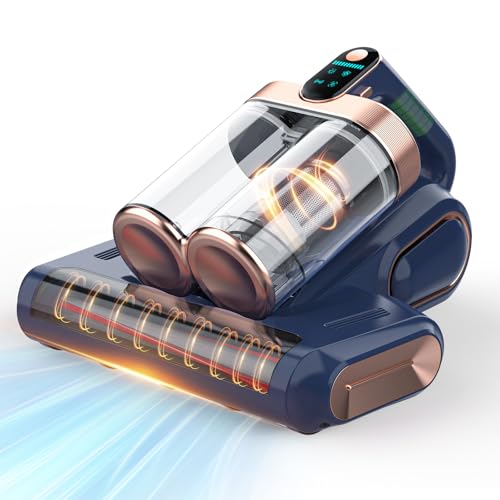
Dual-cup cyclonic separation has largely replaced single-chamber dust bins on modern mattress cleaners. The primary cyclonic chamber spins incoming air to separate larger debris and hair into one container, while the secondary cup collects micro-dust through the fine filter. This separation keeps the main airflow channel clear, preventing the sudden suction drops often seen in standard vacuum dust cups. Unlike larger vacuums designed for deep pile carpeting that handle broad floor debris, dual-cup bed cleaners isolate fine organic powder to protect the internal motor.
Filter maintenance remains vital for keeping suction strong and extending appliance lifespan. Washable sponge inserts and plastic cyclone assemblies can be rinsed under cold tap water, but they must air dry completely for at least 24 hours before reinstallation. Reinserting a damp filter risks motor damage and can cause musty odors inside the airflow channels. Keeping a spare dry filter on hand ensures uninterrupted cleaning sessions when routine maintenance is due.
Power Configurations: Corded Reach Versus Cordless Mobility
Choosing between corded and cordless mattress vacuums involves weighing continuous cleaning power against physical maneuverability. Corded units connect directly to household outlets, delivering uninterrupted electricity to run high-wattage heating coils, UV lamps, and heavy-duty motors simultaneously. Power cords on these machines typically measure between 13 feet and 16.4 feet, providing sufficient reach to circle large king-size beds without requiring extension cords. The absence of a battery pack also keeps the appliance lighter in hand during extended sessions.
Cordless bed vacuums offer superior portability when cleaning multiple surfaces throughout a home. Weighing between 2.9 pounds and 4 pounds, these handhelds transition easily from master bedrooms to children cribs, living room sofas, and vehicle interiors. Lithium-ion battery packs generally supply 20 to 35 minutes of operating time on standard power modes, decreasing to roughly 15 to 25 minutes on boost settings. This runtime is usually adequate for treating one or two mattresses before the unit requires recharging.
Battery management introduces specific trade-offs that buyers should consider before selecting a cordless cleaner. Unlike full-sized cordless vacuum models equipped with swappable batteries, compact mattress cleaners usually rely on integrated rechargeable cells. Recharging depleted batteries typically takes three to four hours, meaning deep cleaning across several bedrooms must be spaced out. Buyers prioritizing whole-home furniture care often favor corded models for uninterrupted stamina, while convenience-focused shoppers prefer cordless agility.
Operational Safety, Thermal Controls, and Maintenance Protocols
Compact mattress cleaners generate substantial internal heat due to their high-RPM motors, internal heaters, and restricted upholstery airflow. Manufacturers integrate thermal shields that automatically pause operation if the internal temperature exceeds safe thresholds. If an overheat shutdown occurs, unplugging or turning off the machine and allowing it to rest for 30 minutes resets the protection circuit. Keeping intake vents unobstructed and emptying dust cups promptly prevents the motor strain that triggers these unexpected thermal pauses.
Pet hair management requires special consideration based on the specific cleaner design. Several manufacturer manuals explicitly caution that certain compact mattress vacuums are not intended for heavy pet hair pickup. Dense fur can quickly tangle around high-speed brush rolls, jamming the drive mechanism and triggering rotor lock errors. Households with pets should look for units with dedicated hair-separating dual cups and detachable roller brushes that simplify spindle de-tangling.
Modern bed vacuums increasingly include real-time diagnostic displays to guide cleaning efficiency. Smart LED screens feature dynamic color bars or dust index sensors that detect particulate density in the airflow stream. A red indicator alerts the user that heavy debris is present, transitioning to blue or green as the fabric becomes clean. Some models also include forward-facing green LED lights on the nozzle to illuminate micro-dust and lint resting on dark fabrics.
Ultimately, determining what is the best mattress vacuum cleaner requires aligning machine specifications with your primary bedroom care goals. If deep allergen removal and moisture extraction on heavy mattresses are your top priorities, a corded machine with heated air, dual-cup HEPA filtration, and high-frequency agitation offers consistent endurance. Conversely, if you need quick, multi-room flexibility across pillows, pet beds, and sofas, a lightweight cordless unit with intelligent dust sensing delivers practical daily convenience. Always review your mattress manufacturer guidelines and cleaner manual to ensure optimal fabric care and longevity.








Write Your Review
No reviews yet. Be the first to share your experience!