


Essential Gear for Tight Plank Seams
Plank alignment issues can ruin an otherwise pristine hardwood or engineered floating floor layout. Uneven subfloors, bowed boards, and friction along locking profiles often create frustrating gaps between adjacent courses. Using the best tongue and groove flooring tools prevents edge crushing while drawing tongue-and-groove milling into snug alignment. Whether setting up durable laminate planks or positioning wide-plank engineered oak, proper force distribution preserves delicate factory edges. Reviewing manufacturer build materials, striking block profiles, and ratcheting jacks reveals how the right gear prevents cracked tongues and unsightly seam separations.
Tapping directly against bare board edges with a conventional steel hammer easily fractures tongues and causes unfixable micro-chips in protective wear layers. Dedicated pull bars, multi-edge tapping blocks, and suction-based seam pullers direct impact energy parallel to the subfloor without marring prefinished surfaces. For rooms featuring laminate flooring with padding, having stable expansion spacers and ratcheting wall jacks keeps your runs straight without dislodging the perimeter gap. Selecting purpose-built installation tools provides the controlled mechanical leverage needed to close stubborn seams smoothly.

Pros
- Quick-release locking lever creates immediate suction on smooth hard floor surfaces
- Includes three impact-absorbing buffer pads to safely withstand mallet strikes
- High-elasticity rubber pad grips securely without damaging delicate floor finishes
- Lightweight 0.75-pound build makes it easy to maneuver and store between uses
Cons
- Does not work on hand-scraped hardwood, textured LVP, or surfaces with heavy wood grain
- Requires the user to supply their own rubber mallet to tap planks into place
The Holriaye Floor Gap Fixer Tool is a manual floor maintenance accessory engineered specifically for homeowners, renters, and DIY renovators managing floating floors. Over time, seasonal temperature changes, humidity fluctuations, and normal foot traffic can cause floating laminate, luxury vinyl, and engineered planks to shift, leaving gaps between boards. These openings not only disrupt the look of a room but also trap debris, dust, and pet dander. This tool offers a simple way to close those gaps without pulling up quarter-round molding or disassembling entire floor sections.
Operation centers on mechanical vacuum adhesion. The tool features an industrial-style rubber suction cup controlled by a heavy-duty quick-release locking lever. When placed over a separated board and clamped down, the unit creates a firm vertical hold on the plank surface. Once locked in position, the user taps the tool horizontally using a mallet to slide the loose plank back into its locking channel, effectively closing the seam without requiring adhesive or complicated hardware.
Construction quality is tailored for repeated workshop or household use. Measuring 8.5 by 4.5 by 3 inches and weighing 0.75 pounds, the tool is compact enough to fit into any basic home repair kit. The contact pad is made of high-elasticity rubber designed to maintain a tight seal while remaining gentle on sealed wood, laminate, and flat tile finishes. To prevent structural damage from hammer impacts, the kit includes three buffer pads that mount to the edge of the tool, absorbing the shock of each mallet strike.
Routine handling and upkeep are straightforward. Before attaching the suction cup, the floor area should be swept clean of dust and grit so the rubber can form an airtight seal and avoid micro-scratches. Maintenance requires nothing more than wiping the bottom rubber pad with a damp cloth after use to remove accumulated dust. If a plank is particularly stubborn, the kit includes three sticky pads that can be applied to assist with grip during the realignment process.
A critical limitation of this tool is surface texture compatibility. The suction mechanism requires an airtight contact area to function. As explicitly noted by the manufacturer, it is not suitable for textured luxury vinyl plank (LVP), hand-scraped hardwoods, wire-brushed finishes, or tiles with deep relief patterns. Surfaces with pronounced grain prevent the vacuum pad from establishing suction, limiting its effectiveness strictly to smooth, flat materials.
For households with smooth floating laminate, vinyl plank, or flat hardwood floors experiencing shifted seams, the Holriaye Floor Gap Fixer is an efficient, low-cost problem solver. It eliminates the need for expensive service calls and keeps flooring neat and dirt-free, provided your floors meet the necessary smooth surface requirements.
The Holriaye Floor Gap Fixer Tool is engineered exclusively for smooth, flat flooring surfaces. It forms a vacuum seal on smooth laminate, flat vinyl planks, polished hardwoods, and even smooth tiles, allowing users to pull loose seams together without damaging the finish.
This tool is not compatible with textured LVP, hand-scraped flooring, embossed wood grain, or heavily textured stone surfaces. Because air escapes through surface grooves, the suction cup cannot hold vacuum pressure on irregular finishes, even with the included sticky pads. Buyers should verify their floor texture before purchase.
The Holriaye 7-in-1 flooring repair kit includes the primary orange plank puller tool fitted with an industrial suction base and a quick-release lever.
Additionally, the package provides three impact buffer pads designed to clip onto the tool edge to absorb direct mallet blows, along with three supplementary sticky pads to provide added traction on stubborn planks.

Pros
- Solid iron construction withstands firm hammer strikes without flexing or cracking
- Dual 45-degree angled striking faces allow easy positioning along walls and inside tight corners
- Felt-padded impact plates help dampen harsh hammering clatter and reduce vibration
- Includes a seam-cleaning prep blade and five reusable adhesive pads for textured plank finishes
Cons
- Does not include a hammer or mallet, which must be supplied separately
- Strictly limited to floating floor installations; will not work on glued, nailed, or stapled planks
- Textured, wire-brushed, or hand-scraped flooring requires using the auxiliary adhesive pads to maintain suction
The kosjund Floor Gap Fixer Tool is a dedicated manual floor maintenance accessory engineered to solve recurring plank separation in floating floor systems. Designed for homeowners, renters, and busy households dealing with shifting laminate, luxury vinyl plank (LVP), or floating engineered hardwood, this tool addresses gaps created by seasonal temperature swings and heavy foot traffic. Instead of prying off baseboards or hiring a flooring crew to dismantle rows of interlocking planks, this tool allows targeted realignment directly from the surface.
The mechanical action centers around a high-density silicone suction cup controlled by a top lever that locks a firm vacuum against the floorboard. Once engaged, the user taps the striking surface with a standard hammer to drive the separated plank back into place. A defining attribute of this model is its dual-sided 45-degree striking surfaces. This angled orientation channels the striking force both forward and downward at the same time, preventing the suction cup from sliding loose mid-strike while sliding the plank smoothly toward the adjoining board.
Durability is anchored by a solid cast iron body that can handle repeated, firm hammer blows without cracking or deforming. To address the loud clatter typical of metal flooring tools, the striking plates are fitted with integrated felt padding. This padded design softens hammer contact, dampens ringing noise in echo-prone rooms, and absorbs impact vibrations that would otherwise travel into the floorboard. Symmetrical dual striking faces also make it easy to work near baseboards, door jambs, or narrow hallways where hammer clearance is restricted to one side.
Preparation is essential when working with floating seams, and this kit includes practical accessories to streamline the job. A slim gap-cleaning blade allows users to scrape away trapped dirt, pet hair, and tracked-in crumbs from the open seam before hammering, ensuring a flush connection without debris jamming the tongue-and-groove joint. For planks with embossed grain, wire-brushed finishes, or matte textures where direct suction might falter, the package includes five reusable adhesive pads that provide an airtight contact layer for the silicone cup.
Users must understand the structural limits of this tool before attempting repairs. It is strictly intended for floating floor installations where planks rest freely over underlayment. It will not work on hardwood or vinyl that has been glued, stapled, or face-nailed down to the subfloor, as attempting to shift fastened boards can damage the plank joints or the tool itself. Additionally, buyers will need to provide their own hammer or rubber mallet, as striking equipment is not included in the box.
For homeowners and apartment dwellers maintaining floating laminate or luxury vinyl floors, the kosjund Floor Gap Fixer Tool provides a practical, low-cost maintenance solution. Its robust iron body, noise-dampening felt pads, dual-angle striking faces, and auxiliary adhesive grip pads equip everyday users to keep high-traffic floors looking seamless and properly aligned.
This floor gap repair tool is strictly engineered for floating floor assemblies, including floating laminate, luxury vinyl plank (LVP), luxury vinyl tile (LVT), and floating engineered hardwood. In floating systems, planks click together without adhesive or mechanical fasteners securing them to the subfloor, allowing individual boards to slide back into alignment under controlled lateral pressure.
Before using the tool, verify that your flooring is not glued down, stapled, or nailed into the subfloor. Attempting to use this tool on adhered or fastened flooring will not close seams and can permanently damage the tongue-and-groove click system. Smooth plank finishes allow direct suction cup attachment, while textured, hand-scraped, or registered-embossed vinyl requires the included reusable adhesive pads to ensure an airtight seal.
The kit includes the primary orange iron floor gap fixer tool, five reusable adhesive grip pads, and a seam-cleaning blade. The gap blade is designed to clear accumulated dust, pet hair, and fine debris out of the seam prior to hammering, which prevents grit from obstructing a tight joint closure.
The five adhesive pads can be trimmed to match specific board dimensions and provide supplemental traction when working on textured surfaces. After cleaning the seam, affix the pad if needed, lock the silicone suction lever onto the board, and tap the felt-padded 45-degree surface with a separate mallet or hammer until the gap closes. The silicone suction cup and adhesive pads can be wiped clean between uses to maintain reliable grip.
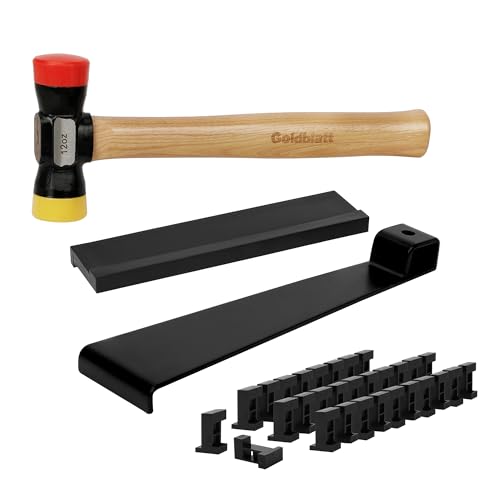
Pros
- Complete four-piece kit includes a 12 oz dual-face mallet, steel pull bar, tapping block, and 30 spacers
- Felt backing on the pull bar and non-marring mallet heads protect delicate plank surfaces from accidental blemishes
- Universal polypropylene tapping block protects tongue-and-groove joints from chipping during board engagement
- 4-in-1 spacers stay stable against base plates and cover multiple floor requirements from 1/4-inch vinyl to 1/2-inch engineered wood
Cons
- Manual installation set designed exclusively for floor assembly rather than routine cleaning or debris removal
- Does not include cutting implements such as a utility knife, shears, or plank cutter required for end-row fitting
- Requires careful hand positioning and protective work gloves to avoid pinched fingers during striking
The Goldblatt Laminate Flooring Installation Kit is a dedicated hard-floor assembly set tailored for DIY homeowners, renters updating rental units, and residential renovators installing floating or tongue-and-groove planks. Engineered specifically for laying laminate, luxury vinyl plank (LVP), luxury vinyl tile (LVT), vinyl planks, engineered wood, and hardwood, this kit provides the essential physical tools needed to secure tight seam alignments without compromising delicate wear layers or locking mechanisms.
In practical flooring projects, achieving tight seams without marring prefinished surfaces requires balanced, controlled impact force. The kit addresses this balance through a 12 oz reinforced mallet featuring an interchangeable double-head configuration. The soft red rubber side delivers dampened impact on sensitive decorative surfaces, while the hard yellow plastic side provides firmer force for snug plank seating. Both non-marring faces work alongside a 9-1/4-inch polypropylene tapping block that shields fragile tongue-and-groove joints from direct mallet strikes, preventing broken locking edges during board alignment.
For closing gaps against baseboards and tight perimeter walls where a standard tapping block cannot reach, the set incorporates a wide-angle pull bar crafted from premium A3 steel with a matte anti-corrosion coating. The back of the pull bar is lined with a circular felt pad, allowing users to draw edge planks tight with the mallet while keeping the metal body from rubbing, scratching, or denting the newly installed floor surface. Complementing the striking tools are 30 pieces of 4-in-1 multi-sided expansion spacers designed with broad bases that resist tipping over during wall placement.
Managing surface expansion is critical across different floor coverings, and the supplied spacers simplify setup by offering multi-gap compatibility: 1 inch for thresholds, 1/2 inch for engineered wood, 3/8 inch for laminate, and 1/4 inch for vinyl. Maintaining the kit is straightforward, requiring only a dry or damp wipe-down to clear installation sawdust before packing away. Because all items are purely mechanical, there are no filters, tanks, electrical cords, or charging routines to manage between jobs.
Prospective buyers should note the practical scope and limitations of this tool package. It is strictly an installation and assembly set, not a floor-cleaning machine or surface-maintenance cleaner. It also does not include cutting gear such as a laminate guillotine, jigsaw, or utility knife, which must be sourced separately to trim boards to length. Additionally, users must exercise care with hand placement and consider wearing work gloves, as holding tapping blocks and pull bars near active strike zones introduces minor pinch risks.
For anyone preparing to install click-lock laminate, modern vinyl plank, or hardwood flooring, the Goldblatt Installation Kit delivers dependable board alignment and valuable finish protection. By combining a balanced hickory-handled mallet, a felt-cushioned pull bar, an edge-saving tapping block, and 30 versatile spacers, it provides solid practical value for budget-minded home improvement projects.
The Goldblatt kit gathers four essential mechanical tools into a single package. At the center is a 12 oz reinforced rubber mallet measuring 12-5/16 inches in total length with a 1-9/16-inch head diameter, fitted with an ergonomic genuine hickory handle and interchangeable non-marring heads in soft red rubber and rigid yellow plastic.
The package also includes an A3 steel wide-angle pull bar with a matte protective coating and an integrated felt backing pad designed to safeguard top finishes. Board engagement is managed by a 9-1/4 x 2-9/32 x 19/32-inch universal tapping block molded from impact-resistant polypropylene, along with 30 self-standing 4-in-1 expansion spacers that provide four calibrated perimeter gaps.
This installation tool kit is built to work across a clear range of modern hard-surface materials. The manufacturer explicitly supports laminate flooring, luxury vinyl plank (LVP), luxury vinyl tile (LVT), standard vinyl plank, engineered wood, and natural hardwood installations.
The included 4-in-1 spacers feature multi-sided steps corresponding to standard manufacturer gap requirements, providing 1/4-inch spacing for vinyl, 3/8-inch spacing for laminate, 1/2-inch spacing for engineered wood, and a full 1-inch clearance for transition thresholds. This tailored spacing helps prevent future floor buckling caused by seasonal expansion and contraction.

Pros
- Ratcheting gear mechanism locks planks securely in position hands-free while you nail or fasten boards.
- Broad compatibility covers solid hardwood, laminate, vinyl planks, and luxury vinyl tile (LVP).
- Ergonomic non-slip handle offers positive control when applying force to stubborn or warped boards.
- Compact 14.17 x 3.94 x 3.94-inch profile maneuvers easily in tight room perimeters and hallway layouts.
Cons
- Requires a solid vertical abutment such as a wall stud or screwed-down subfloor block to push against.
- Manual mechanical operation requires steady hand leverage to advance and disengage the ratchet release.
- Thin click-lock vinyl edges may still require scrap wood shims to distribute pressure evenly without crushing tongues.
The WELLHOME Heavy Duty Ratcheting Flooring Jack is a specialized manual installation tool built to solve one of the most frustrating aspects of floor installation: bowed and crooked planks. Whether you are remodeling a living room with tongue-and-groove hardwood or updating a hallway with luxury vinyl planks, wood boards frequently come out of the box with slight warps or bends. This tool allows homeowners, DIY renovators, and professional installers to apply direct, mechanical pressure to bring uneven boards into tight alignment before fastening.
Unlike relying solely on a mallet and tapping block, which can bounce back and leave faint gaps along the seam, this tool utilizes a ratcheting mechanism. As you crank the handle, the jack advances step by step, pressing firmly against the tongue or groove of the target board while bracing against a wall stud or a temporary block on the subfloor. Once tightened, the ratcheting lock holds the plank firmly under tension, freeing both hands to drive nails, set floor cleats, or snap locking channels securely into place.
The build quality centers around a durable, full-sized metal frame measuring 14.17 inches long by 3.94 inches wide and 3.94 inches high. Finished in a bright orange color, the tool is easy to spot among cut-offs and tool bags on active job sites. The ergonomic handle is outfitted with a textured, non-slip grip that helps maintain control under load, reducing hand fatigue when straightening multiple rows of stubborn flooring across large square-footage areas.
Setup is straightforward and adaptable across different hard floor types. According to the manufacturer, the jack is compatible with virtually any floor thickness, functioning equally well on solid hardwood, engineered flooring, laminate, and LVP. When working along perimeter baseboards, the tool rests against the wall framing or drywall with a backing board to push planks inward. In the middle of an expansive open layout, installers simply screw a temporary scrap wood stop into the subfloor to give the jack a solid base to push against.
Realistic limitations must be kept in mind during operation. Because this is a mechanical pusher, it must have a secure, immovable surface behind it to generate forward force. Working far from walls requires extra prep time to secure temporary stops to the subfloor. Additionally, while the tool is designed to deliver damage-free positioning, thin vinyl click-lock profiles or delicate prefinished wood edges can deform if excessive force is concentrated on a small contact point, making the use of a scrap protective shim advisable on delicate materials.
Overall, the WELLHOME Ratcheting Flooring Jack delivers dependable utility for anyone installing or repairing hard-surface floors. By turning bent and warped boards from unusable scrap into tight, seamless floor runs, this tool pays for itself in saved material, reduced physical effort, and cleaner seam alignment throughout your home renovation project.
The ratcheting mechanism on the WELLHOME flooring jack provides controlled, continuous mechanical force that manual tapping blocks cannot match. By holding forward pressure without slipping, the tool allows installers to slowly pull bowed boards straight against the prior row, eliminating unsightly gaps along the floor's long edges.
This hands-free holding capability is especially helpful during single-person DIY projects. Once the ratchet engages and locks the plank tight against the tongue-and-groove joint, the user can step back, inspect seam consistency across the entire plank length, and comfortably nail or secure the board without fear of the seam shifting out of position.
The WELLHOME flooring jack is explicitly designed to handle a versatile range of hard-surface floor coverings, including solid hardwood, engineered wood, laminate, and luxury vinyl planks (LVP). Its universal clearance fits standard plank thicknesses without specialized adapter plates.
When working with dense solid hardwoods that resist bending, the tool provides the sturdy leverage needed to straighten crooked stock. For softer materials like vinyl or laminate, the controlled ratcheting stroke lets you apply moderate, measured tension to seat joints snugly without damaging delicate click-lock edges.

Pros
- Three stepped edge sizes (1.5 mm, 2.5 mm, and 3.5 mm) eliminate the need for multiple separate tapping tools
- Angled bevel on the thinnest edge grips 3.5 mm to 5.5 mm vinyl planks firmly to stop tool sliding
- Durable polypropylene construction safeguards delicate tongue-and-groove joints from impact fractures
- Lightweight build and broad striking face allow smooth, balanced alignment along long floor runs
Cons
- Requires a separate soft-head mallet, as striking with standard metal hammers can damage the tool and void floor warranties
- Does not include a pull bar or wall spacers, which are still required for edge rows and expansion gaps
The NAACOO Universal Tapping Block is an essential manual installation accessory created for homeowners, DIYers, and property managers installing or repairing interlocking hard floors. Proper seam closure is critical when setting up click-lock resilient vinyl plank (LVP), laminate, or engineered hardwood, as unseated joints lead to visible seams and moisture vulnerability. This lightweight block serves as a protective buffer between your striking mallet and the delicate locking tongue of each plank, helping you achieve uniform, gap-free seams across an entire room without chipping finished surfaces.
A standout design feature is the inclusion of three distinct edge thicknesses on a single body, allowing the tool to adapt across diverse flooring styles. The 1.5 mm edge is tailored for thinner planks measuring 3.5 mm to 5.5 mm, incorporating an angled lip that hooks beneath the plank edge to resist slipping during strikes. The 2.5 mm edge is configured for medium-density floors between 6 mm and 3/8 inch, while the 3.5 mm edge accommodates heavier profiles measuring 10 mm to 12 mm. This multi-thickness versatility enables users to transition smoothly from thin basement vinyl to thicker living room laminate using the same block.
Constructed from resilient polypropylene (PP) plastic, the NAACOO tapping block measures 9-1/4 inches long by 2-1/4 inches wide and weighs less than half a pound. Polypropylene provides the necessary rigid density to transmit tapping energy deep into the plank joint while retaining enough surface resilience to prevent marring micro-beveled edges. The prolonged contact surface spreads the blow over a wider section of the plank, minimizing the localized pressure points that often snap fragile vinyl tongues when struck directly.
Safe operation requires strict adherence to manufacturer handling instructions. The block must be used exclusively with a soft-faced rubber, nylon, or dead-blow mallet. Striking this tool with a conventional steel or claw hammer can fracture the polypropylene body and transfer sharp shock directly to the locking mechanisms. In practice, aligning the correct edge profile against the plank tongue and applying light to moderate mallet taps brings neighboring boards into a secure, flush fit without buckling.
While this tapping block excels at joining open-field floorboards, it has practical limitations inherent to its standalone format. Because it is a dedicated tapping insert rather than a complete installation kit, users will still need to acquire wall expansion spacers and a pull bar for tightening perimeter boards near baseboards and door jambs. Additionally, selecting the wrong edge profile for your plank thickness may exert force on the decorative wear layer rather than the tongue, so checking plank dimensions prior to hammering is essential.
For anyone preparing to install click-lock luxury vinyl, laminate, or tongue-and-groove hardwood, the NAACOO Universal Tapping Block delivers functional versatility at an accessible price point. Its stepped-edge layout accommodates the vast majority of residential plank profiles, while the angled hook feature solves the common frustration of slipping on ultra-thin planks. Supported by the manufacturer lifetime warranty against defects, it is a practical addition to any household tool collection before tackling a new floor installation.
Achieving tight, water-resistant seams during floor installation depends heavily on protecting tongue-and-groove edges from micro-cracking. The NAACOO tapping block helps distribute kinetic force uniformly along the plank edge, ensuring locking mechanisms seat fully without warping. By pairing the correct edge depth to your material-whether thin 3.5 mm vinyl or thick 12 mm laminate-the tool contacts only the designated striking plane, avoiding direct contact with the finished top coat.
For best results across multi-room installations, always test the block against a scrap plank to confirm that the chosen edge matches the tongue profile without riding up onto the decorative wear layer. Striking with a non-marring rubber mallet ensures consistent progression across long board runs while preventing seam separation in high-traffic residential spaces.
Molded from high-grade polypropylene, the NAACOO tapping block combines lightweight portability with structural resistance to impact deformation. Measuring 9-1/4 inches in length, the broad profile provides a stable striking zone that reduces wobbling compared to smaller wooden or basic plastic blocks.
The inclusion of the beveled 1.5 mm edge specifically targets the instability typical of thin resilient vinyl planks, locking beneath the seam to prevent the block from kicking upward during impact. The non-marking black finish helps avoid transfer of scuffs onto light-colored hardwood or pale vinyl surfaces when kept clean during assembly.
Frequently Asked Questions
Can you use a standard claw hammer directly on tongue and groove flooring?
No, striking boards directly with a steel hammer will crush delicate tongue profiles and fracture plank wear layers. You should always use a dual-head rubber mallet paired with a polypropylene tapping block or an angled pull bar to distribute striking force evenly. When laying tight plank layouts like white oak flooring, specialized tools absorb excess shock so seams close cleanly without splintering the wood.
How do flooring jacks help when installing bowed hardwood planks?
Flooring jacks exert ratcheting mechanical pressure against wall studs to straighten crooked or warped boards before fastening. You secure the base against the wall plate and advance the ratcheting gear to hold the bowed plank securely against the previous course. This hands-free tension allows you to blind-nail or staple tongue-and-groove hardwood planks without losing seam tightness.
Will suction-based gap fixer tools work on textured or hand-scraped planks?
No, vacuum suction gap fixers require a completely smooth, non-porous floor finish to create an airtight seal. Heavy graining, wire-brushed textures, and hand-scraped contours prevent the rubber or silicone pad from maintaining suction during mallet impacts. Some kits include auxiliary adhesive pads to assist with light textures, but floating floors with pronounced relief generally require mechanical pull bars instead.
What makes multi-sided expansion spacers necessary during installation?
Expansion spacers establish the uniform perimeter expansion gap required to prevent floor buckling as seasonal humidity changes. Multi-sided spacers provide preset thicknesses like one-quarter inch or one-half inch to match specific manufacturer underlayment and perimeter guidelines. Maintaining this buffer prevents tongue-and-groove joints from binding against drywall or framing under thermal expansion.
What are the %best tongue and groove flooring tools% for closing end seams in tight spaces?
Wide-angle pull bars made from heavy-gauge steel are the most reliable option for pulling end seams tight near walls. The hooked end slips into the perimeter expansion gap behind the final plank while the top flange receives mallet strikes. High-quality pull bars feature rear felt backing pads that protect the surface from scratches while pulling the tongue firmly into the groove.
How do you clean wood floor planks after using installation tools?
Routine post-installation cleanup requires vacuuming loose debris and wiping surfaces with an approved cleaner to mop wood floors using a damp microfiber pad. Never use harsh abrasive chemicals, excessive water, or steam mops, as moisture penetration into freshly cut joints can cause swelling. Regular dry dusting removes construction grit before furniture placement.


Write Your Review
No reviews yet. Be the first to share your experience!