


Automating Daily Floor Maintenance with Smart Docks
Keeping hardwood floors and carpets clear of pet hair, tracked dirt, and food crumbs often turns into a daily chore. Standard robot units handle regular passes across the house, but their tiny onboard dustbins require manual clearing after almost every run. Investing in the best self docking robotic vacuum cleaner solves this inconvenience by directing collected dirt into a dedicated base station automatically. Our analysis evaluates manufacturer specifications, listed suction ratings, and dock capabilities across leading models from brands like Shark, Tikom, dreame and more to help you identify the right hands-off solution. If you also maintain upright hardware, comparing these smart automated units with dedicated Shark vacuums for floor cleaning highlights how automation simplifies daily floor pickup.
Modern docking stations offer distinct advantages ranging from multi-week debris storage to advanced mop washing and hot air drying cycles. While basic auto-empty bases use disposable dust bags or bagless chambers to store debris for up to several months, multifunction stations can also clean mopping pads and replenish water reservoirs. Evaluating your home layout, tangle-free brush rolls, and transition abilities across floor surfaces ensures reliable operation without frequent manual intervention. For homes dealing with muddy paw prints alongside loose fur, pairing automated daily maintenance with dedicated carpet cleaner machines for pet messes delivers thorough whole-home hygiene.

Pros
- Self-maintaining dock automates dust bin emptying, 167°F hot-water mop washing, and heated air drying
- Strong 18,500 Pa suction easily handles fine dust, pet hair, and coarse debris like cat litter
- Automatic 10 mm mop lifting keeps carpets and rugs dry during combined vacuum and mopping runs
- All-rubber roller and specialized side brush noticeably reduce routine hair tangle removal
Cons
- Only connects to 2.4 GHz Wi-Fi networks and does not support 5 GHz frequencies
- All-in-one docking station requires dedicated physical floor space and clearance near an outlet
The Roborock Qrevo S Pro is an automated floor-care system engineered for busy households, parents, and pet owners who need consistent vacuuming and mopping across mixed flooring. Combining dry vacuuming with dual rotating mopping pads, this robot cleaner targets routine messes such as tracked-in dust, pet dander, and food crumbs. Its primary appeal lies in its high degree of automation, allowing users to offload daily floor maintenance to a machine that manages its own dust disposal and mop pad maintenance.
Cleaning capability is centered around a manufacturer-specified 18,500 Pa suction motor that pulls debris from hard floor seams, edges, and carpet pile. When transitioning to carpeted areas, the robot applies an automatic carpet strategy that boosts suction for embedded grit while lifting the mopping assembly 10 mm above the floor surface to protect fibers from moisture. For hard floor areas, the dual spinning mops maintain steady contact to wipe down kitchen spills, dried paw prints, and light surface stains using adjustable water flow rates.
Brush maintenance is often a pain point in pet-friendly homes, but the Qrevo S Pro addresses this with a specialized anti-tangle architecture. It features an all-rubber main brush roll, a zero-tangle side brush, and a guarded omnidirectional wheel, all designed to channel hair directly into the suction inlet rather than wrapping tightly around spinning components. At the all-in-one docking base, collected debris is automatically transferred into a sealed 2.7L dust bag capable of storing between 7 and 9 weeks of dry material under typical household conditions.
Navigation and spatial awareness are powered by smart obstacle detection that helps the vacuum identify and steer clear of everyday floor hazards such as shoes, power cords, toys, and chair legs. Measuring 3.8 inches in height, the low-profile robot slides under raised couches, dressers, and beds where dust clusters tend to hide. The integrated Roborock SmartPlan 2.0 AI adjusts cleaning power and route selection according to the specific floor layout and past cleaning history, maintaining an unobtrusive sound profile of approximately 55 dB during standard operation.
Initial setup is straightforward through the companion app, though it strictly requires a 2.4 GHz Wi-Fi network connection. While the dock manages self-emptying, 167°F mop pad washing, and 113°F warm air drying, owners must still periodically handle basic dock upkeep, such as replacing the 2.7L dust bag, filling clean water, and emptying dirty wastewater containers. The physical size of the docking station also demands thoughtful placement with sufficient wall and clearance space in a central room or laundry area.
For homeowners and renters looking to maintain spotless hard floors and fresh carpets without daily intervention, the Roborock Qrevo S Pro represents a dependable, high-convenience investment. Its strong suction, intelligent mop lifting, and self-cleaning dock features provide practical, time-saving value for busy multi-surface homes managing the steady mess of kids and pets.
The all-in-one docking station on the Roborock Qrevo S Pro acts as a comprehensive base designed to reduce manual floor-care chores. Following each cleaning cycle, the dock automatically pulls debris from the robot dustbin into an internal 2.7L sealed bag. This bag design locks in dust and debris while offering enough storage volume to last between 7 and 9 weeks under normal cleaning frequencies, minimizing contact with loose dirt.
Beyond debris containment, the dock actively manages mop hygiene through heated self-cleaning. It washes the dual rotating pads with 167°F hot water to loosen sticky spills and grime gathered from hard floors, followed by 113°F warm air drying. This controlled drying phase prevents persistent dampness and helps eliminate stale odors, ensuring the cleaning pads are dry, fresh, and ready for the next scheduled floor run.
Managing mixed flooring is straightforward thanks to the adaptive carpet handling built into the Roborock Qrevo S Pro. When sensors detect area rugs or wall-to-wall carpeting, the robot automatically engages a 10 mm mop lifting mechanism. This lifts the damp pads clear of low- to medium-pile carpet surfaces, preventing accidental water transfer while simultaneously ramping up suction to extract embedded particles and pet hair from deep within the fibers.
On hard surfaces, the dual spinning mop system works in tandem with the vacuum function to deliver thorough daily maintenance. By distributing a controlled, adjustable flow of water, the pads provide steady friction to tackle dried beverage splashes, pet footprints, and grease near cooking areas. This dual-action approach allows the robot to leave floors refreshed in a single cleaning pass without requiring manual tool swaps.

Pros
- 3L self-emptying dock significantly reduces daily bin-clearing chores for multi-week hands-free operation
- 6000Pa peak suction with automatic carpet boost provides dependable pull on heavy crumbs and pet hair
- LiDAR smart mapping stores up to 5 separate floor maps, making it well-suited for two-story or split-level homes
- Dual-band Wi-Fi support (both 2.4GHz and 5GHz) avoids common smart home router setup headaches
Cons
- Mopping plate does not auto-lift on carpets, requiring manual removal of the mop bracket or establishing app-based no-mop zones
- The advertised 150-minute runtime is restricted to gentle suction mode and decreases when running at higher suction levels
The Tikom L8000 Plus is an automated robot vacuum and mop designed for households seeking routine floor maintenance without constant hands-on effort. Built with an included self-emptying base station, it suits busy families, apartment renters, and pet owners who need consistent crumb and pet-hair pickup across mixed flooring. By pairing active vacuum suction with a damp-wiping mop module, this compact machine handles everyday dust and floor debris across both carpeted areas and hard-floor surfaces.
Cleaning performance centers on an adjustable vacuuming system that offers three distinct power stages, reaching up to 6000Pa of suction. When the robot transitions onto carpeted areas, the built-in carpet-boost sensor automatically increases suction to the maximum 6000Pa level to pull deeper debris and hair from carpet pile. For hard floors, the 2-in-1 design allows damp mopping using three adjustable water flow settings, matching liquid output to your floor type. Once cleaning concludes, the robot navigates back to its docking station where a 3L sealed dust bag collects debris, offering up to 90 days of hands-free operation before the bag requires disposal.
Navigation is driven by a top-mounted 360-degree LiDAR sensor that scans room layouts in real time. Rather than bouncing randomly off baseboards, the robot maps the home systematically to avoid repetitive passes, stairs, and stationary walls. The accompanying mobile app allows storage of up to five individual floor plans, making it practical for multi-story layouts. Through the app, users can define virtual walls, set specific no-go areas, designate no-mop zones, and select individual rooms for targeted spot cleaning. The unit also pairs with Amazon Alexa and supports both 2.4GHz and 5GHz Wi-Fi bands, simplifying smart home integration.
Routine operation is assisted by an operating runtime of up to 150 minutes when running in gentle suction mode. If the battery depletes midway through a larger floor plan, the robot automatically returns to the self-emptying base to recharge before resuming cleaning exactly where it stopped. Daily upkeep remains relatively low thanks to the auto-empty dock, though standard maintenance still involves periodically checking the brush roll for wrapped hair, rinsing the washable mop pad, and wiping down cliff and optical sensors to preserve navigational accuracy.
There are practical operational limits to keep in mind before purchase. Because the mopping module does not automatically lift when crossing rugs or carpets, users must physically remove the mop bracket or establish digital no-mop zones in the mobile app to keep carpets dry. Additionally, the mopping functionality operates as a passive damp wipe rather than an aggressive oscillating scrubber, making it best suited for light dust removal rather than heavy, dried spills. The maximum 150-minute runtime also applies strictly to the lowest gentle power setting. For households seeking reliable LiDAR mapping, multi-floor flexibility, strong carpet suction, and an auto-empty dust station, the Tikom L8000 Plus provides a well-balanced, practical cleaning package.
The 360-degree LiDAR turret on the Tikom L8000 Plus scans interior rooms quickly to generate accurate digital floor maps within the companion app. This laser-guided system plans orderly cleaning paths rather than wandering, helping the robot clean efficiently along walls and avoid tumbling down staircases. Because the system can store up to five separate maps, homeowners with multiple levels can easily transport the robot between floors without erasing previous room layouts.
Within the mobile application, users can actively manage their cleaning paths using digital boundaries. Setting virtual walls and custom no-go zones keeps the vacuum away from cluttered corners, cables, and pet feeding stations. When the mop pad is attached, creating no-mop zones ensures the damp pad avoids area rugs and wall-to-wall carpeting. The inclusion of dual-band Wi-Fi connectivity supporting both 2.4GHz and 5GHz networks also ensures a reliable connection to home routers during map updates.
The Tikom L8000 Plus incorporates a 2-in-1 sweeping and mopping module that allows the robot to vacuum debris while damp-wiping hard surfaces in a single run. The onboard water reservoir features three electronically controlled water flow levels, giving users direct control over how much moisture is released onto floors such as tile, vinyl, and sealed hard surfaces.
Because the unit relies on a drag-style microfiber mop pad rather than vibrating or spinning scrubbers, it is intended primarily for collecting fine dust, paw prints, and light daily grime rather than heavy, caked-on grease. To avoid dampening carpet fibers, users should set no-mop zones via the mobile app or detach the mop cloth bracket entirely before running a carpet-only cleaning cycle.

Pros
- Brushless, tangle-free suction design eliminates hair wrapping and reduces maintenance for pet owners
- Impressive manufacturer-stated 5200Pa suction across three adjustable power settings
- Slim 2.99-inch height fits easily under low coffee tables, dressers, and couches
- Smart control options include companion smartphone app scheduling plus Alexa and Google Assistant voice commands
- Four-stage electronic water control allows tailored mopping moisture on hard floors
Cons
- Not suitable for medium- or high-pile carpeting; performance is restricted to hard floors, wood, and low-pile rugs
- Relies on bump-and-sensor navigation rather than advanced LiDAR room mapping or designated virtual no-go zones
- Specific dust bin and water tank capacities are not listed in fluid or volume metrics by the manufacturer
The ROPVACNIC Robot Vacuum and Mop Combo (Model S1) is an automated 2-in-1 floor-care machine designed for routine multi-surface upkeep in busy American households. Engineered primarily for apartment dwellers, pet owners, and homeowners managing wood and hard surfaces alongside low-pile rugs, this unit tackles everyday dust, pet shedding, and minor floor spots without requiring manual push-vacuuming. Its combination of wet mopping and vacuuming makes it an appealing option for budget-conscious buyers seeking an entry-level robotic helper for daily maintenance.
In real-world cleaning situations, this robot addresses daily debris using a 3-point cleaning system and a manufacturer-rated 5200Pa of suction across three selectable power stages. Instead of relying on a traditional bristled roller, the machine uses a direct, no-entanglement suction inlet flanked by dual rotating electric side brushes. This direct-suction approach is specifically intended to channel dog and cat hair, crumbs, and tracked-in grit directly into the suction path without wrapping around an agitator bar. Simultaneously, the electronically controlled water tank offers a four-stage personalized water adjustment system, allowing users to dial in light dampness for dust removal or slightly heavier moisture for minor sticky spots on wood and tile-like hard surfaces.
From a structural standpoint, the robot features a remarkably low-profile build measuring 12 by 12 inches with a height of only 2.99 inches, weighing approximately 7.28 pounds in a light black housing. This compact chassis allows it to clear low-hanging furniture, including bed frames, sideboards, and living room couches, where dust bunnies and pet fur often accumulate out of reach. The underside houses dual motorized side brushes designed to reach along baseboards, while the mopping plate attaches smoothly to the base. It comes paired with a compact charging dock to which the robot autonomously returns whenever cleaning concludes or battery replenishment is needed.
Setting up the unit is straightforward, involving app pairing for smartphone scheduling and connecting to voice platforms such as Amazon Alexa or Google Assistant. Maintenance is noticeably lower on the vacuuming side because the absence of a brush roll eliminates the tedious task of cutting away wound-up pet hair with scissors. Users simply empty the internal dry debris container, wipe the drop and bumper sensors periodically, and clear occasional threads from the twin side sweepers. When utilizing the mopping function, routine maintenance involves filling the onboard water reservoir with clean tap water, dampening and securing the mop pad, and washing the cloth pad thoroughly after each cleaning run to avoid stale odors.
Despite its practical advantages, this model has natural operational boundaries. Because it relies on high-coverage sensor algorithms and directional obstacle detection rather than overhead laser LiDAR or optical camera mapping, it cleans in semi-random or reactive patterns and lacks customized virtual boundary lines or selective room targeting. Furthermore, surface compatibility is strictly limited to wood, hard floors, and low-pile carpets; it is not suited for medium- or high-pile carpeting, shag rugs, or unlevel thresholds. The lack of an auto-lifting mop plate also means users should remove the mopping bracket before sending the machine across area rugs to prevent wetting carpet fibers.
For homeowners, renters, and pet owners looking for a budget-friendly automated floor cleaner that tackles daily pet hair without brush-roll tangles, the ROPVACNIC Robot S1 offers reliable utility. While it does not replace a heavy-duty upright extractor or a laser-guided premium robot for deep restorative carpet cleaning, its solid 5200Pa suction rating, slim clearance, and adjustable electronic mopping deliver sensible, hands-free cleanliness across daily hard-surface living areas.
The ROPVACNIC S1 addresses pet hair challenges through a specialized roller-free suction opening rather than a standard spinning brush roll. Traditional vacuum agitator bars tend to collect tightly bound fur, requiring frequent manual intervention and cutting. By pairing a direct suction throat with dual rotating electric side brushes, this cleaner channels stray hairs, dander, and food crumbs straight toward the collection bin, minimizing maintenance hassles for dog and cat households.
Backed by a manufacturer-rated 5200Pa suction profile across three adjustable levels, the unit supplies substantial lift for hard floors, wood surfaces, and low-pile area rugs. Users can select higher suction stages for high-traffic entryways or pet resting zones, ensuring small debris and dry spills are swept clean from perimeter baseboards and tight floor corners.
Equipped with a 2-in-1 mopping module, the ROPVACNIC Robot S1 actively manages floor hydration via an electronically controlled high-capacity water reservoir. Unlike passive gravity-fed drip mops, the electronic system features four personalized water-flow adjustment stages. This granular control allows users to match moisture dispersion to their specific hard-floor conditions, avoiding puddling on sealed wood while delivering sufficient wetness to lift fresh footprints and light dirt.
To maintain optimal results on hard surfaces, the mopping pad should be laundered after every cleaning session, and water should be emptied between cycles. Because the vacuum does not automatically detect carpets to lift its mop plate, damp mopping is best restricted to entirely hard-surface areas like kitchens, hallways, and living rooms with wood flooring.


Pros
- Bagless 60-day self-empty base eliminates the need to buy disposable replacement bags.
- Sonic mopping scrubs at 100 passes per minute to agitate stuck-on surface grime on hard floors.
- True HEPA base filtration captures 99.97% of microscopic particles down to 0.3 microns.
- 360-degree LiDAR navigation provides quick mapping, room customization, and reliable night or day operation.
- CleanEdge Detect system actively blows dust out of baseboards and wall corners into the vacuum path.
Cons
- Requires manual intervention to install, remove, and wash the mopping pads between wet and dry cycles.
- Dumping the bagless dock bin into an indoor trash can may release a small cloud of dust.
- Includes only a 12-ounce starter bottle of cleaning solution, requiring future purchases of compatible formula.
The Shark Matrix Plus Robot Vacuum & Mop Combo (AV2610WA) is designed for busy households, pet owners, and multi-surface homes that need an automated solution for both dry debris and surface grime. Combining strong vacuum suction for carpets with active sonic mopping for hard floors, this robotic cleaner aims to reduce daily maintenance by handling routine floor care on a scheduled grid. With an XL self-emptying base that stores up to 60 days of dust without requiring disposable replacement bags, it offers particular appeal to budget-conscious families who dislike ongoing consumable costs.
Cleaning capability centers around two distinct technologies: Matrix Clean and high-speed sonic mopping. On carpets and hard floors, the robot operates in a cross-directional matrix pattern to make multiple passes over stubborn dirt, providing up to 30% better carpet pickup than standard single-pass cleaning based on manufacturer tests. When wet mopping hard floors, the integrated sonic pad scrubs at 100 vibrations per minute to lift dried-on spills. Through the companion smartphone app, users can initiate targeted Matrix Mop cycles on specific high-traffic zones, delivering up to 50% improved stain cleaning compared to prior base models.
For households with shedding pets and allergy concerns, the robot is equipped with a self-cleaning brushroll designed to actively prevent pet hair wrap while digging deep into carpet fibers. Fine particles and dander pulled into the base are sealed with True HEPA filtration, which captures 99.97% of dust and allergens down to 0.3 microns. Along perimeter baseboards, the CleanEdge Detect system deploys focused air blasts alongside corner recognition to blow trapped dust directly into the vacuum intake path, delivering up to 50% better edge pickup than Shark robots without this feature active.
Navigation is driven by 360-degree LiDAR vision, enabling the robot to create accurate floor plans of your home quickly and operate reliably in bright daylight or pitch darkness. The mobile app allows homeowners to designate specific cleaning zones, adjust passes, and adapt to room rearrangements over time. When the battery runs low during extensive cleaning runs, the unit automatically recharges at the dock and resumes cleaning at the exact point it paused. The base itself is bagless, meaning dirt bins are simply unlatched and emptied into the trash, while the included microfiber mopping pads can be washed and reused.
While the Shark AV2610WA offers automated floor care, it does have practical limitations that buyers should keep in mind. Because the self-emptying base is bagless, opening and dumping the canister into an indoor trash can may create a slight plume of dust, which sensitive individuals may prefer to do outside. Additionally, while the robot vacuums and sonic-mops hard floors, users must still monitor the water and solution levels in the tank and routinely swap or wash the reusable mopping pads between damp cycles. The package also only includes a 12-ounce starter bottle of Shark VACMOP solution, meaning specialized solution must eventually be replenished.
Overall, the Shark Matrix Plus AV2610WA represents a balanced, highly capable floor-care appliance for homes with a mix of carpeting and hard flooring. Its combination of 360-degree LiDAR mapping, bagless 60-day dirt capacity, True HEPA dock filtration, and active scrubbing pads makes it well suited for pet owners, parents, and apartment or single-family dwellers who want hands-off daily floor maintenance without expensive ongoing bag subscriptions.
The Shark Matrix Plus utilizes 360-degree LiDAR vision technology to scan and map living spaces with high precision. This laser-guided system functions independently of ambient light, allowing the robot to map floor plans accurately and avoid obstacles during both daytime and nighttime cleanings. Homeowners can use the interactive smartphone app to view rooms, set specific cleaning zones, and execute targeted Matrix Clean or Matrix Mop cycles.
In addition to mapping precision, the robot incorporates intelligent recharge-and-resume logic. If a cleaning session exceeds the robot's single-charge capacity, it automatically navigates back to the XL dock, replenishes its battery, and returns directly to the spot where it paused to finish the job. This ensures thorough multi-room coverage without missing entire sections of large floor plans.
Managing pet hair and fine allergens is a primary strength of the Shark AV2610WA cleaning system. The robot is fitted with a specialized self-cleaning brushroll engineered to extract hair and dander from carpets and hard floors while continuously clearing itself to minimize annoying hair wraps around the core mechanism.
Once debris is vacuumed, the self-empty base evacuates the robot's internal dust cup into an XL bagless holding canister equipped with True HEPA filtration. This filtration standard captures and traps 99.97% of airborne particles, dust, and pet allergens down to 0.3 microns, preventing fine dirt from blowing back into household air during dock evacuation cycles.
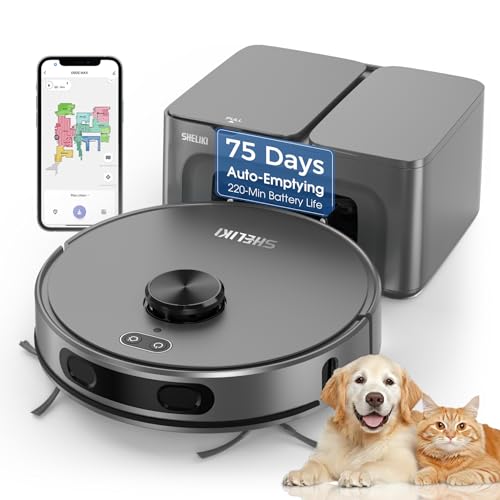


Pros
- High-capacity 4L auto-empty base reduces dustbin maintenance to roughly three times a year
- Exceptional 20,000Pa suction handles stubborn pet hair on both carpet and hard floors
- LiDAR navigation provides fast, accurate room mapping and obstacle avoidance in low-light environments
- Anti-tangle brush system noticeably cuts down on roller maintenance in homes with shedding pets
- Convenient 2-in-1 functionality sweeps and mops in a single automated pass
Cons
- Compatible exclusively with 2.4GHz Wi-Fi networks and will not connect to 5GHz bands
- Manufacturer lists this unit for USA domestic use only
- Exact water tank capacity and runtime metrics are not specified in product data
The Dreame D20 Air Plus is an automated 2-in-1 robotic vacuum and mop designed for households managing regular pet hair, tracked-in dirt, and mixed flooring surfaces like carpets and hardwood. With an auto-empty base station and an array of smart controls, this machine targets busy families, pet owners, and apartment dwellers who want to reduce the frequency of manual floor care without constantly tending to a small onboard dust cup.
In terms of cleaning pickup, the robot stands out with a manufacturer-specified 20,000Pa suction power. This high suction level is intended to pull stubborn pet hair, fine dust, and heavier debris out of carpet fibers and hardwood crevices. The unit handles both sweeping and damp mopping concurrently, using an electronic water tank with adjustable flow levels that can be calibrated for light daily dusting or more intensive hard-surface cleaning. Additionally, its edge-to-corner cleaning design is shaped to track closely along walls and baseboards where dust bunnies naturally gather.
Navigation and hair management are central to the overall design. Guided by a smart LiDAR navigation system, the robot maps floor plans quickly and navigates around everyday home furniture even in dark rooms. To tackle shed pet fur and human hair, Dreame built in a dual anti-tangle mechanism covering both the main brush roll and the side brush, helping prevent clogs before they halt a cleaning cycle. Meanwhile, the included auto-empty dock uses a 4L self-sealing dust bag designed to store up to 120 days of accumulated debris while trapping 99.9% of allergens to keep disposal mess-free.
Day-to-day operation relies on smartphone management through an intuitive mobile application. Users can schedule specific rooms, adjust vacuum power levels, and designate no-go zones around delicate decor or pet food bowls. Maintenance primarily involves swapping out the 4L dust bag every few months, refilling the electronic water reservoir, and occasionally washing the mop pad or wiping down the navigational sensors.
Prospective buyers should consider a few operational constraints before purchasing. The robot operates exclusively on 2.4GHz Wi-Fi networks and will not pair over a standard 5GHz connection, which may require toggling dual-band router settings during initial setup. Furthermore, the unit is designated specifically for USA use, and the manufacturer does not list exact liquid tank volumes or battery runtime figures, meaning households with extensive hard-floor footprints may need occasional manual water refills during damp cleaning routines.
For households seeking dependable automated floor maintenance, the Dreame D20 Air Plus offers a strong combination of high-grade suction, anti-tangle brushes, and multi-month auto-emptying convenience. It is particularly well suited for multi-surface homes and pet owners who want consistent daily maintenance without dealing with tangled rollers or frequent dustbin emptying.
Smart LiDAR navigation drives the movement of the Dreame D20 Air Plus, creating accurate household maps in minutes using next-generation path planning algorithms. Unlike optical camera systems that rely on ambient light, the LiDAR laser system can map and navigate across rooms in total darkness, allowing for scheduled cleaning cycles overnight or while you are away from home.
Through the companion app, users can leverage these digital maps to divide rooms, set targeted zones, and establish no-go boundaries to protect pet feeding stations or cluttered floor areas. The navigation algorithms dynamically route the robot around furniture legs and obstacles while maintaining close coverage along baseboards and into tight corners.
Routine maintenance is minimized thanks to the included auto-empty base station, which houses a 4L sealed dust bag engineered to hold up to 120 days of accumulated dust, dirt, and pet hair. Because the bag self-seals upon removal, users are spared the mess of emptying manual dust bins and inhaling loose allergen particles.
The robot's dual anti-tangle configuration on the main roller and side brush helps reduce the frequency of manual brush clearing. Upkeep primarily involves swapping the disposal bag three to four times per year, rinsing the reusable mop pad, keeping the water reservoir filled, and occasionally checking the wheels and optical sensors for dust buildup.
Frequently Asked Questions
How does a self-docking robotic vacuum empty its dustbin?
A self-docking robotic vacuum cleaner empties its bin using a high-powered suction motor built into the docking base. When the robot docks after a cycle, the base draws debris out through an evacuation port into a sealed bag or canister. Most bases store debris for thirty to ninety days before requiring replacement or manual emptying.
Can self-docking robot vacuums clean both carpets and hard floors in one run?
Many modern hybrid models handle mixed flooring by adjusting suction and managing mop attachments automatically. Units with auto-lifting mop plates raise wet pads when detecting rugs, while others rely on app-configured no-mop zones to avoid wetting fibers. If you have delicate carpets or thick pile, dedicated small vacuums for rugs can supplement robot maintenance.
What is the difference between bagged and bagless self-emptying docks?
Bagged docks use sealed disposable bags that trap fine dust and allergens, whereas bagless docks use a reusable dust canister that empties directly into your trash. Bagged systems keep dust clouds contained during disposal, but require purchasing replacement bags periodically. Bagless bases eliminate recurring costs but can release dust back into the air when opened.
How often do self-cleaning mop docks require water tank maintenance?
Water maintenance intervals depend on the size of the base reservoirs and how frequently the robot mops your home. Most all-in-one stations require clean water refills and dirty water drainage every few days to a week. Keeping the dirty water tank emptied promptly prevents mildew and unpleasant odors from developing inside the dock.
Do LiDAR navigation systems work effectively in dark rooms?
Yes, LiDAR navigation systems navigate reliably in complete darkness because they use light-detection lasers rather than ambient optical cameras. The spinning sensor maps room perimeters and detects obstacles regardless of lighting conditions. This allows you to schedule night-time cleaning routines without leaving room lights turned on.







Write Your Review
No reviews yet. Be the first to share your experience!