


Fine dust along baseboards and sticky kitchen spills make floor maintenance a repetitive chore, especially when vacuuming must happen before mopping. Many busy households look for automated systems capable of sweeping loose dirt and scrubbing sealed floors in a single session without blowing dust back into the air. Evaluating the best robot mop with hepa combo options requires looking closely at filtration efficiency, scrubbing mechanics, and carpet protection features. While some owners still keep a best dry mop for hardwood floors for quick dry dusting, modern hybrid robots automate both tasks through precision mapping.
Based on product specifications and user feedback, models with true HEPA filtration in their self-emptying docks capture up to 99.97% of fine particles down to 0.3 microns. Units equipped with sonic scrubbers or lifting pads handle daily messes while suction ratings up to 20,000 Pa collect pet fur. Selecting the right setup depends on your hard-floor ratio, dock size preferences, and whether you prefer bagless bins or sealed bags.

Pros
- Bagless self-emptying base stores up to 60 days of debris with zero disposable bag costs.
- Sonic mopping scrubs hard floors while the suction system lifts dry crumbs and dirt simultaneously.
- True HEPA filtration in the base traps fine dust and allergens down to 0.3 microns.
- CleanEdge air blasts pull stubborn edge dirt directly into the central vacuum path.
Cons
- Mopping pads and fluid tanks still require manual refilling, removal, and washing between runs.
- Dumping the bagless base container into a trash bin can release some dust into the air.
- Manufacturer specifications do not state the exact battery runtime or water tank capacity.
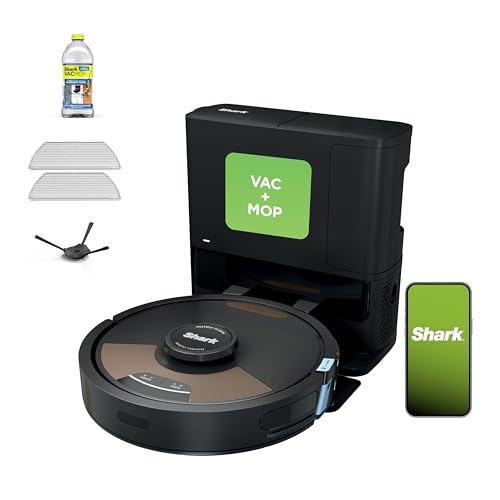
The Shark Matrix Plus 2-in-1 Robot Vacuum and Mop (model AV2613WA) provides automated floor care tailored for busy households, families, and pet owners managing both carpets and hard floors. Engineered to handle routine household messes, this unit vacuums dry debris like crumbs and tracked-in soil while providing sonic mopping across hard surfaces. Its central convenience feature is the self-emptying base station, which holds up to 60 days of debris and eliminates the ongoing expense of buying replacement vacuum bags. Households looking for automated daily maintenance will appreciate having both mopping and vacuuming integrated into one machine.
Cleaning coverage relies on two primary systems: Matrix Clean and CleanEdge Detect. During Matrix Clean cycles, the robot moves in a precision grid layout, taking multiple passes over the same area to lift embedded dirt. According to manufacturer comparisons against single-pass cleaning on level loop sand, this multi-pass grid provides 30 percent better carpet cleaning. For baseboards and tight perimeters, CleanEdge Detect uses corner recognition and blasts of air to blow trapped debris away from walls directly into the cleaning path, resulting in 50 percent better edge cleaning compared to models with the feature turned off. On hard floors, the sonic mopping system scrubs surface stains while the vacuum removes loose grit at the same time.
The robot docks at a bagless self-empty station finished in a black and brass design. Rather than relying on disposable dust bags, the dock features a clear bagless bin that empties directly into the trash. The base incorporates True HEPA filtration and an Anti-Allergen Complete Seal, which captures and seals 99.97 percent of dust and allergens down to 0.3 microns based on manufacturer specifications. With total package dimensions of 21.4 by 14.96 by 5.69 inches and a weight of 16.95 pounds, the dock and robot maintain a manageable footprint in standard living spaces.
Everyday operation is designed around minimal hands-on effort for dry floor care. After vacuuming cycles, the base evacuates the robot dustbin automatically, allowing users to go up to two months before dumping the main canister. If the robot runs low on power in large floor plans, the Recharge and Resume system automatically guides it back to the dock and resumes the cleaning cycle right where it left off. However, mopping does require active attention: users must fill the liquid reservoir before damp cleaning runs and remove, wash, and dry the mop pad afterward to keep it fresh.
Buyers should consider a few realistic operational boundaries before purchasing. Because the self-empty base is bagless, dumping the collected debris into a trash can may release a light puff of fine dust, which allergy-sensitive users should keep in mind. Furthermore, the product specifications do not list explicit battery runtime in minutes or fluid tank volumes, meaning total cleaning area per charge will depend on home layout, carpet thickness, and debris levels. Users must also manage mopping pad installation manually depending on floor transition needs.
The Shark Matrix Plus AV2613WA is a practical, value-conscious automated cleaner for homes with mixed carpets and hard floors. Its combination of grid-based Matrix Clean, corner air blasts, sonic mopping, and sealed HEPA dock filtration delivers dependable everyday maintenance. If you want a hands-off robotic floor cleaner that tackles both sweeping and light scrubbing without ongoing bag purchases, this model serves as a capable household companion.
Matrix Clean technology directs the robot in a precise grid pattern across the room rather than standard single-pass linear lines. By making multiple passes over debris, the robot agitates and lifts embedded dust, pet hair, and crumbs from carpets and hard floors. Shark states that this multi-pass grid delivers 30 percent better carpet cleaning performance compared to single-pass models tested on level loop sand.
To solve edge-cleaning issues along baseboards, CleanEdge Detect actively senses room perimeters and corners. The system deploys targeted blasts of air to blow trapped particles out from walls and directly into the vacuum intake. Manufacturer data shows this active air-assist technology delivers 50 percent improved edge cleaning compared to operating with CleanEdge switched off.
The docking station included with the AV2613WA functions as both an automatic charging dock and a self-emptying dust hub. At the end of a vacuuming run, the dock evacuates the internal bin of the robot and stores up to 60 days of household debris. The bagless collection bin eliminates the need to buy proprietary replacement bags, significantly lowering long-term ownership costs.
Air quality containment is handled by a True HEPA filter fitted inside the self-emptying base. Paired with Shark Anti-Allergen Complete Seal technology, the dock captures and holds 99.97 percent of dust and fine particles down to 0.3 microns. This keeps evacuated debris securely contained inside the base rather than venting fine particles back into the room during the self-empty cycle.

Pros
- Brushless, tangle-free suction design eliminates hair wrapping and reduces maintenance for pet owners
- Impressive manufacturer-stated 5200Pa suction across three adjustable power settings
- Slim 2.99-inch height fits easily under low coffee tables, dressers, and couches
- Smart control options include companion smartphone app scheduling plus Alexa and Google Assistant voice commands
- Four-stage electronic water control allows tailored mopping moisture on hard floors
Cons
- Not suitable for medium- or high-pile carpeting; performance is restricted to hard floors, wood, and low-pile rugs
- Relies on bump-and-sensor navigation rather than advanced LiDAR room mapping or designated virtual no-go zones
- Specific dust bin and water tank capacities are not listed in fluid or volume metrics by the manufacturer
The ROPVACNIC Robot Vacuum and Mop Combo (Model S1) is an automated 2-in-1 floor-care machine designed for routine multi-surface upkeep in busy American households. Engineered primarily for apartment dwellers, pet owners, and homeowners managing wood and hard surfaces alongside low-pile rugs, this unit tackles everyday dust, pet shedding, and minor floor spots without requiring manual push-vacuuming. Its combination of wet mopping and vacuuming makes it an appealing option for budget-conscious buyers seeking an entry-level robotic helper for daily maintenance.
In real-world cleaning situations, this robot addresses daily debris using a 3-point cleaning system and a manufacturer-rated 5200Pa of suction across three selectable power stages. Instead of relying on a traditional bristled roller, the machine uses a direct, no-entanglement suction inlet flanked by dual rotating electric side brushes. This direct-suction approach is specifically intended to channel dog and cat hair, crumbs, and tracked-in grit directly into the suction path without wrapping around an agitator bar. Simultaneously, the electronically controlled water tank offers a four-stage personalized water adjustment system, allowing users to dial in light dampness for dust removal or slightly heavier moisture for minor sticky spots on wood and tile-like hard surfaces.
From a structural standpoint, the robot features a remarkably low-profile build measuring 12 by 12 inches with a height of only 2.99 inches, weighing approximately 7.28 pounds in a light black housing. This compact chassis allows it to clear low-hanging furniture, including bed frames, sideboards, and living room couches, where dust bunnies and pet fur often accumulate out of reach. The underside houses dual motorized side brushes designed to reach along baseboards, while the mopping plate attaches smoothly to the base. It comes paired with a compact charging dock to which the robot autonomously returns whenever cleaning concludes or battery replenishment is needed.
Setting up the unit is straightforward, involving app pairing for smartphone scheduling and connecting to voice platforms such as Amazon Alexa or Google Assistant. Maintenance is noticeably lower on the vacuuming side because the absence of a brush roll eliminates the tedious task of cutting away wound-up pet hair with scissors. Users simply empty the internal dry debris container, wipe the drop and bumper sensors periodically, and clear occasional threads from the twin side sweepers. When utilizing the mopping function, routine maintenance involves filling the onboard water reservoir with clean tap water, dampening and securing the mop pad, and washing the cloth pad thoroughly after each cleaning run to avoid stale odors.
Despite its practical advantages, this model has natural operational boundaries. Because it relies on high-coverage sensor algorithms and directional obstacle detection rather than overhead laser LiDAR or optical camera mapping, it cleans in semi-random or reactive patterns and lacks customized virtual boundary lines or selective room targeting. Furthermore, surface compatibility is strictly limited to wood, hard floors, and low-pile carpets; it is not suited for medium- or high-pile carpeting, shag rugs, or unlevel thresholds. The lack of an auto-lifting mop plate also means users should remove the mopping bracket before sending the machine across area rugs to prevent wetting carpet fibers.
For homeowners, renters, and pet owners looking for a budget-friendly automated floor cleaner that tackles daily pet hair without brush-roll tangles, the ROPVACNIC Robot S1 offers reliable utility. While it does not replace a heavy-duty upright extractor or a laser-guided premium robot for deep restorative carpet cleaning, its solid 5200Pa suction rating, slim clearance, and adjustable electronic mopping deliver sensible, hands-free cleanliness across daily hard-surface living areas.
The ROPVACNIC S1 addresses pet hair challenges through a specialized roller-free suction opening rather than a standard spinning brush roll. Traditional vacuum agitator bars tend to collect tightly bound fur, requiring frequent manual intervention and cutting. By pairing a direct suction throat with dual rotating electric side brushes, this cleaner channels stray hairs, dander, and food crumbs straight toward the collection bin, minimizing maintenance hassles for dog and cat households.
Backed by a manufacturer-rated 5200Pa suction profile across three adjustable levels, the unit supplies substantial lift for hard floors, wood surfaces, and low-pile area rugs. Users can select higher suction stages for high-traffic entryways or pet resting zones, ensuring small debris and dry spills are swept clean from perimeter baseboards and tight floor corners.
Equipped with a 2-in-1 mopping module, the ROPVACNIC Robot S1 actively manages floor hydration via an electronically controlled high-capacity water reservoir. Unlike passive gravity-fed drip mops, the electronic system features four personalized water-flow adjustment stages. This granular control allows users to match moisture dispersion to their specific hard-floor conditions, avoiding puddling on sealed wood while delivering sufficient wetness to lift fresh footprints and light dirt.
To maintain optimal results on hard surfaces, the mopping pad should be laundered after every cleaning session, and water should be emptied between cycles. Because the vacuum does not automatically detect carpets to lift its mop plate, damp mopping is best restricted to entirely hard-surface areas like kitchens, hallways, and living rooms with wood flooring.


Pros
- Bagless 60-day self-empty base eliminates the need to buy disposable replacement bags.
- Sonic mopping scrubs at 100 passes per minute to agitate stuck-on surface grime on hard floors.
- True HEPA base filtration captures 99.97% of microscopic particles down to 0.3 microns.
- 360-degree LiDAR navigation provides quick mapping, room customization, and reliable night or day operation.
- CleanEdge Detect system actively blows dust out of baseboards and wall corners into the vacuum path.
Cons
- Requires manual intervention to install, remove, and wash the mopping pads between wet and dry cycles.
- Dumping the bagless dock bin into an indoor trash can may release a small cloud of dust.
- Includes only a 12-ounce starter bottle of cleaning solution, requiring future purchases of compatible formula.
The Shark Matrix Plus Robot Vacuum & Mop Combo (AV2610WA) is designed for busy households, pet owners, and multi-surface homes that need an automated solution for both dry debris and surface grime. Combining strong vacuum suction for carpets with active sonic mopping for hard floors, this robotic cleaner aims to reduce daily maintenance by handling routine floor care on a scheduled grid. With an XL self-emptying base that stores up to 60 days of dust without requiring disposable replacement bags, it offers particular appeal to budget-conscious families who dislike ongoing consumable costs.
Cleaning capability centers around two distinct technologies: Matrix Clean and high-speed sonic mopping. On carpets and hard floors, the robot operates in a cross-directional matrix pattern to make multiple passes over stubborn dirt, providing up to 30% better carpet pickup than standard single-pass cleaning based on manufacturer tests. When wet mopping hard floors, the integrated sonic pad scrubs at 100 vibrations per minute to lift dried-on spills. Through the companion smartphone app, users can initiate targeted Matrix Mop cycles on specific high-traffic zones, delivering up to 50% improved stain cleaning compared to prior base models.
For households with shedding pets and allergy concerns, the robot is equipped with a self-cleaning brushroll designed to actively prevent pet hair wrap while digging deep into carpet fibers. Fine particles and dander pulled into the base are sealed with True HEPA filtration, which captures 99.97% of dust and allergens down to 0.3 microns. Along perimeter baseboards, the CleanEdge Detect system deploys focused air blasts alongside corner recognition to blow trapped dust directly into the vacuum intake path, delivering up to 50% better edge pickup than Shark robots without this feature active.
Navigation is driven by 360-degree LiDAR vision, enabling the robot to create accurate floor plans of your home quickly and operate reliably in bright daylight or pitch darkness. The mobile app allows homeowners to designate specific cleaning zones, adjust passes, and adapt to room rearrangements over time. When the battery runs low during extensive cleaning runs, the unit automatically recharges at the dock and resumes cleaning at the exact point it paused. The base itself is bagless, meaning dirt bins are simply unlatched and emptied into the trash, while the included microfiber mopping pads can be washed and reused.
While the Shark AV2610WA offers automated floor care, it does have practical limitations that buyers should keep in mind. Because the self-emptying base is bagless, opening and dumping the canister into an indoor trash can may create a slight plume of dust, which sensitive individuals may prefer to do outside. Additionally, while the robot vacuums and sonic-mops hard floors, users must still monitor the water and solution levels in the tank and routinely swap or wash the reusable mopping pads between damp cycles. The package also only includes a 12-ounce starter bottle of Shark VACMOP solution, meaning specialized solution must eventually be replenished.
Overall, the Shark Matrix Plus AV2610WA represents a balanced, highly capable floor-care appliance for homes with a mix of carpeting and hard flooring. Its combination of 360-degree LiDAR mapping, bagless 60-day dirt capacity, True HEPA dock filtration, and active scrubbing pads makes it well suited for pet owners, parents, and apartment or single-family dwellers who want hands-off daily floor maintenance without expensive ongoing bag subscriptions.
The Shark Matrix Plus utilizes 360-degree LiDAR vision technology to scan and map living spaces with high precision. This laser-guided system functions independently of ambient light, allowing the robot to map floor plans accurately and avoid obstacles during both daytime and nighttime cleanings. Homeowners can use the interactive smartphone app to view rooms, set specific cleaning zones, and execute targeted Matrix Clean or Matrix Mop cycles.
In addition to mapping precision, the robot incorporates intelligent recharge-and-resume logic. If a cleaning session exceeds the robot's single-charge capacity, it automatically navigates back to the XL dock, replenishes its battery, and returns directly to the spot where it paused to finish the job. This ensures thorough multi-room coverage without missing entire sections of large floor plans.
Managing pet hair and fine allergens is a primary strength of the Shark AV2610WA cleaning system. The robot is fitted with a specialized self-cleaning brushroll engineered to extract hair and dander from carpets and hard floors while continuously clearing itself to minimize annoying hair wraps around the core mechanism.
Once debris is vacuumed, the self-empty base evacuates the robot's internal dust cup into an XL bagless holding canister equipped with True HEPA filtration. This filtration standard captures and traps 99.97% of airborne particles, dust, and pet allergens down to 0.3 microns, preventing fine dirt from blowing back into household air during dock evacuation cycles.

Frequently Asked Questions
Do robot vacuum and mop combos feature true HEPA filtration?
Yes, select models include true HEPA filtration, typically integrated into the self-emptying base dock rather than the robot body. Systems like the Shark Matrix Plus use sealed bases designed to capture 99.97% of dust and allergens down to 0.3 microns during bin emptying. This traps fine debris securely without venting clouds back into your living space.
How do hybrid robot cleaners avoid wetting carpets while mopping?
Most hybrid cleaners use sensor mapping to detect floor transitions and either lift the pad or avoid rugs entirely. For example, some models automatically raise their mop pads up to 10 millimeters over low pile. For thicker flooring like plush carpet for bedrooms, setting no-mop boundaries in the companion app keeps the damp pad completely away.
Can a robot mop replace deep scrubbing tools for tough spills?
Robot mops handle routine daily maintenance and surface footprints, but they do not replace dedicated tools like steam mops for daily use on baked-on grime. Sonic agitation and downward scrubbing pressure loosen fresh spills and pet tracks effectively. However, heavy sticky liquids or dried kitchen sauces still benefit from manual spot cleaning.
How frequently does a self-emptying robot dock require maintenance?
Base dustbins generally hold debris for 60 to 90 days before needing disposal, depending on home pet activity. Stations with automated pad washing clean and dry the microfiber pads after each cleaning cycle. Simpler charging docks require users to manually detach and wash the mop pad after every cleaning session.
Which cleaning solutions are safe to put in a robot mop tank?
Only manufacturer-approved floor solutions or plain water should be placed into the robot clean-water tank. Using unapproved detergents, vinegar, or bleach can damage internal pumps and clog fine spray nozzles. Always check the brand documentation to preserve your hardware and avoid floor streaks.


Write Your Review
No reviews yet. Be the first to share your experience!