


Pulling up old flooring often reveals a stubborn, petrified grid of yellow mastic or black cutback that refuses to budge. Scraping dry glue directly off a porous slab risks gouging the masonry and creates clouds of irritating dust. Identifying the Best Carpet Glue Remover From Concrete saves hours of grueling physical labor while preserving the integrity of your subfloor. Professional floor installers know that softening old residues at the chemical level transforms hours of heavy chipping into a straightforward scraping job. If you just pulled up broadloom using a sharp carpet knife, tackling the tacky residue left on the slab is the immediate next hurdle before laying down new flooring.
Standard solvent strippers historically relied on harsh petroleum distillates that release overwhelming fumes and create indoor air hazards. Modern soy-based solutions tackle aged mastics by breaking down the bond naturally without caustic off-gassing. Selecting the right carpet glue remover for concrete surfaces depends primarily on your project square footage and the dwell time required for the specific adhesive formula. Whether you need a dedicated carpet adhesive remover for a small hallway patch or a full basement renovation, matching the solvent volume to your slab dimensions keeps your remodel running smoothly and cleanly.

Pros
- Soy-based, non-caustic, and biodegradable formula eliminates the need for harsh petroleum strippers
- Low-odor and low-VOC composition allows for indoor application without intense, lingering chemical fumes
- Effectively softens heavy mastics, carpet adhesives, and tile glues on concrete slabs
- Straightforward scrape-away process reduces the labor involved in surface preparation
Cons
- Requires substantial dwell time, taking between 1 to 8 hours depending on adhesive type
- Formulated specifically for concrete substrates and is not suitable as a multi-surface cleaner on finished wood or vinyl
- A single 32-fluid-ounce quart covers limited square footage, requiring larger bulk sizes for whole-room projects
Blue Bear 500MR BEAN-e-doo is a contractor-grade mastic and adhesive remover designed specifically for concrete subfloor preparation. Geared toward homeowners, DIY renovators, and property managers tackling flooring replacement, this specialized liquid breaks down legacy adhesives left behind after pulling up old carpet, vinyl, or tile. Rather than relying on aggressive petroleum-based distillates, the formula delivers focused solvent power through a soy-based matrix.
The cleaning mechanism focuses on chemical penetration and softening rather than abrasive mechanical action. The biodegradable, non-caustic solution settles into the glue layer, loosening stubborn bonds without releasing overwhelming fumes. Because it features a low-odor and low-VOC formulation, it is particularly suitable for indoor residential spaces, enclosed basements, and occupied buildings where air quality and chemical sensitivity are critical considerations.
Achieving effective results depends on allowing adequate contact time. According to manufacturer specifications, the solution requires a dwell time of 1 to 2 hours for black or asbestos mastics, while vinyl and acrylic mastics generally require 4 to 8 hours to soften thoroughly. Once the chemical action transforms the hardened adhesive into a pliable gel, users can scrape away the residue using a standard manual floor scraper, re靜applying only if heavy accumulation persists.
Packaged in a convenient 32-fluid-ounce (1-quart) bottle measuring 4 x 4 x 9 inches, this size suits small remediation projects, targeted spot cleaning, or test patches before committing to larger renovation areas. The manufacturer notes a general coverage rate of approximately 100 to 200 square feet per gallon, meaning a single quart provides proportional coverage suitable for compact hallways, bathroom renovations, or entry foyers.
A realistic limitation of this product is the necessary patience and labor involved. This is not an instant spray-and-wipe cleaner; it requires hours of dwell time followed by physical scraping and debris collection. Furthermore, it is formulated specifically for concrete surfaces, meaning it should not be applied to finished hardwood, composite decking, or decorative floor coverings that could be damaged by adhesive-dissolving chemicals.
For homeowners and renovators seeking a dependable, fume-conscious way to clear old carpet glue, tile mastic, and construction adhesives from concrete slabs, Blue Bear 500MR BEAN-e-doo offers a practical, safer chemical approach. Its targeted action, low-VOC profile, and soy-derived chemistry make it a strong asset for smooth, ready-to-finish concrete preparation.
Effective floor prep with Blue Bear 500MR relies on allowing the formula sufficient time to dissolve stubborn bonding agents. For older black mastics, the recommended penetration period is typically 1 to 2 hours. For modern vinyl or acrylic mastics, the required dwell time extends to 4 to 8 hours to ensure deep penetration through the adhesive layer.
Once the adhesive softens, it can be removed using a long-handled floor scraper or putty knife. Users should monitor the applied area to ensure the chemical remains active during the dwell process, reapplying a thin layer if dense spots require additional treatment before final cleanup.
This formula is engineered specifically for concrete surfaces, helping expose clean, bare slabs ready for tile setting, epoxy coating, or new flooring underlayments. It is designed to dissolve carpet glues, construction adhesives, tile mastics, and legacy black mastics that commonly resist standard household cleaning solutions.
Because it acts as a potent solvent against adhesives, it should be restricted to bare concrete substrates. Applying this solution to finished floors, vinyl planks, or natural hardwoods risks softening or stripping the protective finishes and underlying adhesives of those installations.
Pros
- Soy-based, biodegradable, and non-caustic formula eliminates the need for harsh petroleum strippers
- Low-odor and low-VOC characteristics make indoor residential floor prep significantly more manageable
- Penetrates and softens both asphalt mastics and vinyl tile glues effectively on concrete slabs
- Clear dwell-time guidance and 100 to 200 square foot coverage per gallon simplify project budgeting
Cons
- Formulated strictly for concrete subfloors and not suitable for wood, laminate, or finished flooring
- Requires patient dwell times ranging from 1 to 8 hours before softened adhesive can be scraped away
- Heavily troweled ridges or multiple adhesive layers may require physical scraping and repeat spot applications
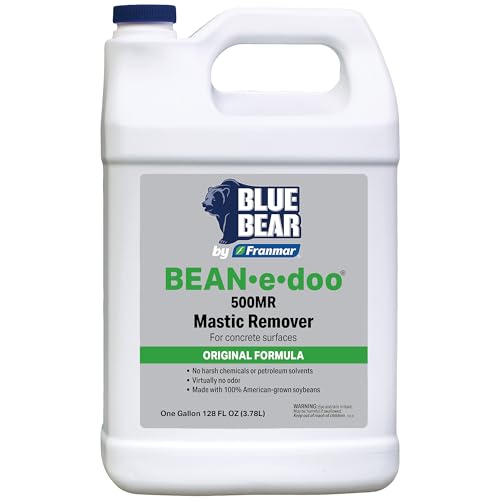
Blue Bear 500MR BEAN-e-doo is a contractor-grade mastic and adhesive remover engineered for DIY homeowners, renovators, and property managers tackling concrete subfloor preparation. When pulling up old carpet, vinyl composition tiles, or aged linoleum, sticky adhesive beds and hardened mastics often remain bonded to the porous concrete underneath. This 128 fluid ounce liquid solution is designed to penetrate beneath those stubborn bonding agents, softening them into a manageable slurry that can be scraped away prior to laying new tile, floating planks, or fresh finishes.
The standout characteristic of this formula is its soy-based, biodegradable chemistry. Unlike traditional floor strippers that rely on aggressive petroleum solvents, Blue Bear 500MR achieves deep residue breakdown without caustic chemicals or intense, lingering fumes. Its low-VOC and low-odor profile makes it well suited for occupied households, enclosed basements, and sensitive indoor areas where strong chemical odors would otherwise disrupt daily life. According to product directions, dwell times vary based on adhesive type: black or asphalt mastics soften within 1 to 2 hours, whereas stubborn vinyl or acrylic glues typically require 4 to 8 hours of soaking.
Application is straightforward and requires only basic floor-prep tools. The liquid is poured or spread across the concrete surface, allowed to sit undisturbed while it dissolves the adhesive matrix, and then removed using a handheld or stand-up floor scraper. With an estimated coverage rate of 100 to 200 square feet per gallon, a single container is well proportioned for typical home remodeling zones such as laundry rooms, basements, mudrooms, or kitchens.
After scraping the loosened adhesive, the concrete can be cleared of sticky patches that would otherwise prevent proper leveling or new floor adhesion. Because the formula relies on dwell time rather than rapid chemical evaporation, it stays active long enough to work through dense trowel patterns. For areas where dried mastic was applied in unusually thick ridges, a second spot application may be needed to clear the surface down to bare concrete.
The primary limitation to keep in mind is surface compatibility. Blue Bear 500MR is specifically intended for concrete surfaces and is not recommended for wood subfloors, hardwood planks, or sensitive composite flooring that could absorb the oil-based soy liquid. Additionally, this is not an instant cleaner; achieving clean results depends entirely on giving the liquid sufficient dwell time and following up with manual scraping effort.
For homeowners and renovators planning a flooring overhaul over a concrete foundation, Blue Bear 500MR offers an effective, low-fume alternative to harsh solvent strippers. Its combination of biodegradable soy chemistry, manageable indoor odor, and reliable adhesive-softening performance makes it a dependable choice for preparing concrete floors for their next installation.
Achieving clean concrete requires matching dwell time to the specific adhesive present on the floor. For older black asphalt or asbestos-type mastics, the manufacturer recommends allowing Blue Bear 500MR to penetrate for 1 to 2 hours until the substance softens. For modern vinyl and acrylic floor adhesives, a dwell window of 4 to 8 hours is typically required for the formula to break through the synthetic polymers.
Once the adhesive has noticeably softened, use a wide-blade floor scraper to lift the residue from the concrete slab. Coverage runs between 100 and 200 square feet per gallon depending on the porosity of the concrete and the thickness of the adhesive layer. In sections with thick ridges, applying a light secondary coat and allowing brief dwell time helps remove residual sticky spots.
Blue Bear 500MR is formulated strictly for use on concrete surfaces, including basement slabs, garage floors, utility spaces, and commercial concrete subfloors. It is intended for the removal of carpet glue, tile mastic, and construction adhesives before installing new flooring systems.
This product should not be applied to plywood subfloors, particle board, solid hardwood, engineered wood, laminate, or decorative finished floors. The penetrating soy formula is optimized for masonry and concrete, meaning porous wood subfloors may absorb the oils and compromise subsequent finish adhesion.
Essential Questions About Concrete Carpet Glue Stripping
How long does soy-based carpet glue remover need to dwell on concrete?
Dwell times range from 1 to 2 hours for black or asphalt mastics and 4 to 8 hours for vinyl or acrylic adhesives. Soy-based formulas rely on active penetration rather than rapid solvent evaporation, so allowing adequate soaking time is critical. The active ingredients break down adhesive bonds into a soft sludge that scrapes away effortlessly. Rushing the process leaves hardened glue stuck in porous concrete pores.
Can you apply new flooring immediately after removing carpet glue from concrete?
No, the concrete slab requires thorough washing and complete drying before installing any replacement floor covering. Soy-based removers leave a temporary oily film that prevents new adhesives, primers, or thin-set mortar from bonding properly. Scrubbing the concrete with water and a degreasing detergent removes this slick barrier completely. Once the slab passes a basic moisture check, your subfloor is ready for new carpet, tile, or floating planks.
How much concrete adhesive remover is needed per square foot?
One gallon of concrete adhesive remover covers between 100 and 200 square feet depending on glue thickness and slab porosity. Heavily textured subfloors with thick, troweled glue ridges consume liquid closer to the 100-square-foot mark. Smooth slabs with light residue allow the remover to spread further toward the 200-square-foot boundary. For small entryways or single closets, a 1-quart container provides sufficient coverage without buying excess bulk chemical.
Does soy-based carpet glue remover produce hazardous fumes indoors?
No, soy-derived formulas feature low-odor and low-VOC characteristics that remain manageable in occupied indoor rooms. Unlike traditional mineral spirits or harsh solvent strippers, biodegradable formulas eliminate overpowering fumes in enclosed basements. Proper airflow through an open window or fan remains good practice during any renovation project. The absence of caustic petroleum solvents makes the stripping process much safer for living areas.
What scraper works best with chemical carpet glue removers on concrete?
A heavy-duty floor scraper equipped with a rigid steel blade provides the most leverage on softened glue. Plastic putty knives bend too easily against tough mastic, while razor scrapers can dull rapidly on abrasive masonry surfaces. Steel blades glide smoothly over concrete to lift the emulsified glue into tidy rows for cleanup. If any sticky residue tracks onto adjacent textile flooring during cleanup, a portable carpet shampooer quickly cleans the affected fibers.
Why is chemical removal preferable to mechanical grinding for carpet glue on concrete?
Chemical softening eliminates hazardous airborne dust and prevents mechanical gouging of the subfloor slab. Mechanical grinding generates large volumes of fine silica dust that require sealed containment and industrial HEPA filtration. It also risks chewing up the surface profile of the concrete, which demands leveling compounds later. A chemical stripper keeps the old mastic damp and contained, letting you scrape it up safely without damaging the concrete structure.


Write Your Review
No reviews yet. Be the first to share your experience!