


Cleaning vehicle carpets and tight seat gaps often reveals how quickly small crumbs, beach sand, and dried mud defeat underpowered equipment. When shopping for a portable auto cleaner, motorists frequently ask %what is a good pa for a car vacuum% to handle stubborn road grit without wasting time. While domestic canister or upright machines draw heavy current from household wall outlets, portable vehicle cleaners operate under stricter power constraints dictated by internal batteries or direct vehicle auxiliary sockets. Selecting the right suction rating ensures that stray gravel and clinging debris lift off the floor mats rather than rolling endlessly beneath the nozzle.
Suction power alone does not tell the complete story, but understanding Pascal ratings provides a reliable baseline for what a compact machine can realistically lift. Much like choosing handheld vacuums designed for quick messes in residential spaces, selecting an automotive vacuum requires balancing motor capabilities, filtration quality, and appropriate detailing attachments. This guide explores standard automotive suction ranges, clarifies the distinction between sealed pressure and working airflow, and explains how modern corded and cordless models perform across different vehicle interiors.


Pros
- Includes two interchangeable rechargeable batteries to extend total operating time without waiting on a single charge cycle.
- Versatile 6-in-1 capability functions as a vacuum, blower, and inflator for automotive, home, and outdoor gear.
- Lightweight 1.96-pound body is easy to handle in confined spaces like vehicle footwells and overhead shelving.
Cons
- The dust container capacity is not specified by the manufacturer, which may require frequent emptying during larger tasks.
- The exact filtration efficiency rating is not documented for the included reusable filters.
The FAOGO A01-Ultra is a portable cordless handheld vacuum cleaner tailored for vehicle owners and homeowners who need a compact tool for quick spot-cleaning tasks. Weighing just 1.96 pounds, its lightweight body is built for one-handed operation in tight quarters such as car footwells, vehicle consoles, sofa cushions, and computer keyboards. Because it is a compact handheld model, it is designed for targeted mess pickup rather than whole-home floor cleaning.
According to manufacturer specifications, the vacuum is driven by a brushless motor generating up to 50,000 Pa of suction across three adjustable power settings: low, medium, and high. To support extended cleanup sessions, the package includes two rechargeable batteries. The manufacturer lists operating runtimes of up to 150 minutes on low mode and up to 60 minutes on high mode across the two batteries. Shoppers should note that these figures are manufacturer-provided estimates rather than independently verified lab tests, and actual run duration will vary based on the chosen suction mode and attachment load.
Beyond standard dry debris pickup, this model features a 6-in-1 multi-functional design that allows it to operate as an air blower and inflator. The package provides six specialized attachments suited for vacuuming crevices, lifting surface pet hair from fabric seats, dislodging crumbs from keyboards, and inflating accessories like balloons or outdoor air mattresses. A dedicated storage bag keeps all nozzles and accessories contained when traveling or stored in a car trunk.
Routine maintenance centers on the dust collection chamber and the two included reusable filters. The manufacturer notes that the filters can be cleaned and reused; however, users should ensure washed filters are completely dry before reinserting them into the motor housing. The exact dust cup capacity and certified filter standard (such as HEPA) are not specified in the documentation, so frequent emptying may be necessary during heavier vehicle detailing.
While this compact handheld cannot replace an upright or stick vacuum for general floor maintenance, it serves as a highly capable secondary cleaner for localized debris. Shoppers seeking a portable, cordless cleaner for car interiors, desk workstations, and occasional outdoor inflation will find practical utility in this dual-battery kit.
The FAOGO kit includes six distinct attachments engineered to expand the handheld cleaner beyond basic dry vacuuming. These tools allow users to adapt the device for tight crevices between car seats, surface dusting across upholstery, and focused blowing to clear dust from electronics and keyboards.
The package also supports inflation tasks, making it practical for inflating balloons, pool toys, or camping air mattresses. Alongside the attachments, the manufacturer includes two reusable filters, two batteries, a battery charger, and a dedicated storage bag to keep all accessories neatly organized in a vehicle or closet.
Power is managed through a two-battery system designed to minimize cleaning interruptions. By providing two separate rechargeable packs, the vacuum allows users to swap batteries when one runs out during deeper detailing jobs.
The manufacturer specifies maximum operating times of up to 150 minutes on low mode and up to 60 minutes on high mode when utilizing both included batteries. Because operating on high suction increases power draw, real-world battery longevity will depend on the selected mode and the resistance encountered during vacuuming or inflating.

Pros
- Comes with two interchangeable batteries and a charger for extended cleaning sessions.
- Compact and lightweight 1.9-pound frame reduces hand fatigue during tight car interior detailing.
- Multi-use attachments allow the device to act as an air duster and inflator in addition to a vacuum.
Cons
- Compact handheld dustbin requires frequent emptying during extended cleanups.
- Manufacturer suction and runtime figures have not been validated by independent lab tests.
The FAOGO X12-Ultra handheld vacuum is a compact, cordless utility cleaner engineered for vehicle interiors, furniture, electronics, and small household messes. Weighing just 1.9 pounds, this portable device is aimed at drivers, apartment residents, and homeowners who need a convenient grab-and-go option for dry crumbs, pet hair, and surface dust without dealing with full-sized equipment.
According to manufacturer specifications, the vacuum utilizes a high-speed brushless motor capable of generating up to 50,000Pa of suction power. The system is powered by two removable, rechargeable battery packs that deliver a combined manufacturer-stated runtime of up to 60 minutes. While this dual-pack configuration allows continuous work by swapping packs, real-world runtime will vary depending on power draw, tool selection, and cleaning intensity.
Beyond standard dry vacuuming, the X12-Ultra features a multi-functional design with six included nozzles. These attachments allow the tool to function as an air duster for keyboards and tight crevices, as well as an inflator for balloons or small air mattresses. The kit also includes a storage bag to keep the main unit, charger, batteries, and nozzles organized in a trunk or closet.
Routine maintenance centers on the washable dust container and two included reusable filters. The dustbin detaches easily for disposal of dry debris, and both the bin and filters can be cleaned with water when dust accumulates. To prevent motor damage and maintain airflow, the manufacturer recommends letting washable components dry completely before reassembly.
Because of its compact dirt capacity and specialized attachment set, this unit serves as a supplemental detailer rather than a primary vacuum for carpets or hard floors. Shoppers seeking a versatile, multi-purpose car vacuum and air duster with swappable batteries will find the included accessory bundle practical for tight spaces and light cleanup jobs.
The FAOGO X12-Ultra comes equipped with six dedicated nozzles designed to handle distinct utility jobs. In vacuum mode, the nozzles assist with drawing pet hair, crumbs, and fine dust out of car seat seams, cup holders, and furniture crevices.
By attaching the appropriate nozzles to the exhaust or air port, the tool converts into an air blower or inflator. This setup is suited for blowing dust out of computer keyboards, camera gear, and electronic vents, or inflating small inflatables such as balloons and pool floats.
The package also includes two reusable filters, allowing one to be washed while the other remains in service, alongside a storage bag that holds the entire accessory kit, charger, and spare battery together.
Power is supplied by two interchangeable rechargeable batteries, addressing the short runtimes common to single-battery handheld vacuums. The manufacturer states that the dual-battery setup provides up to 60 minutes of combined operating time under standard conditions.
The quick-swap battery system allows users to replace a depleted pack immediately, minimizing downtime during longer detailing projects. A dedicated charging adapter is included in the package to recharge the packs between cleaning sessions.
Pros
- 12V auxiliary power eliminates rechargeable battery limits during detailed car cleanups.
- Generous 16-foot cord reaches comfortably from the front console into the vehicle trunk.
- Added maintenance value with an extra washable HEPA filter and a dedicated cleaning brush included.
Cons
- Requires a 12V car auxiliary power port and cannot plug into standard household wall outlets without an adapter.
- Corded setup requires routing the wire around foot pedals, center consoles, and seat rails.
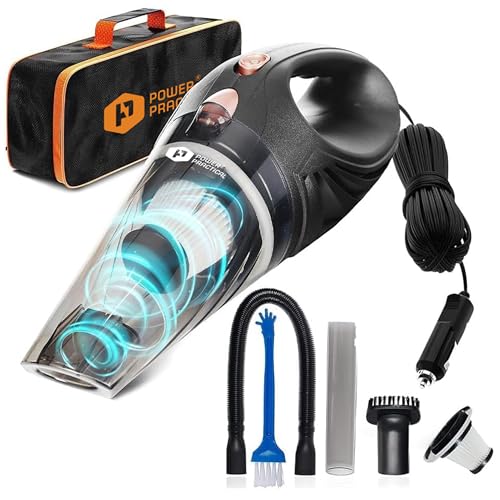
The ThisWorx Handheld Car Vacuum is a compact cleaning tool engineered specifically for vehicle interiors. Powered through a car or truck 12V auxiliary socket, it serves drivers who want on-the-go cabin cleanup without the runtime limits or battery degradation of cordless handheld units. Its lightweight form factor, weighing under 2.5 pounds, and slim profile make it easy to maneuver between vehicle consoles, seats, and footwells.
According to manufacturer specifications, the vacuum is driven by a 106-watt motor designed to produce cyclonic suction. The manufacturer lists it for common automotive debris, such as beach sand, crumbs, drive-thru food spills, and pet hair. Because it draws power straight from the 12V vehicle electrical system, suction remains steady throughout cleaning rather than declining as a portable battery depletes.
Reach is provided by a 16-foot power cord, giving drivers sufficient slack to clean front floorboards, rear rows, and typical cargo compartments without straining the connection. At roughly 13.4 inches long, the ergonomic body is simple to guide into low spaces. While the cord ensures continuous power, users must manage the wire around floor mats and seat tracks during use.
The package includes three vehicle-detailing attachments: a flathead nozzle, an extendable hose nozzle, and a brush tool. These accessories target specific automotive tasks, from agitating carpet fibers to reaching tight gaps beneath seat rails. For filtration, the vacuum utilizes a washable HEPA-rated filter to retain dust inside the debris cup during cleaning.
Routine maintenance involves unlatching the dust container to empty collected debris, followed by brushing or rinsing the washable filter. The manufacturer includes a spare HEPA filter, a filter-cleaning brush, and a storage carry bag to keep all attachments contained in the trunk or under a seat. Note that this vacuum is configured solely for 12V vehicle power and cannot plug directly into a standard 120V household wall outlet without a separate AC-to-DC converter.
For vehicle owners seeking an affordable, dedicated car vacuum that avoids battery management, this model delivers practical convenience. Its combination of a 16-foot reach, multiple nozzle types, and a spare filter makes it a sensible option for routine automotive maintenance, provided your vehicle has an accessible 12V auxiliary outlet.
The vacuum connects directly to a vehicle 12V DC auxiliary outlet, drawing steady power from the automotive electrical system. The 16-foot integrated power cord allows you to navigate from the dashboard power port through passenger rows and into rear cargo spaces without snagging.
Because the unit operates corded via the car auxiliary port, cleaning sessions are not constrained by typical rechargeable battery runtimes. However, owners should keep their vehicle power guidelines in mind to avoid running down the car battery during prolonged cleaning sessions when the engine is switched off.
The vacuum comes with an automotive interior detailing kit featuring three functional attachments: a flathead nozzle for narrow gaps, an extendable hose for awkward angles beneath seats, and a brush nozzle to loosen debris from upholstery and fabric floor mats.
In addition to the nozzle attachments, the kit includes a filter-cleaning brush, a spare washable HEPA filter, and a branded carrying bag to store the vacuum and its components neatly inside your vehicle.
Evaluating Pascal Ratings and Automotive Suction Performance
Understanding automotive vacuum specifications begins with recognizing how manufacturers quantify suction force. A baseline car vacuum typically generates between 4,000 Pa and 6,000 Pa, which provides adequate pulling power for surface dust, dry leaves, and loose crumbs on flat surfaces. For ground-in beach sand, small road pebbles, and pet fur clinging to woven automotive carpet, ratings between 12,000 Pa and 15,000 Pa offer substantially greater pulling strength. Advanced cordless units driven by high-speed brushless motors often state suction figures between 30,000 Pa and 50,000 Pa, delivering strong static lift designed for dense upholstery and stubborn crevices.
Determining the ideal rating depends primarily on your routine cleaning challenges and the interior materials of your vehicle. Vehicles fitted with rubber all-weather floor mats require far less suction to clean thoroughly than vehicles with deep-pile velour carpeting that traps sharp grit. Furthermore, static suction ratings must work alongside efficient airflow and effective mechanical agitation to dislodge settled debris. Examining how suction metrics interact with motor construction, attachments, and power supplies makes it easier to match equipment to your detailing routine.
Defining Pascals and Kilopascals in Vacuum Cleaning
The Pascal, abbreviated as Pa, is the standard international metric unit for measuring pressure or suction force per unit area. In the context of vacuum cleaners, this rating describes sealed suction, which indicates the maximum negative pressure the motor creates when airflow is entirely blocked. Manufacturers frequently express this figure in kilopascals, where one kilopascal equals one thousand pascals. For instance, a vacuum rated at 5 kPa produces an equivalent sealed suction force of 5,000 Pa.
Automotive product documentation sometimes measures this same physical principle using inches of water lift. Water lift indicates how many inches of water the vacuum motor can pull up a sealed tube against the pull of gravity. A specification such as a 20-inch water lift motor, seen on compact 12V models like the Armor All AA12V2, translates mathematically to approximately 5 kPa of static suction. Both units measure the motor’s pulling capacity rather than the speed or volume of air moving through the machine.
Sealed pressure provides a valuable baseline metric, but it only reflects how strongly a vacuum pulls when the nozzle is pressed flush against a surface. As soon as the nozzle lifts slightly to allow air and debris into the dust cup, the working suction drops significantly. Consequently, evaluating a car vacuum requires examining both its maximum sealed pressure rating and how effectively its motor maintains airflow during active sweeping motions.
Practical Suction Benchmarks Across Automotive Tasks
Entry-level car cleaners generally operate in the 4,000 Pa to 6,000 Pa range. This tier includes many traditional corded auxiliary models that draw power directly from the vehicle cigarette lighter socket. These machines excel at lifting lightweight debris, such as cigarette ash, dried crumbs, fallen leaves, and surface dust from hard plastic consoles and smooth leather seats. However, they often struggle when attempting to extract fine sand or heavy gravel that has settled deep into carpet fibers.
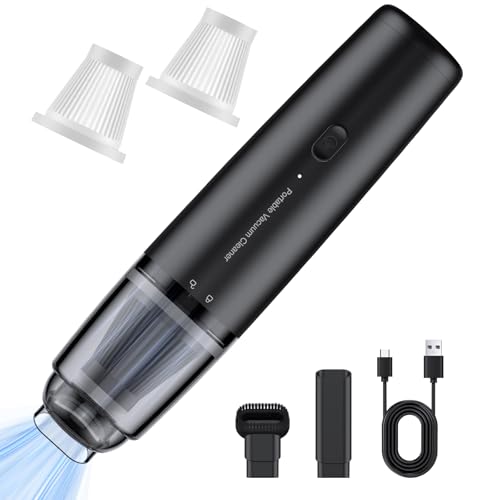
Mid-tier automotive vacuums provide between 8,000 Pa and 15,000 Pa of suction force. Compact cordless options like the LYFUHUI Car Handheld Vacuum fall directly into this category with a stated 13,000 Pa suction output. This pressure level easily manages coarse dirt, dried mud flakes, food particles wedged into seat joints, and moderate amounts of pet hair. For most motorists performing weekly cabin upkeep, a rating in this range delivers a reliable balance between battery efficiency and cleaning capability.
High-output portable vacuums operate between 30,000 Pa and 50,000 Pa, a level typically powered by multi-cell battery packs and specialized brushless motors. The FAOGO Car Vacuum models demonstrate this tier with advertised 50,000 Pa ratings. Vacuums in this category generate enough vacuum pressure to pull dense mineral grit from footwells and lift stubborn pet hair from textured seat fabrics. This elevated pulling strength also allows these tools to operate dual-function attachments, such as inflators or high-pressure dusting blowers.
Selecting among these tiers depends on the severity of debris your cabin experiences on a regular basis. Daily commuters carrying briefcases and dry snacks can maintain clean upholstery with lower suction tiers without difficulty. In contrast, drivers who frequently transport dogs, haul outdoor sports equipment, or track damp beach sand into the vehicle will benefit noticeably from mid-range or high-output machines.
The Interplay Between Static Suction and Airflow
A common misconception in vehicle detailing is that a higher Pascal rating automatically guarantees superior cleaning speed. Pascals measure static lift, which determines whether a vacuum can pick up a heavy single object like a dropped pebble. Airflow, measured in cubic feet per minute, determines how much volume moves through the intake to carry dirt into the collection cup. Without sufficient airflow, even a motor with high sealed suction will struggle to clean broad areas quickly.
Motor design plays an essential role in establishing this balance between static lift and moving air. Traditional brushed motors, frequently found in economical 12V tools like the ThisWorx 2.0 with its 110-watt configuration, provide steady mechanical reliability and predictable airflow. Brushless motors, on the other hand, spin at much higher revolutions per minute without generating mechanical friction on commutators. This mechanical efficiency allows brushless motors to generate immense static suction while maintaining the airflow needed to suspend particles in the air stream.
Airflow volume becomes especially critical when managing embedded pet hair and fine dust that cling to vehicle fabrics. Static pressure helps unseat the hair, but continuous air velocity pulls the strands through the filter housing without stalling. In residential cleaning, similar principles govern vacuums designed for tough pet messes, where dedicated extraction and strong airflow combine to lift stubborn fibers from upholstery.
When reviewing product specifications, motorists should remember that a compact vacuum with a moderate Pascal rating and generous airway geometry can often clean faster than a unit with high static pressure choked by a tiny intake nozzle. A well-engineered airway prevents turbulence, reduces motor strain, and ensures that lifted debris reaches the dust container instead of settling back onto the floorboard.
Power Source Limitations: 12V Auxiliary Versus Cordless Batteries
The power supply of a vehicle vacuum places hard physical boundaries on how much suction pressure its motor can produce. Direct 12V corded vacuums plug into the vehicle auxiliary cigarette lighter port, drawing electricity directly from the car battery or alternator. Because standard automotive auxiliary circuits are protected by 10-amp or 15-amp fuses, manufacturers must limit motor power to approximately 100 to 120 watts to prevent blowing the fuse. Models like the ThisWorx Handheld Car Vacuum, operating with a 106-watt motor, respect these constraints.
Because input wattage is capped on 12V auxiliary connections, corded car vacuums generally top out between 4,000 Pa and 6,000 Pa of suction. The trade-off for this moderate suction level is unlimited operating runtime. Drivers can clean an entire full-size SUV, including the trunk and cargo floor, without worrying about battery exhaustion. With generous cords spanning 15 to 16 feet, these machines provide constant, predictable power for extended detailing sessions.
Cordless handheld vacuums utilize internal lithium-ion battery packs that can discharge energy at much higher rates than a 12V auxiliary port allows. This high instantaneous current enables compact brushless motors to achieve suction ratings of 13,000 Pa, 30,000 Pa, or even 50,000 Pa. However, running high-draw motors rapidly drains small battery packs. A cordless vacuum running at maximum suction might operate for 15 to 30 minutes before requiring a recharge, although dual-battery kits help double that working window.
Drivers must weigh whether uninterrupted runtime or maximum pulling power best matches their vehicle upkeep habits. If you prefer taking your time to meticulously detail seat tracks, door pockets, and rear cargo areas, a 12V corded machine prevents unexpected interruptions. If you prefer swift, high-intensity cleanups without dealing with tangled power cords stretching across vehicle door jambs, a high-suction cordless model offers greater convenience.
The Role of Nozzle Geometry and Agitation Attachments
Raw motor suction must be directed properly to achieve effective cleaning on automotive surfaces. The shape and diameter of the cleaning attachment directly influence the localized suction force at the point of contact. Attaching a narrow crevice tool concentrates the available air stream through a restricted opening, dramatically increasing air velocity. This concentrated force allows a modest 5,000 Pa vacuum to easily lift heavy crumbs and grit trapped along seat seams and center console edges.
Wider dusting brushes spread the suction across a broader surface area, lowering localized pulling force but adding mechanical bristles. Bristles are indispensable for dislodging static dust from air conditioning vents, instrument clusters, and dashboard seams without scratching sensitive surfaces. The mechanical brushing action loosens dirt so the air stream can carry it away, compensating for the distributed suction pressure.
Specialized tools like pet hair rakes, featured with machines like the Armor All AA12V2, rely on friction ridges to mechanically break the bond between pet hair and fabric weave. Pet hair often weaves itself into automotive upholstery, resisting even 50,000 Pa of direct suction. Scraping the fabric with a textured rubber or silicone rake gathers the hair into clumps, allowing the vacuum nozzle to ingest it smoothly without clogging.
Preserving Suction Through Filter and Dust Cup Care
Regardless of whether a vacuum starts with 5,000 Pa or 50,000 Pa, its real-world performance declines rapidly if filtration maintenance is neglected. In a compact automotive vacuum, the distance between the dust cup and the motor filter is only a few inches. As fine road silt, ash, and chalky dust accumulate on the filter pleats, airflow resistance spikes, causing suction at the nozzle to plummet within minutes of operation.
Modern automotive cleaners employ washable double filtration systems or dense HEPA filters to protect the motor from abrasive dust. Models such as the ThisWorx 2.0 include washable filters and small cleaning brushes to knock loose debris from the pleats between cleanings. When washing a filter with tap water, always consult the manufacturer manual for specific care directions, and ensure the filter is completely dry before reinstalling it. Reinstalling a damp filter restricts airflow, degrades suction, and risks drawing moisture directly into the high-speed electric motor.
Emptying the dust bin before it reaches its maximum fill line is equally critical for maintaining steady suction. Cyclonic vacuums rely on empty space inside the canister to generate a spinning vortex that separates heavy dirt from the exhaust stream. When the cup overfills, debris bypasses the vortex and packs directly against the filter face, choking the motor and leading to immediate performance loss.
Matching Suction Specifications to Your Vehicle Routine
Selecting the right suction rating ultimately comes down to the types of messes your vehicle encounters and how often you clean. If your vehicle primarily serves as a daily commuter and you store it in a garage, a standard 12V auxiliary vacuum offering 4,000 Pa to 6,000 Pa is typically sufficient. It plugs in instantly, stows neatly under a seat or in the trunk, and easily tidies up coffee sugar spills, pastry crumbs, and dry leaves without battery management.
Families with young children, pet owners, and outdoor adventurers generally require greater suction capacity. Ground-in snacks, dried beach sand, and pet fur woven into footwell carpets demand a minimum of 12,000 Pa to 15,000 Pa for efficient removal. Choosing a multi-mode cordless tool in this category provides the flexibility to switch between lower power settings for light dusting and high-output modes for stubborn carpet extraction.
For drivers who want professional-style results from a portable tool, cordless units reaching 30,000 Pa to 50,000 Pa deliver maximum pulling capability. While these high-draw tools require mindful battery management, their intense static lift pulls deeply embedded silt out of automotive carpets that lower-powered models leave behind. Pairing adequate suction with disciplined filter maintenance and the correct detailing nozzles guarantees a fresh, clean cabin on every journey.




Write Your Review
No reviews yet. Be the first to share your experience!