


Standard household vacuums quickly encounter their limits when faced with standing puddles, coarse sawdust, or scattered gravel in the garage. Domestic uprights and stick vacuums rely on delicate internal impellers that can break when ingesting heavy screws, while damp sludge quickly ruins conventional dry dust bags. Determining what to look for in a shop vac begins with understanding how utility machines isolate moisture and channel abrasive grit directly into a heavy-duty containment drum. These dedicated wet-and-dry systems safeguard regular residential equipment while tackling demanding cleanup tasks that would cause severe blockages elsewhere.
Unlike standard domestic units or compact handheld vacuums for kitchen mess, dedicated utility cleaners use bypass motors engineered to prevent liquids from reaching sensitive electrical wiring. Evaluating air volume, motor horsepower, collection drum volume, and compatible nozzle assemblies ensures your selected unit handles messy garage projects without becoming cumbersome to operate. Reviewing these mechanical specifications before buying helps prevent common frustrations such as inadequate suction, premature filter blinding, and awkward wastewater disposal.



Core Factors When Evaluating a Utility Wet and Dry Vacuum
Choosing an effective utility cleaner requires looking past exterior casing shapes and examining the functional engineering that governs suction strength, debris containment, and liquid handling. Utility vacuums endure punishing conditions such as collecting wet masonry residue, clearing backed-up sink drains, and extracting sawdust directly from operating woodworking power tools. Reviewing manufacturer ratings, drum dimensions, airflow mechanics, and nozzle assemblies helps you pinpoint a machine configured for your specific workspace. Balancing these operational capabilities ensures you avoid buying an undersized cleaner that clogs repeatedly or an oversized tank that proves impossible to store conveniently.
Understanding Motor Power, Airflow, and Sealed Pressure Ratings
Motor output ratings on utility machines are frequently advertised as peak horsepower, which represents the maximum mechanical output produced momentarily during initial startup under laboratory conditions. A compact model like the Shop-Vac 2021005 1 Gallon 1.0 Peak HP Micro provides enough pulling strength for concentrated benchtop spills and vehicle footwell cleanups. Mid-range and heavy-duty designs, such as the Shop-Vac 5430113 6 Gallon 4.5 Peak HP Wet/Dry or the 10-gallon model, deliver 4.5 peak horsepower to sustain airflow across wider and longer hoses. While peak figures provide a convenient shorthand for motor size, airflow volume and static sealed pressure provide far more accurate indicators of real-world cleaning capability.
Airflow volume is measured in cubic feet per minute, abbreviated as CFM, and indicates the physical volume of air moving through the hose into the collection drum. Higher CFM numbers determine how effectively a vacuum entrains loose particles like wood shavings and fine plaster dust across wide floor nozzles. The 1-gallon portable model delivers 50 CFM of airflow, which suits tight quarters and targeted, short-range debris pickup. Larger motors pull significantly more air volume, allowing wide floor sweepers to lift dense collections of dirt quickly without requiring multiple slow passes across the workshop floor.
Sealed pressure, commonly referred to as static water lift, indicates the motor’s pulling force against sealed resistance, measured in inches of vertical water column lift. The Shop-Vac 1-gallon model specifies 45 inches of water in sealed pressure, demonstrating its mechanical ability to pull liquids and dense debris upward against gravity. High water lift becomes critical when clearing standing sludge from low drains, pulling damp gravel from vehicle carpets, or drawing water through long vertical hose runs. Motors operating on standard residential current, such as 120 volts at 6.0 amps, balance robust suction power without tripping typical household circuit breakers.
Tank Capacity and Tub Dimensions for Garage and Workshop Demands
Tank capacity directly dictates how long you can operate the vacuum before pausing your work to empty dense debris or liquid contents. Compact 1-gallon utility units emphasize light weight and convenient storage, making them suitable for quick craft cleanups, desktop maintenance, and vehicle detailing. These compact housings can be stored directly on a utility shelf or mounted on a garage wall bracket to keep floor spaces clear. The limitation remains holding capacity, as damp sawdust or water fills a 1-gallon drum within moments, making larger tasks inefficient.
Mid-sized drums, represented by the Shop-Vac 5430113 6 Gallon 4.5 Peak HP Wet/Dry unit, strike a practical balance between waste capacity and manageable handling. A 6-gallon drum provides sufficient room to capture wood chips from miter saws, vacuum out multiple vehicles, or manage small household plumbing leaks. The unit remains compact enough to lift into a car trunk or carry up basement stairs without excessive physical effort. For general home maintenance and occasional DIY projects, this middle-tier tank volume handles diverse cleanup tasks without occupying excessive storage room.
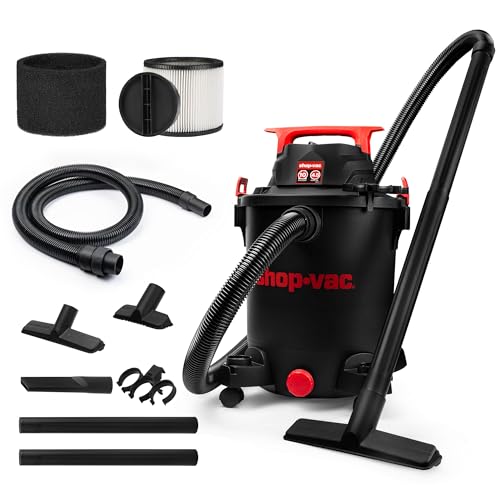
Large 10-gallon machines like the Shop-Vac 5430115 wet and dry vacuum cater to demanding workshop renovations, extensive flooded basements, and heavy remodeling debris. An expansive drum holds extensive quantities of wet sludge and coarse drywall scrap before triggering the internal liquid shutoff mechanism. The primary operational trade-off involves physical footprint and filled weight, since water weighs roughly 8.3 pounds per gallon. A full 10-gallon drum can exceed 80 pounds of liquid payload, requiring dependable caster wheels and heavy-duty side handles for secure management.
Hose Diameters, Airflow Resistance, and Clog Prevention
Hose diameter has a profound effect on air velocity and the maximum physical size of debris the vacuum can ingest without jamming. Narrower hoses, such as the 1.25-inch diameter found on the 1-gallon micro unit and standard accessory kits, produce high air velocity for targeted dust extraction. This compact hose size allows excellent flexibility when reaching between automotive console gaps, vacuuming upholstery, or cleaning delicate tools. However, the narrower internal passage is prone to clogging when attempting to vacuum coarse wood offcuts, leaves, or clumpy wet insulation.
Larger utility models frequently step up to wider hose fittings, such as the 1-7/8-inch diameter hose supplied with the 10-gallon Shop-Vac machine. Wider tubing allows larger objects like wood splinters, drywall fasteners, and damp garden debris to enter the drum cleanly without lodging in bends. The larger internal cross-section also decreases friction losses along the hose interior, maintaining effective suction through a 7-foot hose run. Matching hose diameter to your primary cleaning material prevents constant stops to clear choked suction lines.
Durable hose materials, typically composed of ribbed polypropylene or flexible copolymer plastics, must resist crushing while bending around workshop obstacles. Inexpensive plastic tubing can flatten under intense vacuum pressure, starving the bypass motor of necessary cooling air. Reliable hoses maintain an open circular cross-section even when pulled firmly around door frames or stepped on accidentally by heavy work boots. Checking that friction-fit swivel connectors lock firmly into the vacuum inlet prevents the hose from detaching during vigorous cleaning strokes.
Filtration Media Types for Dry Dust and Wet Spill Collection
Effective filtration safeguards the motor impeller from abrasive dust while preventing fine particles from exhausting back into your ambient breathing air. Dry vacuuming requires dry-rated media, such as pleated cartridge filters or paper disc filters, to catch fine dust before it reaches the exhaust port. The Shop-Vac 6-gallon unit includes a paper disc filter secured by a mounting ring, which serves as a practical barrier for coarse sawdust and household sweepings. Fine materials like sanding dust or fireplace ash benefit from high-surface-area cartridge filters that resist premature surface caking.

Wet vacuuming requires a completely different filtration setup to prevent filter damage and preserve internal airflow. Standard paper filters must be removed before suctioning water, because wet cellulose tears easily and allows dirty sludge to enter the motor housing. A foam sleeve, provided with both the 6-gallon and 10-gallon Shop-Vac models, replaces dry filters during liquid pickup. The porous foam traps floating foam bits, animal hair, and coarse debris while letting moisture-laden air circulate safely without destroying the media.
Cartridge filters, such as the pleated filter included with the 10-gallon model, offer significantly more surface area than flat paper discs. The accordion folds distribute incoming air across a broad expanse of filter material, slowing down dirt accumulation and extending runtime between cleanings. When vacuuming ultra-fine masonry or drywall dust, pairing a cartridge filter with an internal disposable collection bag provides valuable two-stage filtration. The collection bag traps the bulk of dust upon entry, keeping the primary cartridge clean and simplifying tank emptying.
Drainage Ports and Handling Heavy Wastewater
Emptying wastewater presents an ergonomic issue that many vacuum owners overlook until the collection drum is filled with dirty, heavy liquid. Compact 1-gallon drums are light enough to pour out directly into a workshop sink or outdoor drain without mechanical difficulty. However, lifting an open 6-gallon or 10-gallon drum containing dozens of pounds of sloshing wastewater risks muscle strain and messy floor spills. Removing a heavy motor head from a full tank also creates dripping mess across freshly cleaned garage floors.
An integrated bottom drain outlet, featured on the Shop-Vac 10-gallon model, resolves this physical strain by using gravity to empty the drum. Operators simply wheel the machine to a floor drain or outdoor sump, remove the threaded cap, and allow dirty water to drain freely. When managing extensive indoor moisture extraction from saturated carpeting, using a dedicated carpet extractor for home use provides targeted detergent injection and controlled water recovery. Gravity drain ports eliminate the awkward lifting and tilting movements that frequently cause accidental tank drops.
Blower Port Utility for Outdoor and Workshop Debris Clearance
Many modern wet and dry utility vacuums incorporate reversible airflow routing, transforming the motor exhaust into a functional air blower. By detaching the suction hose from the front vacuum inlet and securing it into the rear exhaust port, the machine projects high-velocity air outward. Units such as the Shop-Vac 5430113 and 5430115 include dedicated blower ports capable of clearing leaves from patios, blowing sawdust off stationary power tools, or sweeping garage thresholds. This 3-in-1 capability expands tool versatility without requiring the purchase of a standalone electric leaf blower.
Using the blower port safely requires verifying that the collection tank and interior filters are free of fine residual dust before switching ports. Fine drywall dust left inside an unemptied drum can blast out through the exhaust as an airborne cloud if the unit is engaged in blower mode unexpectedly. Securing the hose firmly into the exhaust port ensures the high-velocity air stream does not disconnect the friction fitting during use. Fitting an extension wand to the blower hose gives you targeted directional control when dislodging debris from tight spaces behind workshop workbenches.
Accessory Tool Kits, Gulper Nozzles, and Specialty Attachments
A utility vacuum’s versatility depends heavily on matching specific nozzle designs to particular cleaning surfaces and debris types. Wide gulper nozzles, included with the Shop-Vac 3PC Nozzle Kit and 9064300 Cleaning Kit, excel at rapid debris pickup across flat shop floors and automotive carpets. The broad opening distributes suction evenly, allowing the head to swallow small gravel, wood scraps, and liquid puddles without sticking to the floor. Rigid extension wands provide comfortable standing reach, allowing you to clean wide floor areas or high shelving without continuous bending.
Crevice tools provide narrow, high-velocity suction channels necessary for extracting grit from tight seat crevices, between workbench supports, and along floor baseboards. Molded from rigid polypropylene, these durable attachments resist abrasive wear against coarse concrete surfaces without splitting. Specialized interior cleaning sets, like the Shop-Vac 9064300 1.25 Inch Diameter Cleaning Kit, also incorporate round dusting brushes with soft bristles. These brushes dislodge surface dust on delicate surfaces like window blinds, air vents, and vehicle dashboards without causing surface scratches.
Verifying attachment dimensional compatibility is essential before purchasing replacement nozzles or accessory kits. Most residential Shop-Vac cleaners utilize 1.25-inch inner diameter friction-fit attachments on their extension wands and hose ends. Larger commercial vacs often use 1-7/8-inch or 2.5-inch hoses, which cannot connect to 1.25-inch tools without stepped reducer adapters. Integrated tool holders on the vacuum body, such as those built into the 6-gallon and 10-gallon units, keep essential wands and crevice tools neatly organized and ready for use.
Mobility, Caster Wheels, and Total Cleaning Reach
Cleaning wide garage spaces or detached workshops requires adequate operating reach so you avoid constantly moving between electrical wall outlets. The Shop-Vac 10-gallon model combines a 15-foot power cord with a 7-foot hose, providing 22 feet of total cleaning reach from a single outlet connection. Smaller 1-gallon designs feature shorter 6-foot cords and 4-foot hoses tailored for compact benchtop areas where the machine rests near the work surface. Calculating your workshop perimeter and available outlet locations helps determine whether an extra-long power cord is necessary.
Moving a weighted vacuum smoothly across rough garage concrete requires durable, well-placed caster wheels. Swiveling casters positioned around the drum base provide multidirectional rolling stability, reducing the risk of tipping when the hose is pulled during cleaning. Weighing 18 pounds empty, the 10-gallon machine rolls smoothly across floor seams and scattered cords on its wheeled platform. A sturdy top carrying handle provides a balanced grip when lifting the machine across thresholds or hoisting it into a vehicle trunk.
Safe Operation, Power Disconnection, and Routine Maintenance
Maintaining consistent suction and prolonging utility vacuum motor life requires routine user care and strict adherence to safety guidelines. An internal mechanical float valve rises as wastewater fills the drum, sealing off the motor intake once fluid reaches maximum safe capacity. When the motor pitch suddenly rises and suction ceases, immediately power off the unit, disconnect the electrical cord, and empty the drum contents. Bypassing the float valve or ignoring sudden airflow cutoff can draw water directly into the motor housing, causing electrical hazards and motor failure.
Always disconnect the power plug from the wall outlet before removing the motor head, inspecting filters, or clearing hose clogs. While wet and dry utility vacs easily collect standing water, homes managing recurring biological pet accidents on indoor carpets often benefit from specialized pet stain vacuums that combine mechanical scrubbers with chemical extraction. After wet pickup tasks with your utility vac, wash the collection tub thoroughly, rinse the foam sleeve in clean water, and allow all parts to dry completely before reassembly to prevent mold growth and unpleasant odors.
Assessing motor horsepower, airflow volume, drum dimensions, hose sizing, and filtration media ensures you choose a utility cleaner matched to your actual tasks. Whether your routine requires a compact 1-gallon portable model for benchtop detailing or a 10-gallon high-capacity machine with a bottom drain for major workshop messes, matching these specifications guarantees reliable performance. Understanding these essential mechanical factors protects your equipment investment and keeps your home, vehicle, and workshop clean.






Write Your Review
No reviews yet. Be the first to share your experience!