


Everyday messes, dry spills, and quick cleanups around the kitchen or automobile require fast suction without hauling out heavy household equipment. Many homeowners and vehicle owners wonder what is the best handheld dustbuster when comparing portable cordless models designed for convenience. Handheld vacuums vary significantly in motor voltage, battery runtime, filtration efficiency, and specialized nozzle attachments. Understanding how these compact appliances handle localized debris makes it easier to select a model that fits your specific cleaning routine.
Cordless handheld units range from compact 8-volt machines designed for light crumbs to high-powered 20-volt lithium-ion models capable of lifting embedded dirt and pet hair. When evaluating options, factors like dustbin capacity, ease of emptying, and washable filters determine everyday reliability. While full-sized machines handle primary floorcare and dedicated vacuums suited for vehicle detailing tackle liquid spills, a reliable hand vac fills the gap for rapid spot pickups. Examining technical specifications and design features helps ensure you choose a portable cleaner that delivers steady suction across multiple surfaces.


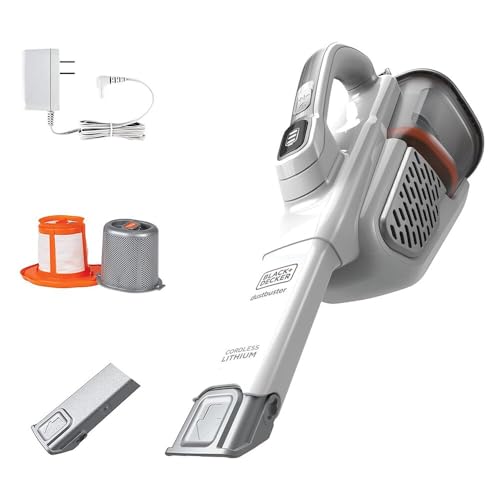


Pros
- Integrated pull-out crevice tool and flip-up brush ensure attachments are always available on the tool body.
- Lightweight 2.6-pound frame reduces arm fatigue during stair cleaning and car detailing.
- Washable 21-ounce dust bowl empties cleanly without needing consumable replacement bags.
Cons
- The manufacturer does not provide exact battery runtime or charging duration specifications in the product data.
- Designed solely for dry spot cleanup and lacks floorhead extensions for whole-room floor maintenance.
The BLACK+DECKER Dustbuster AdvancedClean cordless handheld vacuum (ASIN B006LXOJC0) is designed for quick, targeted cleanups around the home and vehicle. At 2.6 pounds, this compact cleaner suits homeowners, renters, and vehicle owners looking for a lightweight grab-and-go option for stairs, sofa cushions, car floorboards, and high-traffic entryways. Its handheld format targets localized messes rather than full-room floor maintenance.
Cleaning power is driven by a 16V MAX lithium-ion battery paired with cyclonic action, which the manufacturer states spins dust and debris away from the filter to maintain consistent suction. Documented uses include picking up everyday dirt, loose debris, hair, and pet hair from furniture, carpeted stairs, and car interiors. Manufacturer documentation does not specify numerical suction ratings in air watts or cubic feet per minute, nor does it state an exact continuous run time per charge, so cleaning sessions should be planned around short spot tasks.
The build incorporates an integrated rotating slim nozzle that turns to reach tight angles between car seats or along baseboards. Rather than requiring detached accessory storage, the vacuum features a pull-out crevice tool and a flip-up dusting brush built directly onto the nozzle. Debris collects in a translucent 21-ounce bagless dirt bowl, allowing users to see when the chamber is approaching capacity. The package also includes a dedicated charging station that holds the vacuum upright while replenishing the battery.
Maintenance centers on routine emptying and filter upkeep. The manufacturer recommends emptying the 21-ounce dust bowl after every use and washing both the bowl and filter regularly to preserve suction performance. Because the bowl is washable, debris can be dumped out without direct contact with settled dirt. Users should ensure the washable filter is completely air-dried before reinstalling it into the vacuum housing.
This Dustbuster is built strictly for dry debris and should not be used on wet spills or damp surfaces. While it lacks motorized floor nozzles or extended wand reach for general flooring, it serves as a practical, low-profile supplemental vacuum for quick household messes, upholstery maintenance, and vehicle upkeep.
The primary physical feature of this Dustbuster model is its onboard accessory configuration. The slim nozzle rotates to adjust to awkward cleaning angles, making it easier to maneuver around automotive consoles, under vehicle pedals, and between sofa sections. A built-in crevice tool slides forward when extra reach is needed, and a flip-up brush engages quickly for dusting delicate trim or upholstery without requiring separate loose attachments.
Measuring 17.25 by 5.5 by 7.75 inches and weighing 2.6 pounds, the unit is balanced for one-handed operation. The included charging station provides a stable footprint for countertop or shelf storage while keeping the 16V battery connected to power between uses.

Pros
- 200-degree nozzle rotation allows access to high shelves, under car seats, and around tight corners.
- Onboard tools flip or slide out directly, eliminating the need to store and carry loose accessories.
- Weighs only 3 pounds, reducing wrist strain during quick spot cleaning.
Cons
- Handheld design and compact dirt bowl are not intended for whole-home floor vacuuming.
- Product documentation does not specify the exact battery runtime in minutes per charge.
The BLACK+DECKER Pivot Vac (model BDH2000PL) is a compact, cordless handheld vacuum designed for quick cleanups around the home and inside vehicles. Weighing 3 pounds, this portable unit targets everyday spot messes, crumbs, and light debris where bringing out a full-sized upright or canister vacuum would be inconvenient. Shoppers seeking a secondary cleaning tool for stairs, car interiors, upholstery, or countertops will find its focused form factor suited to fast pick-ups.
Power is supplied by an internal 20V MAX lithium-ion battery system, which the manufacturer states delivers high suction power for quick cleaning tasks. Because this model utilizes cyclonic action to spin debris away from the filter, airflow remains active as dirt enters the bowl. The documentation does not list exact runtime figures in minutes or specific air-watt ratings, so operating duration depends on the mess and frequency of use. It is primarily built for dry debris on vehicle upholstery, furniture cushions, and hard surfaces.
The central physical feature is the wide-mouth nozzle that pivots through a 200-degree arc. This articulated neck allows users to angle the suction opening above cabinets, under vehicle footwells, or into narrow recesses without awkward wrist twisting. Unlike portable vacuums that require carrying loose attachments, the BDH2000PL integrates its tools directly onto the nozzle body. It features a flip-up dusting brush for delicate surfaces and an extendable crevice tool that slides out to provide extra reach into deep gaps.
Maintaining the vacuum centers on its translucent bagless dirt bowl and washable filter assembly. The clear casing lets you monitor when debris accumulates, and the bowl opens for direct dumping into the trash to eliminate ongoing bag purchases. Cleaning the washable filter helps maintain airflow, though the filter must be allowed to air-dry fully before reinstallation. Measuring 7.16 by 6.2 by 11.9 inches, the nozzle folds against the body for compact placement on a shelf, counter, or utility bench.
As a dedicated handheld cleaner, the BDH2000PL is not built to clean large floor areas or replace an upright vacuum for household carpeting. Shoppers should ensure a handheld spot-cleaner matches their planned tasks, as it does not include floor extension wands or a motorized floor head. Backed by a 2-year limited warranty from BLACK+DECKER, this unit offers a practical, self-contained option for vehicle owners and households needing fast mess management without loose parts to track down.
The BLACK+DECKER BDH2000PL incorporates its cleaning attachments directly into the pivoting nozzle housing, eliminating loose accessories that can get lost in storage.
An extendable crevice tool slides forward from the nozzle tip to provide targeted reach between car seats, along baseboards, and into deep crevices. When gentle surface agitation is needed, a flip-up brush rotates into place to sweep dust from vehicle vents, window blinds, or fabric upholstery.
Routine care for the BDH2000PL involves a translucent, bagless dirt bowl that allows immediate visual checks of collected debris. The bowl unlatches for direct emptying into a waste receptacle.
To support consistent airflow, the vacuum uses cyclonic separation alongside a washable filter. Periodic rinsing under tap water keeps the filter clear of fine dust buildup, though it must be completely dry before reinsertion to protect internal components.
BLACK+DECKER provides a 2-year limited warranty for the BDH2000PL Pivot Vac, covering defects in materials and workmanship under ordinary household use.
Warranty coverage details, operational guidance, and genuine replacement filter sourcing should be confirmed through official BLACK+DECKER customer support channels.

Pros
- Ultra-lightweight 1 lb build makes it effortless to maneuver in tight vehicle interiors and around desks.
- Multi-functional design serves as both a dry vacuum and an air pump or duster.
- Standard Type-C charging port allows convenient recharging at home, in the office, or inside a vehicle.
Cons
- Mini form factor has a small collection capacity that is unsuitable for large-area floor cleaning.
- Max power mode reduces operating runtime to approximately 12-15 minutes before requiring a recharge.
The Mr.ego cordless handheld vacuum is a compact, multi-functional cleaning tool designed primarily for quick touch-ups in vehicles, home offices, RVs, and small living spaces. Weighing just one pound, this mini handheld unit suits drivers looking to clear console debris, remote workers tidying keyboards and desks, or campers needing a portable utility device. Its form factor allows it to stow neatly into glove compartments, backpacks, or desk drawers without taking up substantial storage space.
Cleaning performance is centered on a manufacturer-specified 126,000 RPM brushless motor rated to produce up to 22000Pa of suction. The vacuum operates across three selectable settings: Eco mode provides an estimated 30 to 35 minutes of runtime for light dust pickup, Normal mode runs for 20 to 25 minutes for routine debris, and Max mode delivers 12 to 15 minutes for heavier dirt. Shoppers should note that these suction ratings and runtimes are manufacturer-supplied specifications rather than independent laboratory test results, and actual cleaning duration will vary depending on the chosen power level.
Beyond standard suction tasks, the device features a 4-in-1 design that supports blowing, inflating, and deflating. The unit includes a specialized attachment kit featuring a crevice nozzle for tight seams between car seats, a dusting brush head for vents and keyboards, and an extended nozzle for deeper reaches. On the reverse or output side, the air stream can be utilized as an air duster to blow out dust from delicate surfaces, pump up pool floats or air mattresses, or evacuate air from vacuum-storage bags during travel.
Power and routine maintenance are tailored for mobile convenience. The vacuum utilizes a standard 15W+ Type-C fast-charging connection that achieves a full charge in approximately three hours, allowing users to recharge from home USB adapters or car charging ports. Debris disposal uses a twist-to-remove cup design to keep hands relatively clean during emptying. Internal filtration relies on a washable, reusable HEPA filter, which the manufacturer notes must be fully air-dried before reinstallation to prevent suction loss or motor strain.
While practical for targeted spot cleaning, this handheld model has distinct functional boundaries. Its mini footprint and modest dust cup volume make it unsuited for large-scale floor cleaning or whole-room vacuuming, and the 12 to 15 minute limit on Max mode requires measured use during intensive cleanups. For shoppers seeking an ultra-portable, multi-use inflator and car-detailing tool at an accessible price point, the Mr.ego handheld vacuum serves as an adaptable companion for light-duty messes and quick on-the-go maintenance.
The Mr.ego handheld vacuum incorporates a multi-speed power management system featuring three distinct operating modes. According to manufacturer specifications, Eco mode delivers between 30 and 35 minutes of operation for light dusting, Normal mode runs for 20 to 25 minutes for routine cleanups, and Max mode provides 12 to 15 minutes of peak suction for concentrated messes.
Recharging is handled via a modern Type-C port supporting 15W or higher fast-charging standards. A complete recharge takes approximately three hours from a depleted state. Because it relies on standard USB Type-C input, the vacuum can be charged using compatible in-vehicle 12V USB adapters, standard wall chargers, or portable power banks, offering high flexibility for automotive and travel use.
This unit provides versatility through its 4-in-1 operational capabilities, functioning as a vacuum cleaner, air duster, inflator, and deflator. By directing air output through dedicated attachments, users can blow dust from electronics or inflate items such as camping mattresses and pool floats, as well as compress storage bags.
The accessory package includes a dedicated crevice tool designed to reach deep into car seat tracks and tight gaps, a dusting brush attachment to lift fine dust from air vents and consoles, and an extended nozzle to expand the vacuum reach. Each nozzle attaches directly to the body to switch quickly between suction and air-pumping functions.
Debris containment is managed via a compact dust collection bin that utilizes a twist-to-remove mechanism for straightforward emptying. This design allows users to discard collected dirt directly into a waste bin without complicated disassembly.
The vacuum utilizes a washable and reusable HEPA filter to capture fine debris and protect the 126,000 RPM brushless motor. To sustain steady suction and prevent clogging, the manufacturer instructs users to wash the filter periodically and ensure it is completely dry before reinstalling it into the vacuum body.
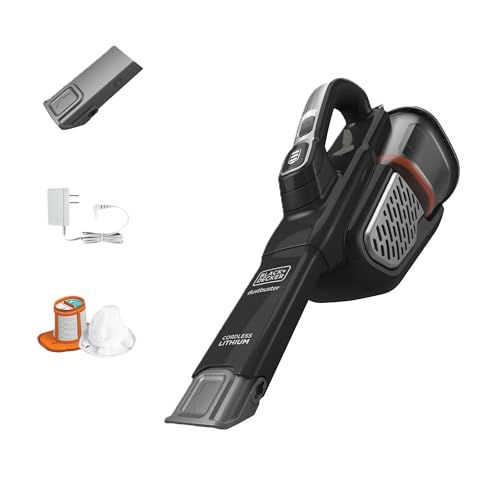
Pros
- Built-in pull-out crevice tool provides extended reach without tracking separate attachments.
- Substantial 750ml collection capacity exceeds the bin size of many comparable compact hand vacuums.
- Lightweight 2.4-pound body makes it easy to carry up stairs and navigate vehicle interiors.
Cons
- Manufacturer specifications do not state the exact battery runtime or charging duration.
- Designed exclusively for dry pickup and is not suitable for liquid spills or wet surfaces.
The BLACK+DECKER dustbuster AdvancedClean+ (model HHVK515J00FF) is a cordless handheld vacuum engineered for quick cleanups around the house, dorm, or car. Weighing 2.4 pounds, this unit is aimed at shoppers seeking an agile, portable cleaner for dry spills rather than assembling a full-sized stick or upright vacuum for small tasks.
According to the manufacturer, the vacuum is driven by a 20V MAX lithium-ion battery that delivers up to 35 air watts of suction power. Cleaning controls feature two operating speeds, giving users the option to switch into a power boost mode for more demanding dry debris. Collected material goes into a 750ml dustbin, providing generous capacity for a hand vacuum and reducing trips to empty debris during quick cleaning tasks.
The physical design highlights convenience with an integrated, extending crevice tool built into the nozzle. This feature pulls forward to address baseboards, sofa seams, and tight car seat gaps without needing clip-on accessories. The unit measures 15.88 inches long, 6.9 inches wide, and 8.05 inches high, sporting an integrated carry handle and an all-black exterior.
Routine operation involves single-button power and speed adjustments. The product documentation specifies the vacuum for dry messes, meaning it should not be exposed to damp debris or standing liquids. While the manufacturer provides suction and dustbin figures, specific battery runtimes per charge, charging times, and filter maintenance schedules are not included in the supplied specifications and should be confirmed via the product manual.
For buyers needing a convenient secondary vacuum for crumbs, tabletop debris, and vehicle interiors, the BLACK+DECKER HHVK515J00FF provides useful suction settings, an integrated detail tool, and high bin capacity. Those looking to vacuum wall-to-wall carpeting, deep-clean upholstery, or handle wet messes should pair it with equipment designed for those heavier cleaning demands.
The BLACK+DECKER HHVK515J00FF features a 750ml dustbin, which offers significant dry debris volume compared to basic small hand vacuums. This extra space helps hold larger dry spills without requiring immediate emptying.
Its extending crevice tool is built directly into the housing, sliding forward when needed to clean corners or vehicle consoles. Weighing 2.4 pounds with dimensions of 15.88 x 6.9 x 8.05 inches, the compact frame supports quick handling and easy storage in standard utility closets or cabinets.

Evaluating Handheld Vacuum Performance and Design Features
Determining what is the best handheld dustbuster requires examining how motor specifications, physical form factors, and airflow designs align with immediate household cleaning needs. A handheld cleaner is not meant to replace a whole-home floor vacuum, but rather to provide rapid suction for localized dry spills, vehicle detailing, and tight corners. Different models deliver vastly different levels of cleaning power depending on their internal battery configurations and motor types. By reviewing how voltage ratings, filtration paths, and physical attachments function, buyers can determine which configuration best addresses their daily cleanup routine.
Motor Power, Voltage Classes, and Suction Ratings
Portable vacuums rely on internal direct-current motors powered by rechargeable battery packs ranging from 8 volts up to 20 volts. An entry-level machine running on an 8-volt or 12-volt platform delivers sufficient airflow for basic kitchen counter debris, dry cereal, and loose dust. Higher-voltage units, such as 16-volt and 20-volt models, generate substantially greater static pressure to extract debris embedded in carpet fibers or car upholstery. Some modern compact vacuums utilize high-speed brushless motors reaching over 100,000 revolutions per minute, which produce elevated suction levels measured in pascals. Matching the voltage class to your intended cleaning surface ensures the machine generates enough velocity to lift dirt without stalling.
Suction measurements for handheld vacuums are often communicated through air watts, motor voltage, or static suction pressure. Air watts represent the actual working power of airflow combined with suction at the nozzle opening, with higher-end cordless units delivering up to 35 air watts of pickup force. Meanwhile, sealed suction ratings expressed in pascals measure pure lifting capacity against resistance, which proves especially relevant when clearing fine grit from car floor mats. Two-speed power settings on advanced models allow users to balance suction strength against battery consumption. Using a lower speed handles routine dusting while reserving the boost mode for stubborn crumbs and pet messes.
Battery Chemistry, Runtime Realities, and Charging Configurations
Modern handheld dustbusters overwhelmingly utilize lithium-ion battery technology, which provides consistent suction power until the cell is fully depleted. Older nickel-cadmium batteries suffered from gradual power drop-offs and memory issues, but lithium cells maintain strong airflow throughout the entire operational cycle. Most portable hand vacuums deliver between 10 and 20 minutes of continuous runtime on a standard charge, with power boost modes reducing that window to approximately 10 to 12 minutes. Because spot cleanups typically take less than three minutes to finish, a 15-minute operating window is usually more than enough for everyday tasks. Users tackling broader spaces may prefer keeping a dedicated tool for spot work while deploying full-sized cordless vacuum cleaners for room-to-room carpet care.
Charging methods and dock designs directly influence how convenient a hand vacuum is to store and keep ready for use. Traditional models often feature wall-mounted charging brackets or tabletop drop-in cradles that keep the unit continuously topped off between jobs. Other compact designs now incorporate standard Type-C charging ports, enabling flexible recharging in vehicles, office workspaces, or via portable power banks. LED battery status lights on the handle help monitor remaining capacity so the unit does not shut down unexpectedly during a chore. Recharging times vary from three to five hours depending on the charger wattage and battery capacity.
Nozzle Geometries, Extension Tools, and Articulation
The shape and physical reach of a handheld nozzle dictate where the machine can clean effectively without awkward hand positioning. Many standard dustbusters incorporate narrow, tapered noses that concentrate incoming airflow into a focused cleaning path. Some models enhance this configuration by adding extendable or pull-out crevice wands that slide directly out from the primary housing. An extra-long crevice tool eliminates the need to bend deeply when retrieving dropped debris between automotive seats or behind heavy living room furniture. Built-in mechanisms prevent losing loose accessories, keeping the necessary tools permanently attached to the vacuum body.
Pivoting and rotating nozzles provide another layer of ergonomic flexibility when cleaning elevated or confined surfaces. A pivoting chassis allows the nozzle to rotate up to 200 degrees, letting users reach atop bookshelves or beneath low shelves while holding the handle comfortably. Rotating slim nozzles turn sideways to slide vertically into narrow gaps between appliances or couch cushions. For situations involving delicate furnishings, integrated flip-up brushes sweep dust loose from lampshades, keyboards, and fabric upholstery. Specialized configurations with flexible four-foot hoses separate the motor weight from the cleaning head entirely, allowing easy two-handed cleaning across vehicle ceilings and stair risers.
Dirt Bowl Capacity, Cyclonic Action, and Hygienic Disposal
Handheld vacuum dustbins range from small 13-ounce bowls up to spacious 750-milliliter containers designed for larger debris volume. A translucent collection bowl allows the operator to observe dirt accumulation immediately and identify when airflow might become restricted. Many manufacturers employ cyclonic action within the chamber, spinning incoming air around the bowl perimeter to separate heavy particles from the central filter element. This spinning separation helps keep dirt away from the filter mesh, prolonging steady suction performance during extended pickups. Choosing a larger bin capacity reduces the frequency of emptying stops, which proves helpful when vacuuming pet bedding or dried leaves in a garage.
The method of emptying accumulated debris affects how clean your hands remain during regular maintenance. Modern units often feature push-button, one-touch release mechanisms that pop open the dust door directly over a wastebasket. Twist-off canisters require manual disassembly to dump dirt, which can create loose dust clouds if emptied too quickly. Models with washable dirt bowls allow users to rinse the plastic vessel under running tap water to remove clingy dust and odors. Maintaining a clean dirt cup ensures that air enters and exits the vacuum chamber without lingering residue interfering with mechanical seals.
Filtration Design, Washable Elements, and Airflow Preservation
Filtration in bagless handheld vacuums protects the high-speed motor from airborne grit while preventing exhausted dust from blowing back into the room. Most units utilize a two-stage system consisting of a rigid plastic or fabric pre-filter basket paired with a fine inner pleated filter. High-end compact models may incorporate washable HEPA filter elements designed to trap microscopic particles, dander, and fine automotive dust. When picking up fine craft particles or powdery drywall residue, fine filters can clog quickly if not inspected regularly. Maintaining clean filter media is the single most critical factor in preserving strong, reliable suction over the lifespan of a hand vac.
Washable filters simplify ongoing maintenance by eliminating the immediate need for disposable replacement parts after every cleanup. Manufacturers typically recommend tapping loose debris off the pleated element into a trash can before rinsing the filter beneath lukewarm tap water. Detergents and harsh chemicals should generally be avoided unless specifically permitted by the manufacturer product manual. The filter must be allowed to air-dry completely for at least 24 hours before reinstallation into the vacuum body. Operating a cordless hand vacuum with a damp filter can damage the electric motor and promote mildew formation inside the sealed housing.
Surface Versatility: From Vehicle Detailing to Pet Care
Handheld vacuums excel across diverse household surfaces because their lightweight frames maneuver easily where full-sized cleaners cannot fit. In automobiles, compact cordless models navigate tight floorwells, seat tracks, door pockets, and dashboard vents with minimal effort. Integrated LED headlights on select units illuminate dark crevices beneath vehicle seats, making hidden crumbs and gravel immediately visible. The inclusion of motorized or rubberized pet hair brushes transforms a standard hand vac into an efficient tool for clearing stubborn fur from upholstered sofas and carpeted stairs. Stiff bristles pull embedded strands free from fabric weaves so the direct airflow path can pull them into the dirt chamber.
Certain versatile models incorporate multi-functional capabilities beyond conventional vacuuming, such as blowing, inflating, and deflating modes. Rear exhaust air ports fitted with specialized nozzles can blow sawdust out of workshop crevices or clear lint from computer keyboards. Small nozzle adapters also allow portable vacuums to inflate camping mattresses, pool floats, or vacuum-pack storage bags during seasonal travel. While primary suction remains the most common use case, having auxiliary blowing features expands the utility of a handheld tool around workshops and vehicles. Evaluating whether you need multi-surface utility or simple crumb pickup helps identify the ideal feature set.
Diagnosing Common Suction Drop and Airflow Bottlenecks
When a cordless hand vacuum exhibits reduced suction power, the root cause is almost always an airflow blockage or saturated filter. Overfilling the dust chamber past the maximum fill line allows debris to compress directly against the intake baffle, choking off incoming air. Hair and string can wrap around the narrow entrance of the crevice nozzle, creating an internal barrier that traps larger particles before they reach the bowl. Removing the dustbin and inspecting the primary intake aperture with a flashlight quickly reveals whether a physical blockage exists. Clearing obstructions with a blunt tool restores natural air movement and relieves strain on the motor.
Battery degradation and improper charging habits can also mimic weak suction symptoms over time. If a vacuum runs for only a few seconds before shutting off, the battery pack may not be holding a full charge, or the charging contacts may be dirty. Cleaning the metallic charging pins on the base and vacuum handle with a dry cloth ensures stable electrical contact during storage. Allowing the battery to cool down after intense use before placing it on the charging dock protects the chemical cells from premature thermal degradation. Following the care instructions outlined in the manufacturer user guide ensures reliable power delivery across years of routine service.
Key Selection Criteria for Handheld Cleaners
Selecting an optimal handheld dustbuster involves balancing physical weight, physical reach, power capacity, and everyday convenience. Ultra-lightweight models weighing around one pound offer effortless portability for desk cleanups and glove compartment storage, though they typically feature smaller dust capacities. Larger units equipped with 20-volt motors and extended crevice tools weigh between two and three pounds, providing greater cleaning stamina for heavy-duty household tasks. Consider where you plan to store the vacuum, whether on a wall mount near the kitchen or tucked away inside a laundry cabinet. Ensuring the charging setup fits your available outlet locations makes daily grab-and-go cleaning seamless.
Noise levels and motor tone represent additional comfort considerations when operating high-speed handheld vacuums in quiet living spaces. High-rpm brushless motors generate a distinct high-pitched whine, while traditional brush motors produce a deeper mechanical hum during operation. Two-speed controls let users run the machine quietly on lower power when performing quick surface dusting around children or pets. Build quality, solid latching mechanisms, and manufacturer warranty terms also reflect the long-term durability of the appliance. Focusing on practical engineering attributes rather than marketing buzzwords ensures you invest in a cordless vacuum that consistently performs when unexpected messes happen.
Final Considerations on Handheld Vacuum Ownership
Owning a capable handheld cleaner simplifies daily household maintenance by turning minor spills into effortless thirty-second cleanups. Rather than dragging out heavy corded equipment for crumbs beneath the dining table, a portable vacuum resolves the mess immediately. Keeping the filter clean, checking the intake path for stray blockages, and storing the machine on its charging base ensures it remains ready for action. By prioritizing dependable motor performance, comfortable ergonomics, and easy disposal over unnecessary novelties, you can select a tool that serves your household reliably. Reviewing your specific cleaning demands, flooring transitions, and vehicle needs will point you directly to the ideal handheld configuration.


Write Your Review
No reviews yet. Be the first to share your experience!