


Tackling dense carpet fibers, embedded pet hair, or heavy dirt often reveals the limits of an ordinary household cleaner. When everyday messes resist standard pickup, many homeowners immediately ask which vacuum cleaner has the strongest suction to ensure their next machine handles heavy-duty tasks without hesitation. However, raw pulling force at the nozzle does not tell the entire story, because true cleaning capability depends heavily on the relationship between sealed suction and working airflow. Exploring options like specialized pet stain vacuums shows that mechanical agitation and specialized attachments frequently matter just as much as pure motor draw.
Suction specifications can also confuse shoppers because manufacturers quote various metrics ranging from electrical wattage and air watts to static water lift and pascals. A compact handheld unit might advertise an impressive pressure rating in pascals, yet a full-sized corded vacuum cleaner typically moves significantly more total air volume across a broad floor nozzle. Understanding how sealed pressure interacts with overall air movement helps you determine which format genuinely delivers the power required for your specific floors. By examining how motor efficiency, sealed filtration pathways, and nozzle dynamics collaborate, you can select equipment that maintains dependable pickup over years of regular use.


Pros
- Extremely lightweight at 1.52 pounds, minimizing wrist fatigue during elevated or vehicle cleaning.
- Dual washable filtration helps prevent fine dust clogs and eliminates the immediate need for replacement filters.
- Flexible extension hose and crevice tools make it easy to reach tight crevices under car seats and along baseboards.
Cons
- Not designed for primary floor cleaning or large-area carpet coverage due to the compact handheld form factor.
- Product documentation does not provide part numbers or verified retail sources for replacement filters.
The Gxzsk Handheld Vacuum is a compact, cordless vacuum cleaner built for localized cleaning tasks in cars, home offices, and living spaces. Weighing 1.52 pounds and measuring 15.4 by 4.25 by 4.1 inches, it is designed for users who need a fast, portable solution for small dry messes rather than a full-size floor vacuum. The cordless handheld design makes it easy to carry outside to a vehicle or maneuver into high corners without wrestling with a power cord or searching for nearby electrical outlets.
According to manufacturer specifications, the vacuum is driven by a high-speed motor delivering up to 15kPa (15,000Pa) of suction power. It is powered by an internal 6000mAh battery that charges in approximately 3 hours using fast-charging technology. The manufacturer lists a maximum runtime of up to 30 minutes on a full charge, supported by an integrated battery indicator light that displays remaining power. Cleaning performance is focused on dry household debris, crumbs, dust, and loose pet hair on upholstery, vehicle floor mats, and desk surfaces.
The unit features a gray and deep blue plastic housing with an easy-to-empty 520mL dust cup. Air filtration relies on a two-tier system: an outer coarse steel mesh screen catches larger debris, while an inner HEPA-rated filter traps finer dust particles. The manufacturer notes that both the steel screen and the HEPA filter are washable and reusable, which helps maintain airflow by reducing clogs. The package includes three auxiliary attachments: a narrow suction nozzle for gaps, a brush attachment to agitate hair and dust on upholstery, and a flexible extension hose to access awkwardly angled areas.
Routine operation and maintenance are straightforward. Setup requires fully charging the internal battery prior to use. Once the 520mL bin fills with debris, it detaches from the motor assembly for quick emptying into a trash can. When suction diminishes, the steel pre-filter and HEPA filter can be rinsed under clean water. The manufacturer emphasizes allowing all filter parts to air dry completely before reinstalling them into the vacuum to avoid damaging the motor or compromising filtration efficiency.
Shoppers should keep in mind that this model is intended strictly for dry spot cleaning and quick touch-ups. Its compact cleaning width and handheld format make it impractical for cleaning expansive carpets or large open hard floors, and it has no documented wet-pickup capability. Additionally, the availability of exact replacement filters is not established in the listing, so buyers should exercise care when washing and handling the included filter. For vehicle owners and homeowners seeking an affordable, lightweight handheld tool for upholstery and crumb cleanup, the Gxzsk cordless vacuum offers convenient attachments and adequate battery duration for small jobs.
The Gxzsk cordless vacuum uses a two-stage filtration system designed to manage dry debris. It incorporates an upgraded coarse steel mesh that traps larger particles before they reach the inner pleated HEPA filter. This design helps minimize suction drop caused by dust buildup on the primary filter element.
Both the steel pre-filter and the HEPA filter can be washed and reused, which reduces the immediate need for disposable replacements. Always ensure that washed filters dry thoroughly before reinstalling them into the vacuum. Emptying the 520mL dust cup frequently helps sustain airflow and ensures reliable performance during spot cleaning.
The vacuum comes with three accessory pieces to assist with varied cleaning scenarios. The slim suction nozzle is tailored for narrow crevices, baseboards, and tight gaps between car seats where focused direct suction is required.
For textiles and vehicle upholstery, the snap-on brush attachment helps dislodge hair and dust clinging to fabric surfaces. A flexible extension hose connects to both nozzles, allowing users to reach around awkward obstructions, vacuum under vehicle pedals, or extend upwards toward elevated corners without tilting the entire vacuum body.

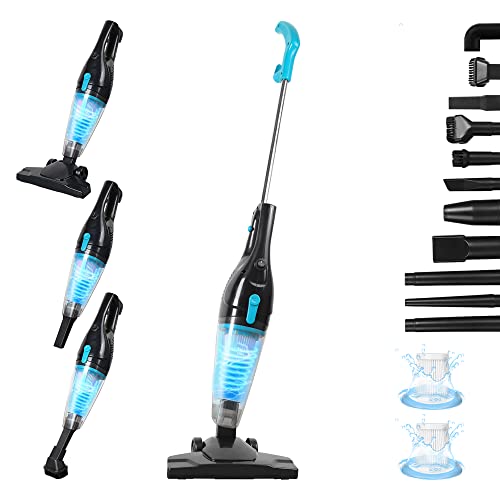
Pros
- Ultralight 3-pound design makes carrying between rooms and cleaning stairs virtually effortless.
- Continuous corded operation provides steady suction without the hassle of recharging batteries.
- Large 0.8L dust bin empties hygienically with a single-button release.
- Includes multiple versatile attachments and two spare washable HEPA filters.
Cons
- The 16.4-foot cord requires frequent outlet changes in larger rooms or open-concept spaces.
- Lacks a motorized spinning brush roll, limiting deep agitation on medium- or high-pile carpets.
- Exclusively built for dry pickup and cannot be used for damp spills or wet cleaning.
The Intercleaner corded vacuum cleaner functions as a versatile multi-configuration stick and handheld vacuum designed primarily for budget-conscious households, apartment dwellers, and dorm residents. Weighing just 3 pounds without its power cord, it bridges the gap between a traditional broom and a portable utility vac. It suits anyone looking to tackle dry daily messes, stray pet fur, and entryway grit without dealing with dead rechargeable batteries or heavy upright machinery.
In everyday use, the unit utilizes a 400W motor that generates a manufacturer-stated 15KPa of suction. This provides dependable pickup for surface debris, crumbs, and loose hair across bare floors like hardwood, tile, and marble, as well as short-pile carpets. Because the floor tool does not employ a motorized bristle roll, it relies on direct suction airflow, which prevents scratches on sensitive hard finishes and stops long pet hair from winding around a roller bar. However, this direct-suction approach also means it cannot agitate or deep-clean plush, thick carpets.
The build quality reflects a functional, lightweight plastic design engineered for quick transitions between tasks. Converting from stick mode to handheld operation is fast, allowing users to attach the dusting brush or crevice tools to detail baseboards, keyboards, windowsills, or vehicle upholstery. A 16.4-foot cord supplies steady wall power, ensuring you never run out of juice mid-room, though it does restrict continuous travel radius compared to longer 25-foot or 30-foot upright cords.
Dust containment and maintenance are practical for a compact vacuum. The 0.8-liter transparent collection cup holds several small cleaning cycles of debris before requiring a trip to the trash bin, where a one-button bottom door allows quick emptying. Air filtration relies on a three-layer setup, and the package conveniently includes two extra washable HEPA filters, which help keep maintenance costs low and air exhaust clean.
Realistic limitations must be kept in mind before buying. The modest 16.4-foot cord will require periodic plug swaps in larger open layouts. Furthermore, the lack of an agitating brush roll restricts effective floor cleaning to hard flooring and low-pile mats, rendering it ineffective for deep carpet grooming. It is also designed strictly for dry debris and should never be used to vacuum water or liquid spills.
For renters, small-home owners, or anyone wanting an inexpensive secondary vacuum for quick kitchen cleanups, pet hair maintenance, and car detailing, the Intercleaner corded vacuum represents practical everyday utility. It delivers reliable corded suction and versatile handheld cleaning without the cost or battery degradation common to cordless stick vacuums.
The Intercleaner stick vacuum utilizes a 3-layer filtration system intended to trap fine dust and airborne particles before exhaust air leaves the motor housing. The package includes two extra washable HEPA filters in addition to the pre-installed setup, providing ready-to-use spares while dirty filters dry.
Maintaining the filtration system requires routinely tapping loose dust out of the pleated filter elements and washing them under lukewarm running water when soil builds up. Filters must be completely air-dried for at least 24 hours before reinstallation to prevent moisture from damaging the motor or reducing suction airflow.
The 0.8-liter bagless dust cup unlatches via a single push-button trapdoor at the bottom, allowing dust and pet hair to fall directly into the trash can without requiring manual contact with the collected debris.
This vacuum is primarily tailored for sealed hard-floor surfaces, including hardwood, marble, ceramic tile, laminate, and vinyl. Its non-motorized floorhead glides smoothly without scratching delicate finishes or flinging lightweight debris across the room.
For carpets, compatibility is limited to short-haired carpet, low-pile floor mats, and flat-weave runners. Because it lacks a rotating bristle bar to beat fibers, it cannot pull deeply embedded grit out of medium-pile rugs or plush carpeting.
Above-floor compatibility is broad due to the convertible handheld chassis. By switching out the wand for the crevice tool or dusting brush, users can clean stair risers, sofa cushions, window blinds, mattresses, car seats, and vehicle floor mats.

The Science of Suction: Measuring and Maximizing Vacuum Cleaning Power
When homeowners investigate which vacuum cleaner has the strongest suction, the most accurate engineering answer points to corded upright and commercial canister models equipped with large AC bypass motors. These machines draw continuous current from a standard wall outlet, allowing them to pull substantial airflow across wide floor nozzles without managing battery heat or runtime constraints. However, raw pulling force at a sealed opening is only one component of a vacuum cleaner’s true pickup capability. Practical cleaning results depend on how well a machine balances sealed static pressure with active airflow, floorhead agitation, and airtight filtration channels.
Understanding Suction Metrics: Pascals, Air Watts, and CFM
Vacuum specifications often display figures that sound impressive but describe completely different physical measurements. Sealed suction is frequently measured in pascals (Pa) or kilopascals (kPa), which quantifies the negative pressure created when the vacuum inlet is entirely blocked. Compact handheld cleaners often advertise ratings between 15 kPa and 25 kPa because their small motors can pull a high vacuum level against a narrow opening. While static pressure reveals how strongly a motor pulls against resistance, it does not measure how much air moves through the system during active cleaning.
Airflow is measured in cubic feet per minute (CFM), representing the actual volume of air traveling through the wand and dust container every sixty seconds. Without high CFM, a vacuum cannot transport heavy grit, cereal, or loose gravel along a long hose and into the collection bin. Full-sized corded machines excel in CFM, frequently moving over 60 to 100 CFM through broad floor nozzles. A machine with exceptional static pressure but low CFM can hold a billiard ball at the nozzle tip, yet it may struggle to clean a broad area of carpet effectively.
Air watts represent a standardized calculation that combines both static pressure and airflow to reflect the actual mechanical output at the cleaning nozzle. Electrical wattage, such as a 400W or 480W motor rating, merely reflects how much electricity the motor consumes rather than how efficiently it converts that current into suction. A poorly sealed housing or inefficient fan impeller can waste substantial electrical energy as heat without generating meaningful pickup. Focusing on air watts or verified airflow metrics provides a far more reliable indicator of suction efficiency than electrical wattage alone.
Corded vs. Cordless Power: How Power Delivery Dictates Pulling Force
The fundamental difference between corded and battery-powered vacuums lies in their energy supply and thermal management. A corded stick or upright vacuum draws uninterrupted power from household wiring, permitting the motor to spin continuously at maximum output without fear of depleting a battery pack. Models equipped with power cords spanning 16 feet or more provide stable, unthrottled suction across an entire cleaning session. Because these motors do not require battery monitoring circuits to prevent cell degradation, their internal fans can generate strong, dependable airflow from start to finish.
Cordless vacuums rely on rechargeable lithium-ion battery packs that operate under strict thermal and electrical constraints. High-drain brushless motors can deliver remarkable short bursts of suction in boost mode, but running at peak output rapidly drains battery cells and creates significant heat. Most cordless stick vacuums provide their advertised runtime, such as 40 to 45 minutes, only when operating in lower-power economy modes. To preserve battery longevity and manage internal temperatures, electronic controllers often step down motor speed, meaning maximum suction is typically reserved for brief, stubborn spot cleanups.
Battery voltage also influences motor performance over the course of an operating cycle. As a 2600mAh or 6000mAh battery pack discharges, cell voltage naturally declines, which can alter motor speed unless advanced voltage regulation circuitry is present. Premium digital displays often help users track remaining charge percentages in real time so they can gauge available cleaning power. For households needing sustained, intense suction across multiple carpeted rooms, corded designs continue to offer superior continuous performance without runtime limits.
Handheld and Compact Vacuums: High Static Pressure vs. Airflow Volume
Many portable car vacuums and mini cleaners boast ratings up to 25000Pa, leading shoppers to wonder how such small devices compare to larger household equipment. These compact handheld units achieve high static pressure because their miniature brushless motors vent through narrow, focused nozzles. When placed directly against vehicle upholstery, crevice corners, or tight seams, that concentrated pull lifts crumbs and surface dust efficiently. However, this concentrated static force cannot replace the broad air volume required to lift dirt across an expansive living room floor.
Handheld cleaners serve a specialized function in everyday household maintenance, excelling where maneuverability and quick access matter most. Utilizing lightweight handheld vacuums for kitchen messes allows you to address localized spills, drawer debris, and breadcrumbs without retrieving a bulky upright machine. Integrated utility features like built-in blowing ports, inflation attachments, or one-touch dust dumping add everyday versatility to these portable units. Recognizing that high static pressure serves localized spot cleaning prevents unrealistic expectations regarding whole-home vacuuming.
Floorhead Architecture: Why Nozzle Seal and Brush Rolls Matter
Even a vacuum with outstanding motor suction will perform poorly if its cleaning head fails to establish a proper seal against the floor. A floor nozzle that allows air to leak through loose edge seals loses its ability to lift dirt out of crevices and floorboard cracks. Well-engineered vacuum heads incorporate flexible rubber squeegee blades, floating baseplates, and perimeter gaskets to direct all available airflow beneath the intake opening. When the nozzle seals correctly against the surface, every cubic foot of moving air pulls directly on loose dust.
Deep carpet cleaning requires more than strong suction alone, because dense synthetic and wool fibers physically trap soil particles. Motorized brush rolls featuring V-shaped bristle patterns and anti-tangle ridges mechanically beat carpet piles, dislodging embedded grit so the vacuum’s airflow can sweep it away. Without mechanical agitation, even extreme suction will simply compress the carpet pile without drawing up dirt buried near the backing. When dry vacuuming and brush agitation reach their limits on deeply soiled fibers, utilizing a carpet extractor for deep cleaning provides the liquid extraction necessary to lift stubborn grime.
Cleaning hard floors presents the opposite challenge, where excessive suction and stiff bristles can cause problems rather than improve pickup. High-velocity suction can occasionally push lightweight debris across smooth surfaces or scratch delicate hardwood finishes if stiff bristles make direct contact. Modern multi-surface cleaners often feature softer roller bars, integrated green LED headlights to illuminate micro-dust, and adjustable suction controls. Lowering suction slightly on hard floors prevents the floorhead from sticking to the surface while maintaining adequate airflow to gather loose particles.
Filtration Systems and Airflow Resistance
Every filtration layer inside a vacuum cleaner introduces aerodynamic resistance that the motor must overcome. Multi-stage filtration systems typically combine coarse steel mesh, cyclonic separation chambers, pre-motor foam pads, and fine HEPA exhaust media to capture dust before exhausting air. While dense filtration media ensures that 99.97% of fine particles remain trapped inside the machine, it also restricts airflow if the filter pores become saturated. Maintaining a clean filtration path is therefore the single most critical factor in sustaining maximum suction throughout the machine’s lifespan.
Most modern bagless stick and handheld vacuums include washable, reusable HEPA filters that help preserve long-term suction when serviced regularly. Rinsing a filter with cool water removes fine drywall dust, pet dander, and soot that gradually clog porous media. It is vital to let washed filters air dry completely for at least 24 hours before reinstalling them into the vacuum housing. Inserting a damp filter can choke airflow, promote mold growth inside the dust bin, and potentially cause catastrophic motor moisture damage.
Diagnosing and Restoring Lost Suction
When a vacuum cleaner suddenly loses pulling power, users frequently assume the motor is failing, but physical blockages are almost always the cause. Pet hair, thread, and large debris can accumulate at the narrow bend where the floorhead connects to the extension wand. Similarly, clogs can lodge midway through flexible hoses, choking off air passage and causing the motor pitch to rise as it strains against the blockage. Checking each separate component of the air pathway by looking through detached wands quickly isolates where the restriction is located.
Dust cup capacity also directly influences working suction in bagless vacuum configurations. As high-capacity containers, such as 0.5-liter or 0.8-liter dust cups, fill beyond their maximum fill lines, cyclonic air separation breaks down. Fine dust swirls into the upper filter shroud rather than settling at the bottom, rapidly suffocating airflow through the motor. Emptying the dust cup frequently and wiping down rubber sealing gaskets ensures that air seals remain airtight and internal cyclonic velocity remains optimal.
Hair tightly wound around the brush roll bearings creates mechanical drag that slows rotation and hampers dirt pickup. Modern anti-winding brush designs help reduce hair tangling, but occasional inspection remains necessary in households with long-haired pets. Removing the roller from the floorhead housing lets you cut away threads and clear debris from the drive belt sprockets. Regular mechanical clearing prevents the drive motor from overheating and preserves efficient debris transfer directly into the suction channel.
Matching Suction Power to Specific Household Cleaning Tasks
Having extreme suction is not always an advantage, which is why premium vacuums feature multiple power settings or relief valves. Operating at maximum suction on lightweight area rugs or delicate window curtains can pull the fabric directly into the nozzle, stalling the motor and risking fabric damage. Three-stage suction selectors, digital touchscreen controls, and variable motor speeds allow you to tune pulling force to the task at hand. Selecting moderate suction allows floorheads to glide smoothly over dense carpets while preserving enough velocity to capture loose dust.
Suction equipment also extends into specialized personal care niches that operate on entirely different mechanical principles. For example, specialized ear suction tools utilize micro-vacuum motors designed to generate gentle, low-decibel suction between 20 and 30 decibels. These devices use soft silicone tips and multiple low-pressure settings to clear wax without subjecting sensitive eardrums to aggressive pulling force. Recognizing that suction tools are engineered for specific bodily or household applications ensures you select the right mechanical parameters for each unique task.
Practical Takeaways for Long-Term Suction Performance
Determining which cleaner delivers the strongest suction ultimately requires balancing your household flooring, room sizes, and cleaning habits against manufacturer claims. While corded upright and canister units provide the highest continuous airflow and deep-cleaning force, cordless stick vacuums offer unmatched convenience for daily maintenance. Portable handheld units deliver concentrated static pressure ideal for vehicle interiors and quick kitchen touchups. Maintaining clean filters, clearing blockages promptly, and selecting the proper floorhead settings ensures that whichever vacuum you choose continues to provide optimal cleaning power for years to come.


Write Your Review
No reviews yet. Be the first to share your experience!