


Navigating Low-Light Spaces with Intelligent Floor Cleaning
Dust bunnies and scattered pet hair often collect under low beds, behind dark couches, and in dimly lit hallways where standard optical robotic cleaners tend to stumble. Upgrading to the best robot vacuums with light sensors and integrated LiDAR technology allows automated units to map layouts accurately without relying on bright ambient lighting. Modern homes with varied floor surfaces demand reliable navigation so cleaners do not stall against stray shoes or wander off course after sunset. Many floor-care shoppers also seek convenience through compatible self-emptying robot vacuums that reduce hands-on dustbin maintenance.
To help you evaluate these automated machines, this guide compares models by analyzing manufacturer specifications, published suction metrics, navigation hardware, and listed bin capacities. Some units combine suction ratings reaching up to 15,000 Pa with dedicated mopping pads, while specialized fabric units target mattress dust using UV-C light sensors. Understanding trade-offs between bagless docking stations and allergen-sealed bags helps ensure you select a design tailored to your household layout. Every option highlighted below reflects verified technical details and stated feature sets rather than unverified lab testing.


Pros
- Bagless self-emptying base avoids the recurring cost of proprietary disposal bags
- True HEPA dock filtration captures fine dust, dander, and allergens down to 0.3 microns
- 360-degree LiDAR navigation operates reliably in both daylight and dark rooms
- Matrix Clean multi-pass pattern delivers thorough coverage on high-traffic floor areas
- Up to 120-minute runtime with automated Recharge and Resume for whole-home coverage
Cons
- Bagless canister dumping can disperse airborne dust if emptied quickly indoors
- Operates as a dry-only robot vacuum without wet mopping or liquid scrubbing features
- At 4.1 inches tall, the top LiDAR dome may restrict clearance under low couches or cabinets
The Shark AV2501S AI Ultra Robot Vacuum is an automated dry-floor cleaner designed for busy households, active pet owners, and multi-surface homes requiring hands-off daily maintenance. Equipped with a self-emptying base that stores debris for up to 30 days, this model addresses the common chore of constantly dumping miniature on-board robot bins. For homeowners with shedding pets or high-traffic entryways, having an automated machine that docks and self-clears debris brings meaningful convenience to standard cleaning routines.
Under the hood, Shark utilizes a multi-surface cleaning system engineered to pick up dirt and debris across all floor types. Rather than relying on a single straight-line pass, the manufacturer integrates Matrix Clean Navigation, which commands the robot to vacuum in a precise grid pattern, passing over messes multiple times. Coupled with Shark suction and a self-cleaning brushroll designed to actively shed pet hair, the vacuum is configured to manage fine dust, dander, and tracked-in grit without requiring immediate manual intervention after every run.
A primary highlight of this system is the bagless, self-emptying base station. Unlike competing designs that rely on recurring purchases of disposable dock bags, this station uses an easy-dump collection bin paired with true HEPA filtration. Shark claims the base filter captures and seals 99.97% of dust and allergens down to 0.3 microns, which makes it particularly attractive for allergy-conscious households. Measuring 13.7 inches wide by 4.1 inches tall and weighing 14.42 pounds as a total package, the hardware feels solid, though the 4.1-inch clearance requires some planning around low couches and bed frames.
Day-to-day operation is coordinated by 360-degree LiDAR vision, which quickly maps the home and navigates around everyday obstacles in bright daylight or total darkness. Through Wi-Fi pairing with Amazon Alexa or Google Assistant, users can initiate on-demand sessions or schedule daily cycles. The onboard battery supports up to 120 minutes of runtime, and when the battery depletes mid-cycle, the Recharge and Resume protocol sends the unit back to the dock before returning to complete the unfinished zones. Maintenance involves periodically washing the bagless canister, checking the side brushes, and servicing the washable base filters.
While the automated emptying dock saves considerable time, the bagless mechanism means dumping the collection canister can occasionally disperse a small puff of dust, which might bother sensitive users. In addition, this model is purely a dry robot vacuum; it does not support wet mopping, liquid extraction, or scrubbing. Homeowners with exceptionally low furniture should also verify vertical clearance, as the top-mounted LiDAR dome increases total robot height compared to non-mapping or camera-only alternatives.
For households seeking reliable automated vacuuming without ongoing consumable bag costs, the Shark AV2501S AI Ultra represents a strong balance of navigation intelligence and debris management. Its combination of methodical matrix grid cleaning, pet-hair-focused brush design, and HEPA-filtered self-emptying makes it a dependable choice for keeping both carpet and hard floors consistently tidy between deeper cleaning sessions.
The Shark AV2501S utilizes 360-degree LiDAR vision to scan and map floor plans accurately upon its initial cleaning runs. Because LiDAR relies on light detection and ranging rather than optical cameras, the vacuum navigates effectively in both well-lit rooms and total darkness without losing its spatial coordinates.
In addition to basic pathing, Shark equips this model with Matrix Clean Navigation. Instead of a single back-and-forth track, the robot can execute overlapping passes in a grid pattern. This methodical coverage helps ensure that high-traffic corridors, entryways, and pet resting zones receive focused vacuum agitation rather than quick, single sweeps.
Pet hair management is a core design focus for the Shark AI Ultra system. The robot features a self-cleaning brushroll engineered to clear hair wrap during operation, minimizing the chore of cutting tangled pet fur off the roller bar between cleaning cycles.
Complementing the brushroll is the self-empty base station equipped with true HEPA filtration. The manufacturer states that this filtration setup captures 99.97% of dust and allergens down to 0.3 microns, trapping fine dander and tracked-in outdoor particles inside the sealed dock rather than recirculating them into living spaces.

Pros
- Brushless, tangle-free suction design eliminates hair wrapping and reduces maintenance for pet owners
- Impressive manufacturer-stated 5200Pa suction across three adjustable power settings
- Slim 2.99-inch height fits easily under low coffee tables, dressers, and couches
- Smart control options include companion smartphone app scheduling plus Alexa and Google Assistant voice commands
- Four-stage electronic water control allows tailored mopping moisture on hard floors
Cons
- Not suitable for medium- or high-pile carpeting; performance is restricted to hard floors, wood, and low-pile rugs
- Relies on bump-and-sensor navigation rather than advanced LiDAR room mapping or designated virtual no-go zones
- Specific dust bin and water tank capacities are not listed in fluid or volume metrics by the manufacturer
The ROPVACNIC Robot Vacuum and Mop Combo (Model S1) is an automated 2-in-1 floor-care machine designed for routine multi-surface upkeep in busy American households. Engineered primarily for apartment dwellers, pet owners, and homeowners managing wood and hard surfaces alongside low-pile rugs, this unit tackles everyday dust, pet shedding, and minor floor spots without requiring manual push-vacuuming. Its combination of wet mopping and vacuuming makes it an appealing option for budget-conscious buyers seeking an entry-level robotic helper for daily maintenance.
In real-world cleaning situations, this robot addresses daily debris using a 3-point cleaning system and a manufacturer-rated 5200Pa of suction across three selectable power stages. Instead of relying on a traditional bristled roller, the machine uses a direct, no-entanglement suction inlet flanked by dual rotating electric side brushes. This direct-suction approach is specifically intended to channel dog and cat hair, crumbs, and tracked-in grit directly into the suction path without wrapping around an agitator bar. Simultaneously, the electronically controlled water tank offers a four-stage personalized water adjustment system, allowing users to dial in light dampness for dust removal or slightly heavier moisture for minor sticky spots on wood and tile-like hard surfaces.
From a structural standpoint, the robot features a remarkably low-profile build measuring 12 by 12 inches with a height of only 2.99 inches, weighing approximately 7.28 pounds in a light black housing. This compact chassis allows it to clear low-hanging furniture, including bed frames, sideboards, and living room couches, where dust bunnies and pet fur often accumulate out of reach. The underside houses dual motorized side brushes designed to reach along baseboards, while the mopping plate attaches smoothly to the base. It comes paired with a compact charging dock to which the robot autonomously returns whenever cleaning concludes or battery replenishment is needed.
Setting up the unit is straightforward, involving app pairing for smartphone scheduling and connecting to voice platforms such as Amazon Alexa or Google Assistant. Maintenance is noticeably lower on the vacuuming side because the absence of a brush roll eliminates the tedious task of cutting away wound-up pet hair with scissors. Users simply empty the internal dry debris container, wipe the drop and bumper sensors periodically, and clear occasional threads from the twin side sweepers. When utilizing the mopping function, routine maintenance involves filling the onboard water reservoir with clean tap water, dampening and securing the mop pad, and washing the cloth pad thoroughly after each cleaning run to avoid stale odors.
Despite its practical advantages, this model has natural operational boundaries. Because it relies on high-coverage sensor algorithms and directional obstacle detection rather than overhead laser LiDAR or optical camera mapping, it cleans in semi-random or reactive patterns and lacks customized virtual boundary lines or selective room targeting. Furthermore, surface compatibility is strictly limited to wood, hard floors, and low-pile carpets; it is not suited for medium- or high-pile carpeting, shag rugs, or unlevel thresholds. The lack of an auto-lifting mop plate also means users should remove the mopping bracket before sending the machine across area rugs to prevent wetting carpet fibers.
For homeowners, renters, and pet owners looking for a budget-friendly automated floor cleaner that tackles daily pet hair without brush-roll tangles, the ROPVACNIC Robot S1 offers reliable utility. While it does not replace a heavy-duty upright extractor or a laser-guided premium robot for deep restorative carpet cleaning, its solid 5200Pa suction rating, slim clearance, and adjustable electronic mopping deliver sensible, hands-free cleanliness across daily hard-surface living areas.
The ROPVACNIC S1 addresses pet hair challenges through a specialized roller-free suction opening rather than a standard spinning brush roll. Traditional vacuum agitator bars tend to collect tightly bound fur, requiring frequent manual intervention and cutting. By pairing a direct suction throat with dual rotating electric side brushes, this cleaner channels stray hairs, dander, and food crumbs straight toward the collection bin, minimizing maintenance hassles for dog and cat households.
Backed by a manufacturer-rated 5200Pa suction profile across three adjustable levels, the unit supplies substantial lift for hard floors, wood surfaces, and low-pile area rugs. Users can select higher suction stages for high-traffic entryways or pet resting zones, ensuring small debris and dry spills are swept clean from perimeter baseboards and tight floor corners.
Equipped with a 2-in-1 mopping module, the ROPVACNIC Robot S1 actively manages floor hydration via an electronically controlled high-capacity water reservoir. Unlike passive gravity-fed drip mops, the electronic system features four personalized water-flow adjustment stages. This granular control allows users to match moisture dispersion to their specific hard-floor conditions, avoiding puddling on sealed wood while delivering sufficient wetness to lift fresh footprints and light dirt.
To maintain optimal results on hard surfaces, the mopping pad should be laundered after every cleaning session, and water should be emptied between cycles. Because the vacuum does not automatically detect carpets to lift its mop plate, damp mopping is best restricted to entirely hard-surface areas like kitchens, hallways, and living rooms with wood flooring.


Frequently Asked Questions
How do light sensors and LiDAR navigation help robot vacuums clean in the dark?
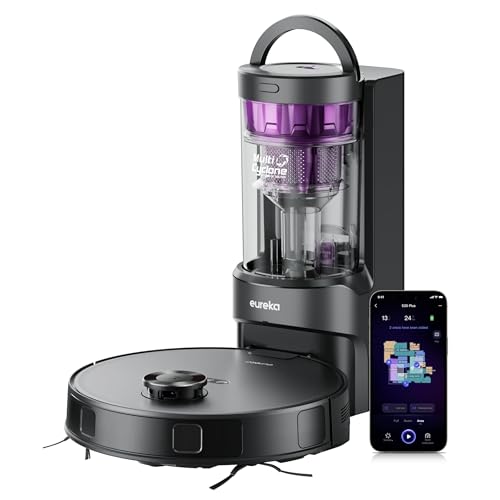
Light sensors and LiDAR modules emit their own laser signals, enabling the vacuum to calculate room dimensions without overhead lighting. Stated specifications for models like the Eureka E20 Plus and Roomba 115X confirm dual LiDAR maps rooms accurately day or night. This prevents the robot from getting lost under furniture or in dark hallways. Optical camera vacuums, by contrast, frequently struggle when ambient room lighting drops.
Can robot vacuums with light sensors transition smoothly onto carpets and rugs?
Most robot vacuums equipped with floor sensors detect surface changes, though navigation depends on carpet thickness. The Eureka E20 Plus features an auto-lifting mop that elevates 10mm when carpets are detected. For homes with plush rugs, exploring specialized robot vacuums for high pile carpets ensures adequate clearance without stalling. Standard optical cliff sensors also prevent units from tumbling down open stairs.
What is the difference between a bagless self-emptying base and a bagged dock?
Bagless docks collect debris into an emptyable canister without recurring bag costs, whereas bagged docks seal debris in disposable allergen bags. For example, the Shark AV2501S utilizes a bagless canister holding 30 days of debris. The Roomba 115X dock uses an AllergenLock bag holding 90 days of debris, avoiding dust plumes during emptying. Buyers must weigh recurring bag costs against the dust cloud potential when dumping a bagless bin manually.
How does UV-C light sanitation function on automated vacuums?
Built-in UV-C light targets fine particles on fabrics while safety sensors shut the light off if lifted. On the CREATULIZE X1 mattress vacuum, a 270nm UV-C light pairs with high-frequency beating to dislodge hidden matter. Safety sensors shut off the light if lifted for over 0.2 seconds to protect user vision. This specialized design supports mattresses, sofas, and bedding rather than standard hard flooring.
How should pet owners maintain anti-tangle brush rolls on robot vacuums?
Regular inspection of brush rolls and side sweepers prevents long pet hair from binding around motor bearings. Many modern robots use rubberized or V-shaped anti-tangle rollers, such as the Eureka E20 Plus. Periodically unlatching the roller cover allows you to clear stray strands caught on the roller ends. Keeping the optical cliff and pathing sensors clear of pet dander also ensures consistent room navigation.




Write Your Review
No reviews yet. Be the first to share your experience!