


Eliminating Daily Floor Chores Without the Cost of Disposal Bags
Managing pet hair and tracked-in grit across bare floors and rugs quickly turns into a daily chore when a robot bin fills up mid-cycle. Traditional auto-empty docks solve that hassle but introduce an ongoing expense for proprietary replacement bags. Investing in the best robot vacuum with bagless self empty station eliminates those recurring supply purchases while offering weeks of hands-free dirt collection. Many popular self emptying robot vacuums rely on sealed bags, yet bagless bases allow you to dump the canister directly into the trash with a single latch.
This review evaluates leading models by comparing manufacturer specifications, published suction power ratings, navigation hardware, and overall dust cup capacities. Some designs feature dual LiDAR mapping and specialized roller designs, while others pair vacuuming with an auto-lifting mop pad for mixed surfaces. If your home has thick rugs, pairing strong suction with suitable agitation matters just as much as navigating around furniture, similar to considerations for robot vacuums for high pile carpets. Reviewing these verified features helps you match the right machine to your layout without unexpected maintenance costs.


Pros
- Bagless self-emptying base avoids the recurring cost of proprietary disposal bags
- True HEPA dock filtration captures fine dust, dander, and allergens down to 0.3 microns
- 360-degree LiDAR navigation operates reliably in both daylight and dark rooms
- Matrix Clean multi-pass pattern delivers thorough coverage on high-traffic floor areas
- Up to 120-minute runtime with automated Recharge and Resume for whole-home coverage
Cons
- Bagless canister dumping can disperse airborne dust if emptied quickly indoors
- Operates as a dry-only robot vacuum without wet mopping or liquid scrubbing features
- At 4.1 inches tall, the top LiDAR dome may restrict clearance under low couches or cabinets
The Shark AV2501S AI Ultra Robot Vacuum is an automated dry-floor cleaner designed for busy households, active pet owners, and multi-surface homes requiring hands-off daily maintenance. Equipped with a self-emptying base that stores debris for up to 30 days, this model addresses the common chore of constantly dumping miniature on-board robot bins. For homeowners with shedding pets or high-traffic entryways, having an automated machine that docks and self-clears debris brings meaningful convenience to standard cleaning routines.
Under the hood, Shark utilizes a multi-surface cleaning system engineered to pick up dirt and debris across all floor types. Rather than relying on a single straight-line pass, the manufacturer integrates Matrix Clean Navigation, which commands the robot to vacuum in a precise grid pattern, passing over messes multiple times. Coupled with Shark suction and a self-cleaning brushroll designed to actively shed pet hair, the vacuum is configured to manage fine dust, dander, and tracked-in grit without requiring immediate manual intervention after every run.
A primary highlight of this system is the bagless, self-emptying base station. Unlike competing designs that rely on recurring purchases of disposable dock bags, this station uses an easy-dump collection bin paired with true HEPA filtration. Shark claims the base filter captures and seals 99.97% of dust and allergens down to 0.3 microns, which makes it particularly attractive for allergy-conscious households. Measuring 13.7 inches wide by 4.1 inches tall and weighing 14.42 pounds as a total package, the hardware feels solid, though the 4.1-inch clearance requires some planning around low couches and bed frames.
Day-to-day operation is coordinated by 360-degree LiDAR vision, which quickly maps the home and navigates around everyday obstacles in bright daylight or total darkness. Through Wi-Fi pairing with Amazon Alexa or Google Assistant, users can initiate on-demand sessions or schedule daily cycles. The onboard battery supports up to 120 minutes of runtime, and when the battery depletes mid-cycle, the Recharge and Resume protocol sends the unit back to the dock before returning to complete the unfinished zones. Maintenance involves periodically washing the bagless canister, checking the side brushes, and servicing the washable base filters.
While the automated emptying dock saves considerable time, the bagless mechanism means dumping the collection canister can occasionally disperse a small puff of dust, which might bother sensitive users. In addition, this model is purely a dry robot vacuum; it does not support wet mopping, liquid extraction, or scrubbing. Homeowners with exceptionally low furniture should also verify vertical clearance, as the top-mounted LiDAR dome increases total robot height compared to non-mapping or camera-only alternatives.
For households seeking reliable automated vacuuming without ongoing consumable bag costs, the Shark AV2501S AI Ultra represents a strong balance of navigation intelligence and debris management. Its combination of methodical matrix grid cleaning, pet-hair-focused brush design, and HEPA-filtered self-emptying makes it a dependable choice for keeping both carpet and hard floors consistently tidy between deeper cleaning sessions.
The Shark AV2501S utilizes 360-degree LiDAR vision to scan and map floor plans accurately upon its initial cleaning runs. Because LiDAR relies on light detection and ranging rather than optical cameras, the vacuum navigates effectively in both well-lit rooms and total darkness without losing its spatial coordinates.
In addition to basic pathing, Shark equips this model with Matrix Clean Navigation. Instead of a single back-and-forth track, the robot can execute overlapping passes in a grid pattern. This methodical coverage helps ensure that high-traffic corridors, entryways, and pet resting zones receive focused vacuum agitation rather than quick, single sweeps.
Pet hair management is a core design focus for the Shark AI Ultra system. The robot features a self-cleaning brushroll engineered to clear hair wrap during operation, minimizing the chore of cutting tangled pet fur off the roller bar between cleaning cycles.
Complementing the brushroll is the self-empty base station equipped with true HEPA filtration. The manufacturer states that this filtration setup captures 99.97% of dust and allergens down to 0.3 microns, trapping fine dander and tracked-in outdoor particles inside the sealed dock rather than recirculating them into living spaces.


Frequently Asked Questions
How does a bagless self-emptying base work on a robot vacuum?
A bagless self-emptying dock uses an internal motor to pull debris directly from the robot dustbin into a transparent base canister. When the robot docks after a cycle, high-velocity air evacuation transfers hair, dust, and crumbs through a sealed channel. You then detach the canister and press a release button to empty it into the trash without buying replacement bags.
How often does a bagless base need to be emptied?
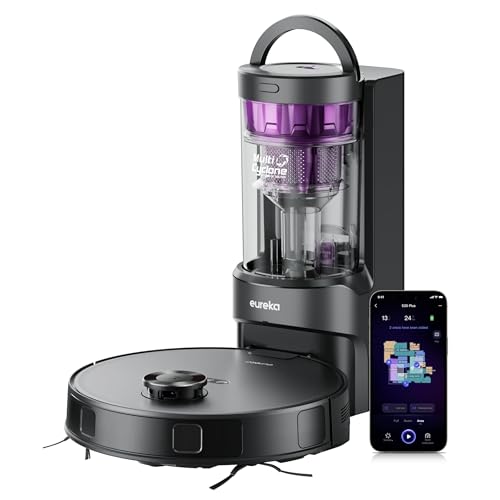
Most bagless docks require manual dumping every 30 to 60 days depending on canister volume and debris buildup. For instance, Shark and Eureka models list holding capacities ranging from 30 to 60 days for normal household dust. Homes with multiple shedding pets may fill the canister faster, making occasional visual checks through the clear bin helpful.
Are bagless self-empty docks effective for pet hair?
Bagless docks handle pet hair effectively when paired with an anti-tangle brushroll and sufficient evacuation suction. Models like the Eureka E20 Plus and Shark Navigator use engineered brushrolls to minimize hair wrap before dirt reaches the dock. Emptying the canister close to the bottom of a wastebasket prevents loose hair from drifting back into the room.
Do bagless robot docks include HEPA filtration?
Certain models include certified HEPA filtration within their bagless stations, though filtration systems vary by model. The Shark AV2501S explicitly features true HEPA filtration that traps 99.97% of dust and allergens down to 0.3 microns. Checking manufacturer specifications ensures you select a dock with the filtration standard your household requires.
Can a robot vacuum replace a traditional upright vacuum?
A robot vacuum manages daily maintenance, but it generally complements rather than replaces an upright vacuum for deep cleaning. Autonomous units handle daily debris across main floors, while stairs and dense carpets benefit from a manual vacuum like the Shark Navigator Lift Away Speed vacuum. Pairing both tools provides regular floor upkeep alongside targeted deep cleaning power.




Write Your Review
No reviews yet. Be the first to share your experience!