


Managing Cat Litter Scatter and Floor Care Needs
Cat owners know how quickly stray granules migrate from the pan to surrounding baseboards and rugs. Tracking cat litter across tile or hardwood creates constant grit underfoot, while litter dust can settle into floor seams. Selecting the best robot vacuum for litter box area maintenance requires balancing strong suction, effective edge sweeps, and tangle-resistant brush systems. Based on manufacturer specifications and product details, specialized automated floor cleaners and companion tools aim to tackle this daily scatter without requiring constant manual sweeping. If your home also features thick rugs nearby, assessing options like the best robot vacuums for high pile carpets can help clarify floor transitions.
Standard dry vacuums handle loose clay, silica, or plant-based pellets, but navigation around pet stations presents unique hurdles. Robot cleaners must carefully skirt food bowls, litter mats, and bulky automatic boxes using infrared or optical sensors. Devices with brushless suction ports or rubber rollers minimize maintenance by avoiding tangled fur, whereas combination vacuum-mop units require designated no-mop boundaries so wet pads never drag across dry clay scatter. To streamline daily floor care, comparing listed suction ratings, runtimes, and debris bin volumes allows you to align automated cleaning with your household layout. For even greater convenience, many pet parents evaluate best self emptying robot vacuums to reduce frequent dustbin maintenance.
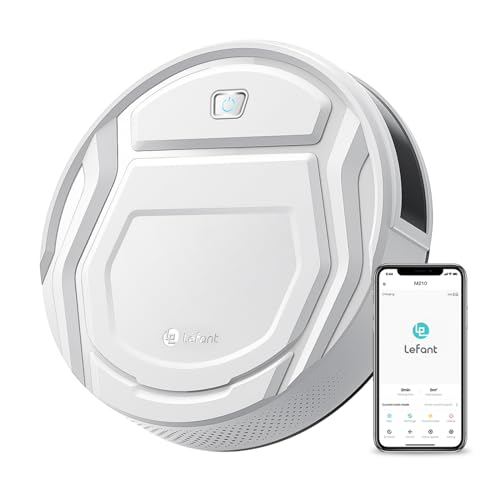
Pros
- Brushless suction port prevents pet hair tangles, reducing maintenance headaches
- Compact 2.99-inch low-profile body easily navigates underneath low-clearance furniture
- Lithium iron phosphate battery provides up to 120 minutes of runtime in low suction mode
- Smart control flexibility with the companion Lefant App plus Alexa and Google Assistant voice integration
- Equipped with 6D anti-collision infrared sensors to help detect obstacles and prevent jamming
Cons
- Lacks a motorized roller brush, which limits deep agitation on medium and high-pile carpets
- Manufacturer explicitly advises against using the zigzag cleaning mode on carpet
- Maximum 120-minute battery life applies specifically to the low suction running mode
The Lefant M210 is an entry-level robotic vacuum designed primarily for routine dry debris removal across hard floors and low-profile living areas. Standing out with its compact frame and roller-free pickup design, this cleaner is well-suited for pet owners, apartment dwellers, and busy households looking for automated daily maintenance without the chore of untangling hair from a traditional motorized brush roll.
Floor cleaning is handled through a brushless suction port paired with a digital motor. Because there is no rotating brush roll underneath, pet hair, dirt, and dust travel straight into the collection bin, significantly lowering hair wrap issues. The cleaner supports six distinct operating modes, including zigzag, random, spot, edge, scheduled timed cleaning, and manual control via the Lefant App. While the unit handles daily debris on hard surfaces effectively, the manufacturer explicitly notes that zigzag mode should not be used on carpets, making it primarily a hard-floor specialist with light area-rug utility.
Measuring approximately 11 inches in diameter and 2.99 inches in height, the Lefant M210 features a notably slim build that allows it to glide under low-clearance bed frames, couches, and entertainment centers where upright vacuums cannot reach. Navigation is guided by upgraded FreeMove Technology 3.0, which utilizes 6D built-in anti-collision infrared sensors to detect potential trapping points and adjust travel paths before the vacuum becomes wedged.
Daily operation and scheduling are managed through Wi-Fi pairing with the dedicated Lefant App, which also lets users adjust suction levels, direct manual movement, and integrate voice commands through Amazon Alexa or Google Assistant. Power is supplied by a lithium iron phosphate battery that delivers up to 120 minutes of runtime when operated in low suction mode. When cleaning cycles end or battery power dwindles, the vacuum automatically returns to its base for self-charging. Routine maintenance centers on sliding out and emptying the internal dustbin and keeping sensor windows clean.
Buyers should be aware of practical operational boundaries before purchasing. Because this model relies exclusively on pure suction without brush-roll bristles, it will not provide deep mechanical agitation on thick carpets or dense area rugs. In addition, reaching the full 120-minute battery benchmark requires operating in low suction mode, meaning higher power settings will yield shorter run times.
For pet owners and households with primarily hard floors seeking an affordable, low-profile robotic vacuum that reduces hair-clearing maintenance, the Lefant M210 offers dependable practical value. Its balance of smart scheduling, voice compatibility, and anti-tangle suction makes it an appealing everyday helper for keeping dust bunnies and shed fur under control.
The key feature of the Lefant M210 for pet households is its brushless suction inlet. Traditional robot vacuums rely on bristle or rubber roller brushes that inevitably collect tangled pet hair, requiring scissors or specialized tools to cut free after every cleaning session. By eliminating the roller brush entirely, this robot pulls loose fur, whiskers, and dander straight into the dustbin.
This brushless layout makes the machine especially effective along hard surfaces such as tile, vinyl, and sealed wood floors where pet hair floats and gathers in room corners. However, without rotating bristles to agitate carpet fibers, pet owners with deep carpet piles should view this vacuum as a hard-floor surface maintainer rather than a deep carpet extractor.
Setup and daily controls run through the companion Lefant App, which allows users to schedule automated floor cleaning, switch power modes, and guide the cleaner manually. Compatibility with Amazon Alexa and Google Assistant adds hands-free voice convenience for starting or stopping cycles.
To navigate living spaces without constant manual rescue, the cleaner relies on FreeMove Technology 3.0. A series of 6D anti-collision infrared sensors monitor the vacuum's surroundings, detecting low furniture skirts, table legs, and tight spaces. The system adjusts trajectory automatically to reduce collisions and prevent the robot from getting stuck beneath household items.


Frequently Asked Questions
Can a robot vacuum pick up heavy cat litter pellets?
Yes, robot vacuums with strong suction and direct intake ports can collect standard clay and pellet scatter. Models like the iRobot Roomba 115X Combo feature up to 15,000 Pa suction to lift dense grit from hard floors and low rugs. Without adequate airflow or an edge-sweeping brush, heavier granules may scatter sideways rather than enter the dust intake. Regularly checking the intake path prevents trapped particles from scratching hard surfaces.
Is a brushless suction port better for pet hair and litter?
Brushless suction ports reduce maintenance around litter boxes by eliminating roller brush hair clogs. The Lefant Robot Vacuum Cleaner uses a direct brushless suction design, which draws hair, dust, and litter directly into the dustbin without wrapping around a rotating bar. While traditional roller brushes agitate carpets more aggressively, brushless ports excel on hard floors where loose granules and fur accumulate.
How do robot vacuums avoid getting stuck on litter mats?
Robot vacuums use obstacle detection sensors and low-clearance wheels to climb over or steer around textured mats. For instance, models equipped with ClearView LiDAR or 6D anti-collision sensors map the room to identify borders and navigate around pet accessories. If a thick rubber trapping mat causes wheel slippage, setting no-go zones via mobile applications keeps the vacuum on open hard flooring. For quick touch-ups on delicate rugs, consider keeping a cordless stick vacuum with removable battery nearby.
Can combo vacuum and mop robots be used near litter boxes?
Combo units should only be used near litter zones when strict no-mop boundaries are enabled. Wet mopping pads will turn clay litter dust into a muddy paste on tile or laminate if the robot mops directly over tracked scatter. Utilizing the app controls on combo vacuums like the Roomba 115X allows you to designate dry-vacuuming only around litter zones. Mopping should be reserved for secondary passes after all dry granules have been collected.
How often should the dustbin be emptied when cleaning litter areas?
Dustbins should be emptied every one to two runs because dense clay litter rapidly fills internal capacity. Self-emptying docks, such as the 2.5-liter AllergenLock station on select Roomba models, hold debris for weeks without requiring hands-on dumping. Standard on-board bins hold less volume and should be cleared frequently to maintain optimal airflow and suction performance during scheduled cleanups.




Write Your Review
No reviews yet. Be the first to share your experience!