


Key Commercial Cleaning Demands and Backpack Vacuums
Maneuvering heavy upright units around crowded office cubicles, restaurant tables, and long stairwells quickly wears down cleaning crews. Choosing the best backpack vacuum for commercial use shifts motor weight to the hips and shoulders, speeding up passes across bare floors and low-pile carpets. When evaluating these machines, commercial cleaners balance suction airflow and harness comfort against shift duration. While large facilities rely on corded backpacks for constant power, smaller operations sometimes compare them against a cordless vacuum with 2 batteries for quick spot cleanups.
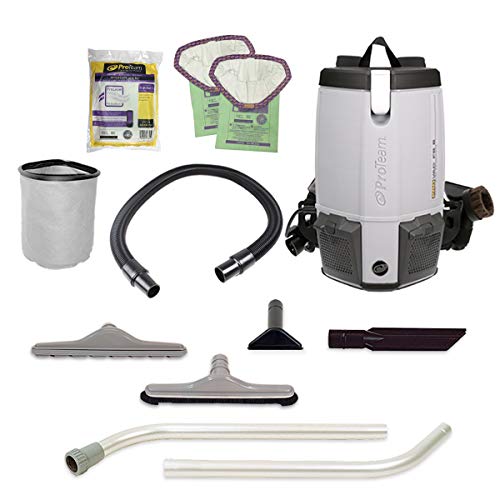
Selecting the ideal model requires checking CFM airflow ratings, canister capacity, and power cord length to minimize outlet changes. Backpack units featuring multi-stage HEPA filtration keep fine dust sealed inside the collection chamber, which helps protect indoor air quality in offices and schools. Commercial models typically carry 6-quart to 10.5-quart capacities and rely on wide floor nozzles rather than heavy upright agitators. This comparison reviews manufacturer specifications, harness designs, and attachment kits across top brands like Hoover, ProTeam, Atrix, and Prolux to help you determine the right fit.




Frequently Asked Questions
Why choose a backpack vacuum over a traditional upright?
Backpack vacuums offer greater speed and mobility around tight desks, stairs, and narrow aisles. Carrying the motor on an ergonomic harness reduces arm strain and lets the operator clean using a sweeping wand motion. This setup allows cleaning crews to cover larger areas with less physical fatigue.
What airflow rating is standard for commercial backpack vacuums?
Most commercial backpack vacuums deliver between 80 and 159 CFM of airflow. Higher airflow, like the 159 CFM on select ProTeam models, pulls debris out of floor crevices more rapidly. Models offering 100 to 120 CFM provide reliable suction for routine office and hard-surface cleaning.
Are bagged or bagless backpack vacuums better for commercial facilities?
Bagged backpack vacuums provide larger capacities and cleaner disposal, while bagless models eliminate the cost of replacement filters and bags. Bagged units hold up to 10.5 quarts of debris, containing dust during changes. Bagless models, like the Prolux XForce Pro, use a dustbin that requires regular emptying after shifts.
How does HEPA filtration benefit commercial cleaning environments?
HEPA filtration captures fine particulates down to 0.3 microns, preventing fine dust from escaping back into the room. Multi-stage filtration helps maintain cleaner indoor air in high-traffic settings like schools and medical offices. While facilities might use a self emptying robot vacuum for light floor upkeep, commercial backpacks handle heavy dust loads.
Can a commercial backpack vacuum handle high-pile carpeting?
Commercial backpack vacuums perform best on hard floors and low- to medium-pile carpets with standard suction tools. Without a motorized brush roll, standard floor tools can drag or fail to lift deeply embedded carpet debris. For deep plush rugs, pairing the vacuum with an electric power nozzle attachment is generally recommended.







Write Your Review
No reviews yet. Be the first to share your experience!