


Dimensional stability determines whether hardwood boards survive thermal cycling without warping, crowning, or separating at the seams. Multi-ply core construction handles fluctuating temperatures far better than solid timber because alternating veneer layers restrict lateral expansion. Installing subfloor heating beneath wood planks requires careful temperature control and proper underlayment selection to avoid drying out natural timber veneers. Selecting the best engineered wood flooring for radiant heat balances core thickness, thermal conductivity, and dependable moisture management across the subfloor. Many homeowners planning installations of engineered wood flooring for high traffic also demand balanced heat distribution so their living spaces stay comfortable throughout winter.
Floating floor assemblies paired with thin electric heating mats offer an efficient method to add comfort without messy mortar beds. Conductive ink heating films and specialized vapor retarders work together to protect factory finishes while delivering steady heat output across every plank. Reviewing manufacturer temperature limits, mat wattage, and underlayment vapor ratings protects your investment from thermal stress. Evaluating the right accessories alongside the best engineered wood flooring for radiant heat ensures your installation remains quiet, cozy, and structurally sound year after year.

Pros
- Mess-free dry installation without mixing mortar, glue, or leveling compounds
- Ultra-thin 0.02-inch profile maintains floor height and standard doorway clearances
- Self-limiting conductive ink prevents hot spots beneath floating floors
- Length can be trimmed on-site to customize coverage along room runs
Cons
- Requires a separate approved 120-volt floor-sensing thermostat for operation
- Mat width is fixed at 3 feet and cannot be trimmed narrower
- Not suitable for wet shower pans, exterior areas, or beneath permanent built-in cabinetry
The QuietWarmth Float Radiant Floor Heating Mat (model QWARM3X10F120) is an electric underfloor warming system tailored specifically for floating hard-surface floor coverings. Unlike traditional radiant systems that demand thick mortar beds or fluid self-leveling underlayments, this mat rolls out directly over your subfloor or acoustic underlayment before floating planks are clicked into place. It suits homeowners, apartment renovators, and DIY remodelers who want to bring gentle, luxurious warmth to chilly floating laminate, engineered hardwood, or luxury vinyl plank (LVP) floors without altering room floor elevations.
Heating performance relies on ultra-thin conductive ink technology that delivers uniform, self-limiting warmth across the entire 30-square-foot coverage area. The self-limiting design is an essential feature for floating hard floors, as it helps prevent localized hot spots that can warp, cup, or compromise vinyl and laminate plank seams. According to manufacturer data, this conductive ink system draws up to 50 percent less electrical power than traditional wired cable systems, keeping daily operating costs modest for typical room warming routines.
The build quality stands out through its razor-thin 0.02-inch thickness and durable film encapsulation. Because the mat adds virtually no height to the floor assembly, transitions between rooms, baseboards, and interior door clearances remain unaffected. Each 3-foot by 10-foot mat comes pre-wired with 15-foot cold leads, providing ample length to route wiring through wall framing into a dedicated electrical box without requiring spliced extension lines on the floor plane.
Installation is straightforward for anyone familiar with basic floating floor assembly. The mat rolls across the subfloor and can be trimmed to length along marked cutoff points to match the room perimeter. You can wire multiple mats in parallel inside a junction box to cover larger rooms up to 120 square feet on a single 120-volt thermostat circuit. For added acoustic dampening and subfloor moisture protection, the mat pairs seamlessly with floating acoustic underlayments such as QuietWalk or floating planks equipped with pre-attached padding.
There are a few installation boundaries to observe before purchasing. The 3-foot mat width cannot be cut narrower, meaning awkward alcoves and narrow passages require careful planning. The mat is strictly rated for dry interior spaces, making it unsuitable for shower floors, steam rooms, exterior decks, or vertical wall mounting. Additionally, it must not be installed beneath heavy permanent flat-bottom furniture, built-in cabinetry, or thick area rugs that could trap heat, and any paired luxury vinyl planks must measure at least 4mm in overall thickness.
For homeowners and remodelers updating their living areas, bedrooms, home offices, or kitchens with floating hard flooring, the QuietWarmth Float heating mat offers a practical, mess-free heating solution. Its combination of ultra-thin construction, dry installation, and floor-safe thermal regulation makes it a smart investment for adding quiet, everyday comfort to modern hard-surface floors.
QuietWarmth Float is engineered specifically for floating floor installations, including laminate flooring, floating engineered hardwood, floating ceramic tile systems, and luxury vinyl planks that are 4mm or thicker. The mat functions with pad-attached floating planks as well as standalone acoustic underlayments like the QuietWalk product family. It should never be used beneath nail-down hardwood or glued-down floor products where fasteners or adhesives could penetrate the conductive ink heating element.
Proper layout planning is key to successful installation. While the mat can be cut to length with standard utility shears across designated lines, the 3-foot width must remain intact to preserve internal electrical bus bars. To prevent thermal blockage, heating mats should be arranged to avoid placement under permanent flat-bottom fixtures, heavy entertainment consoles, or built-in kitchen cabinetry.
Electrical connections run on standard 120-volt household current and must terminate at an approved digital floor-sensing thermostat, which is sold separately. Up to four 3-foot by 10-foot mats (120 square feet total) can be wired in parallel into a standard junction box and controlled by a single thermostat, making it scalable for open-concept layouts and large master suites.

Pros
- Meets National Wood Flooring Association perm guidelines to help moderate subfloor moisture vapor without trapping dampness
- Durable 6 mil wet-strength paper with silicone coating holds up cleanly underfoot during staple and nail-down fastening
- Clean white surface eliminates the sticky black asphalt residue, smudges, and odor common to older tar paper alternatives
- Lab tested and approved for safe use over radiant heat floor systems
Cons
- Functions strictly as a moisture vapor barrier paper and does not provide sound-dampening acoustic padding
- Not designed to resolve severe subfloor hydrostatic pressure, active water leaks, or standing liquid issues
The ROBERTS 70-198 Silicone Moisture Barrier Underlayment is a specialized subfloor vapor retarder engineered for nail-down and staple-down solid wood, engineered wood, and compatible luxury vinyl plank (LVP) installations. For homeowners, DIY renovators, and remodelers laying new hardwood or engineered flooring across main living areas and bedrooms, managing subfloor moisture is essential to help prevent cupping, warping, and floor movement. This clean-handling roll serves as a protective foundational layer between the subfloor and your finished floor planks.
Subfloor vapor transmission can compromise wood planks over time if not handled properly. According to manufacturer specifications, this underlayment reduces vapor flow without trapping moisture against the wood underside, meeting perm ratings recommended by the National Wood Flooring Association (NWFA). Additionally, the material is lab tested and approved for use over radiant heat systems, allowing homeowners with radiant subfloors to install compatible wood planks without interfering with heat transfer.
Built from 6 mil wet-strength paper coated with a smooth silicone layer, this underlayment offers marked physical durability during the layout process. Traditional asphalt-saturated felt papers frequently tear underfoot or leave dirty black marks on tools, hands, and new flooring boards. ROBERTS designs this white 6.51-pound roll to resist tearing during active installation, ensuring it stays intact when staples and flooring cleats puncture the barrier into the subfloor.
Handling and unrolling the barrier is straightforward thanks to its 31.5-inch width and 76.25-foot length, which totals 200 square feet of floor coverage per roll. The manageable roll size allows users to unroll, align, and trim material along room perimeters and doorway transitions with standard utility knives. Because it lays relatively flat and remains clean underfoot, working on top of the laid paper during plank alignment avoids the mess of petroleum-based underlayments.
While the ROBERTS 70-198 excels as a moisture vapor retarder, prospective buyers should recognize its specific role. This product is a thin 6 mil paper barrier and does not supply acoustic insulation, impact sound deadening, or thermal underfoot cushioning found in thick foam or rubber underlayments. Furthermore, it is designed to manage ambient vapor emissions rather than block hydrostatic pressure, active slab moisture leaks, or standing water issues.
For households planning staple or nail-down installations of solid hardwood, engineered wood, or compatible LVP over wooden subfloors or approved radiant heating, the ROBERTS 70-198 provides an NWFA-compliant, clean, and tear-resistant moisture barrier. It represents a practical, mess-free alternative to traditional tar paper that helps safeguard residential wood floors from subfloor vapor fluctuations.
Managing moisture vapor migration from beneath finished floors is critical for preventing cupping, crowning, and board expansion. The ROBERTS 70-198 functions as a vapor retarder that moderates moisture flow from subfloors without creating an impermeable trap where moisture can condense directly against the underside of wood planks.
Meeting the perm ratings recommended by the National Wood Flooring Association, this silicone barrier aligns with standard industry practices for solid and engineered wood installations. Its lab-tested compatibility with radiant heat flooring systems also ensures that households utilizing underfloor heating can maintain stable thermal transfer without degrading the protective barrier.
The ROBERTS 70-198 roll provides 200 square feet of coverage with dimensions of 31.5 inches in width by 76.25 feet in length. Weighing 6.51 pounds, the roll is easy to position, roll out across subfloors, and trim neatly around corners, closets, and perimeter walls.
Constructed from 6 mil wet-strength paper with a silicone coating, the material is designed to avoid ripping or disintegrating when walked on or when penetrated by flooring staples and nails. Unlike traditional tar-saturated asphalt paper, the clean white surface prevents black smudges on hands, tools, and newly placed wood planks during setup.
Pros
- Clean, mortar-free dry installation saves time and avoids messy floor leveling compounds
- Ultra-thin 0.02-inch profile fits beneath floating floors without adding noticeable thickness
- Included programmable thermostat and 15-foot factory lead wires simplify layout and control
- Self-limiting radiant heat technology helps prevent hot spots and overheating on floating planks
Cons
- Mat can be trimmed to length but cannot be cut narrower than its fixed 3-foot width
- Strict placement limitations prohibit use under cabinetry, flat-bottom furniture, or heavy area rugs
- Not approved for wet applications like inside showers, steam rooms, or outdoor spaces
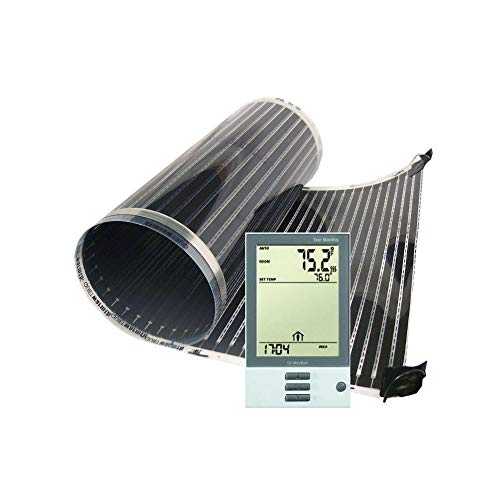
The QuietWarmth Float Radiant Floor Heating Starter Kit is an electric radiant underfloor heating mat engineered specifically for floating floor systems. Comprising a 3-foot by 10-foot mat and a matched programmable thermostat, this 120V system suits homeowners, apartment renovators, and DIY remodelers who want to bring gentle warmth to chilly living spaces. It provides a dedicated heating layer beneath floating luxury vinyl plank, laminate, floating engineered wood, and floating tile without demanding structural alterations to subfloors.
Unlike conventional heating cables that require thick coats of mortar or self-leveling cement, this system operates on an ultra-slim conductive ink film. Measuring just 0.02 inches thick, the mat distributes heat evenly across a 30-square-foot coverage area without adding height to doorways or baseboards. The heating elements are self-limiting, which helps safeguard temperature-sensitive floating floors like luxury vinyl (recommended at 4mm thickness or greater) and laminate from damaging thermal spikes while consuming up to 50 percent less power than traditional wired configurations.
The starter kit pairs the mat with factory-attached 15-foot lead wires and an intuitive programmable thermostat for precise daily temperature schedules. You can tailor the mat length to fit specific room dimensions by trimming along designated cut lines, though the 3-foot width must remain intact. For larger rooms, multiple mats can be wired in parallel through a junction box to control up to 120 square feet on a single thermostat, making layout planning modular and adaptable across bedrooms, kitchens, and living rooms.
Installation is clean and direct because the mat lays dry over approved subfloors or underlayments, such as QuietWalk products, and works with pad-attached floating planks. Because there is no wet mortar or curing time, flooring can be laid immediately above the heating film. Maintenance involves standard digital thermostat operation once installed, requiring no routine servicing or mechanical upkeep beneath the floorboards.
Several practical boundaries must be observed during project planning. The mat cannot be cut widthwise, meaning layout planning must accommodate the fixed 36-inch dimensions. It is strictly unapproved for wet areas such as showers and steam rooms, exterior locations, or installation inside wall cavities. In addition, users must avoid covering heated sections with heavy flat-bottom furniture, built-in cabinetry, or dense area rugs, as thermal trapping can trigger safety shutoffs or damage floating flooring.
For remodelers installing floating luxury vinyl, laminate, or engineered wood who dread stepping onto cold floors during winter mornings, the QuietWarmth Float Starter Kit offers an efficient, low-profile heating solution. It eliminates messy wet work while providing programmable, self-limiting warmth tailored to modern floating floor assemblies.
This radiant heat system is certified for floating hard-surface floors, including luxury vinyl plank (LVP) with a thickness of at least 4mm, floating laminate, engineered hardwood, and floating tile. It can be paired directly with pad-attached planks or laid over compatible acoustic underlayments like QuietWalk.
To protect flooring materials, the mat utilizes self-limiting conductive ink that delivers even heat output without hot spots. It must not be installed underneath permanent fixtures, built-in cabinets, or thick area rugs that trap heat.
Operating on a standard 120-volt electrical circuit, the starter kit mat measures 3 feet wide by 10 feet long, providing 30 square feet of heated area with a razor-thin 0.02-inch profile. Factory-attached 15-foot lead wires route neatly to a junction box or wall control.
The system includes a programmable thermostat to optimize energy usage and schedule heat intervals. If your project spans a larger footprint, you can wire multiple QuietWarmth mats in parallel to heat up to 120 square feet under a single thermostat.

Pros
- Extremely thin 0.02-inch profile avoids raising finished floor thresholds or door clearances.
- Completely mortar-free and dry installation simplifies subfloor prep compared to traditional cable systems.
- Cut-to-length flexibility along the mat length makes adjusting runs straightforward during room layout.
- Self-limiting conductive ink heating design helps prevent hot spots and overheating under approved flooring.
- Includes 15-foot factory-connected lead wires for clean routing to a junction box.
Cons
- Requires purchasing a separate compatible 120V thermostat and junction box components.
- Mat width is fixed at 1.5 feet and cannot be cut or trimmed narrower.
- Not approved for use under heavy area rugs, flat-bottom furniture, built-in cabinetry, or in wet shower areas.
The QuietWarmth QWARM1.5X10F120 is a floating radiant floor heating mat designed to provide electric underfloor warmth beneath floating flooring assemblies. Built specifically for luxury vinyl planks measuring 4mm or thicker, laminate, floating engineered wood, and floating tile, this 1.5-foot by 10-foot mat covers 15 square feet of floor space. It appeals directly to homeowners, DIY renovators, and remodelers seeking supplemental warmth in chilly bedrooms, living areas, basements, or bathrooms without the labor, mess, and floor elevation associated with mortar-set heating cables.
Operating on a standard 120-volt circuit, this heating mat utilizes conductive ink film technology that emits gentle, even heat across its entire surface. Because the heating element is self-limiting, it prevents dangerous hot spots that could warp or damage floating plank flooring. The manufacturer notes that this conductive ink system uses up to 50 percent less power than traditional electric wired systems, running an average bedroom floor for less than a dollar per day. Underfoot, the system transforms cold, hard surfaces into cozy, warm walk paths while maintaining compatibility with acoustic underlayments like QuietWalk for added thermal and sound management.
The physical design of the mat measures exactly 120 inches long, 18 inches wide, and an ultra-thin 0.02 inches thick, weighing only 2.5 pounds. This razor-thin profile ensures your finished flooring height remains virtually unaffected, eliminating clearance issues at doorways, baseboards, and transitional thresholds. The mat comes equipped with factory-attached 15-foot lead wires, facilitating clean wiring runs to a wall-mounted junction box. Users can connect multiple QuietWarmth mats in parallel to a single approved thermostat to heat contiguous areas up to 120 square feet.
Installation is entirely dry and mortar-free, eliminating the need for self-leveling underlayments, thin-set mortars, or messy adhesives. You roll the mat out over your approved subfloor or compatible underlayment and position it in designated walking zones. While the mat can be cut to length at designated points to fit the exact room run, the 1.5-foot width cannot be trimmed narrower, requiring careful layout planning before rolling out planks. Floating luxury vinyl planks of at least 4mm thickness, laminate, or engineered wood snap directly over the heating film.
Despite its installation simplicity, the QuietWarmth mat has clear structural and placement boundaries that buyers must observe. It is not approved for outdoor use, in-wall installation, showers, or steam rooms. To prevent thermal entrapment and floor damage, the manufacturer explicitly directs users not to place heavy area rugs, flat-bottom furniture, or permanent cabinetry directly over heated zones. Additionally, an approved 120V thermostat is not included in the package and must be purchased separately to operate and regulate the heating circuit.
The QuietWarmth Float 1.5x10 radiant heating mat is an outstanding heating accessory for floating floor renovations where minimal thickness and quick, mortarless installation are top priorities. It provides reliable underfoot warmth for modern plank floors across bedrooms, family rooms, and home offices. Homeowners planning a floating floor upgrade who want comfortable, energy-efficient winter warmth without complicated masonry work will find this modular mat well worth integrating into their flooring sub-assembly.
QuietWarmth radiant floor heating mats utilize a completely dry floating installation format that eliminates the need for wet mortars, cement backer boards, or self-leveling compounds. The mat unrolls directly over your subfloor or approved underlayment, making layout rapid and clean during DIY or professional plank floor installations.
Planning your layout requires respecting the fixed 1.5-foot width of the mat. While the mat can easily be cut to length with standard household scissors across designated cutting lines, the width cannot be cut narrower without damaging the electrical bus bars. To heat larger rooms, multiple mats are placed side by side and wired in parallel into a standard electrical junction box.
Wiring is streamlined by the included 15-foot cold leads that come factory-attached to the mat. An approved 120V radiant floor heating thermostat is required to regulate operating temperatures and must be sourced separately. Up to 120 square feet of QuietWarmth mats can be wired to a single thermostat control point on a 120V circuit.
This radiant heat mat is approved for indoor spaces including bedrooms, family rooms, home offices, kitchens, bathrooms, and enclosed three-seasons rooms. It delivers consistent comfort across living spaces that suffer from cold subfloors or drafty crawlspaces.
Clear placement restrictions must be followed to avoid thermal entrapment. The manufacturer explicitly advises against installing mats beneath permanent cabinetry, kitchen islands, or large, flat-bottom furniture that rests flush against the floor without air circulation. Heavy area rugs must also be kept off heated floating floors to prevent heat buildup from damaging the floor finish.
The heating mat is strictly rated for dry and damp indoor floating floor assemblies. It is not approved for wet areas like tiled shower pans or steam rooms, nor is it rated for outdoor patios, decks, or vertical in-wall heating applications.
Pros
- Ultra-thin 0.02-inch profile installs without raising floor height or altering room transitions.
- Zero mortar or self-leveling compound required for a fast, clean floating floor installation.
- Cut-to-length capability accommodates custom floor lengths and targeted walk areas.
- Self-limiting thermal design helps protect floating vinyl and wood finishes from overheating.
- Factory-attached 15-foot lead wires simplify connections to a central junction box.
Cons
- Requires a separate approved 120-volt thermostat that is not included in the package.
- Mat width cannot be cut narrower, requiring careful layout planning around fixed obstacles.
- Not approved for use beneath permanent cabinetry, flat-bottom furniture, or heavy area rugs.
The QuietWarmth Float radiant floor heating mat provides supplemental underfloor warmth specifically engineered for floating floor assemblies such as luxury vinyl planks, laminate, and engineered floating wood. Designed for homeowners, DIY renovators, and basement remodelers, this 1.5-foot by 5-foot mat warms cold subfloors without the complex mortar work typical of traditional wired radiant systems. Covering 7.5 square feet, it suits targeted warm zones in bedrooms, family rooms, home offices, and permitted bathroom areas.
Heating performance relies on ultra-thin conductive ink technology that delivers gentle, evenly distributed warmth directly beneath the walking surface. The manufacturer indicates that this conductive ink system consumes up to 50 percent less electrical power than traditional wire-embedded coils. Because floating floor finishes can be sensitive to rapid thermal spikes, the mat is engineered to be self-limiting, which prevents excessive temperature build-up that might warp or degrade compatible floating luxury vinyl planks or laminate planks.
In terms of construction and physical dimensions, the mat measures 18 inches wide by 60 inches long with an ultra-slim 0.02-inch profile. This razor-thin film allows floating floor planks to rest directly overhead without creating visible floor height discrepancies, eliminating the need to adjust doorway transitions or trim door bottoms. Each mat arrives pre-wired with 15-foot factory leads, enabling straightforward routing into an electrical junction box where multiple mats can be wired in parallel up to a total of 120 square feet on a single thermostat circuit.
Installation avoids wet compounds entirely, which significantly streamlines room renovations. The dry-lay process requires a clean, flat subfloor where the mat is laid flat and cut to length along marked guidelines to match room dimensions. Planners should note that while the mat can be cut shorter, its 1.5-foot width cannot be narrowed. It pairs smoothly with floating luxury vinyl flooring at least 4mm thick, floating engineered wood, or installations supported by QuietWalk underlayments, providing thermal comfort without requiring self-leveling mortar beds.
Clear layout planning is required to avoid product limitations. The system operates on standard 120-volt household electricity, but an approved digital or programmable thermostat must be purchased separately to control the heating circuit. In addition, the mat is strictly prohibited beneath permanent cabinetry, flat-bottomed furniture, showers, steam rooms, and exterior spaces. Placing heavy, dense area rugs directly over the heated floor is also disallowed by the manufacturer because trapped heat cannot dissipate properly.
For homeowners and renovators seeking a clean, dry radiant heating upgrade beneath modern floating floors, this QuietWarmth mat delivers targeted thermal comfort with minimal electrical draw. It is particularly effective along bedside walkways, primary living room seating areas, and chilly basement floating floors. Verifying your floating flooring thickness meets the 4mm minimum requirement and planning around furniture footprints will ensure a reliable, warm floor installation.
Installing QuietWarmth Float mats requires no thinset mortars, messy wet adhesives, or self-leveling cement compounds. The mat unrolls directly across the subfloor or approved insulating underlayment prior to installing floating flooring planks. The 1.5-foot width is fixed, but the mat features designated cut lines that allow installers to trim the length cleanly with scissors to match the room layout.
Electrical configuration uses standard 120-volt current and factory-attached 15-foot cold leads that run back to a junction box. Installers can connect multiple mats in parallel on a single circuit, powering up to 120 square feet of heated area using one compatible 120V thermostat. An approved radiant floor thermostat is required for operation and must be acquired separately.
The QuietWarmth Float mat is designed exclusively for floating floor installations, including luxury vinyl plank (LVP) that is at least 4mm thick, laminate flooring, floating engineered hardwood, and floating ceramic tile systems. It can be paired with pad-attached flooring or placed over compatible acoustic underlayments such as the QuietWalk family of products for enhanced sound reduction and thermal isolation.
Certain installation restrictions must be followed to maintain system safety and protect floor coverings. The heating mat cannot be placed under fixed cabinetry, built-in vanities, or heavy flat-bottom furniture lacking airflow clearance. The manufacturer also prohibits covering heated zones with thick, heavy area rugs, as insulating thermal blankets can trap heat and trigger premature thermal cutoff.

Pros
- High acoustic ratings with an IIC of 70 and STC of 66 for noticeable footfall sound reduction in multi-story spaces
- Pre-attached adhesive strip and overlapping plastic lip provide fast, secure seam sealing during rollout
- Large 600 square foot value roll covers substantial surface area with fewer seams than standard 100 square foot rolls
- Approved by the manufacturer for installation over radiant heated subfloors
Cons
- Restricted to floating laminate and engineered wood floors, making it unsuitable for nail-down solid hardwood or ceramic tile
- The 43-inch wide roll requires adequate staging room to unroll and cut accurately in small or congested rooms
- The 2.5 mm profile adds vertical height that requires confirming clearance under interior doors and existing baseboards
Roberts Black Jack Underlayment is a specialized floor-preparation roll engineered to serve as a supportive acoustic base beneath floating laminate and engineered wood flooring. Designed for DIY homeowners, renovators, and professional installers alike, this underlayment targets common hard-floor issues such as hollow-sounding footsteps and minor subfloor roughness. If you are preparing to install floating planks across an apartment, multi-story home, or high-traffic family living room, laying down an appropriate underlayment is an essential foundation step before clicking your planks together.
Sound dampening is a primary functional benefit of this 2.5 mm thick underlayment. With an Impact Sound Transmission (IIC) rating of 70 and a Sound Transmission Loss (STC) rating of 66, Black Jack is formulated to absorb footfall vibrations and reduce sound transference between building levels. This makes it particularly relevant for second-floor bedrooms, condominiums, and rental units where everyday walking noise can carry through the subfloor into living spaces below. Furthermore, the material is approved for use over radiant heated subfloors, allowing warmth to pass through without degrading the cushion layer.
In terms of dimensions and structural design, each continuous roll measures 43 inches wide by 167.5 feet long, totaling 600 square feet of coverage. Despite this extensive surface area, the entire roll weighs approximately 11 pounds, making it easy to carry from a vehicle into the job site. The roll includes an integrated plastic overlap flap equipped with a factory-applied adhesive strip. This built-in system allows installers to align adjacent runs cleanly, peel off the protective backing, and seal seams securely without juggling separate rolls of seam tape.
Handling and layout are straightforward on properly swept, dry subfloors. Because floating floors depend on a flat foundation, this 2.5 mm dense foam layer helps absorb slight subfloor irregularities, preventing localized plank bounce or premature stress on delicate tongue-and-groove joints. Cutting the material to length requires only a standard utility knife against baseboard perimeters or door casings. By joining seams neatly via the pre-taped overlap, you establish a uniform underlayment plane that helps keep floating planks quiet and stable throughout years of foot traffic.
Realistic limitations must be kept in mind prior to purchase. Roberts Black Jack is explicitly designated for use under floating laminate and engineered wood planks; it is not formulated for direct glue-down installations, solid nail-down hardwood, luxury vinyl tile (LVT) that mandates ultra-dense high-compression underlayments, or ceramic tile. Additionally, adding 2.5 mm of underlayment beneath your finished plank thickness can impact clearance under exterior doors, closet tracks, and transition moldings, meaning measuring existing vertical door gaps beforehand is recommended.
For homeowners and property managers outfitting living rooms, hallways, and bedrooms with floating laminate or engineered wood, Roberts Black Jack provides a dependable, cost-effective base. Buying in a 600 square foot roll format reduces project costs compared to buying multiple individual 100 square foot rolls while significantly reducing the number of spliced seams across large open-concept floor plans.
Acoustic management is a critical factor when installing rigid floating floors. Walking on floating laminate can create a noticeable hollow sound if laid directly over hard subfloors. Roberts Black Jack tackles this with an IIC (Impact Sound Transmission) rating of 70 and an STC (Sound Transmission Loss) rating of 66, which reflect substantial laboratory ratings for muffling impact footfalls and airborne room noise across multi-family and two-story residential floorplans.
Beyond sound management, the underlayment is fully compatible with radiant heated flooring systems. Many foam layers can impede radiant heat transfer or break down under persistent subfloor warmth, but this formulation is rated to tolerate radiant heat installations safely, helping keep finished laminate or engineered wood comfortable underfoot throughout colder months.
The continuous 600 square foot configuration of Roberts Black Jack provides practical installation advantages across large rooms. Measuring 43 inches in width, the roll covers broad floor spans quickly, reducing overall installation time compared to narrower rolls. The total roll weight of 11 pounds remains manageable for a single installer to carry up stairs and maneuver through tight hallways.
The built-in plastic overlap with a pre-applied adhesive strip speeds up seam sealing significantly. As each new strip is rolled out parallel to the previous one, the clear plastic edge overlaps the adjacent foam, and peeling the adhesive release liner creates a sealed joint without needing separate subfloor tape. Standard utility blades easily slice through the 2.5 mm foam around floor vents, door jambs, and perimeter walls.
Frequently Asked Questions
Can engineered hardwood flooring be installed over radiant floor heating?
Yes, engineered hardwood is the most stable real wood option for radiant floor heating systems. Its cross-ply core restricts dimensional movement when temperatures cycle. Solid wood expands and contracts much more, making engineered planks far less likely to cup or gap. Always verify that your flooring manufacturer approves the plank style for radiant heating.
What is the maximum safe temperature for engineered wood over radiant heat in 2026?
Most manufacturer guidelines in 2026 specify a maximum surface temperature of 85 degrees Fahrenheit (29.4 degrees Celsius). Higher temperatures can dry out top veneers, weaken bonding glues, and cause surface checking. Programmable thermostats with floor sensors help maintain uniform, gentle heat. Self-limiting mats like QuietWarmth also prevent hot spots that could damage delicate factory finishes.
Does radiant heat require a specific underlayment under floating engineered wood?
Yes, floating installations over radiant heat require underlayments engineered for heat transfer and vapor protection. Products like Roberts Black Jack Underlayment provide 2.5 mm of cushioning and sound reduction while letting heat pass smoothly into the room. Integrated moisture barriers in quality underlayments also stop subfloor vapor from affecting floating planks.
Can you staple or nail down engineered wood floors over radiant heating?
Nail-down methods are only safe when heating elements sit deeply embedded in concrete or specialized subfloor grooves. Fasteners easily puncture surface-laid electric mats or hydronic tubes. For approved nail-down installations over radiant subfloors, a specialized layer like ROBERTS 70-198 Silicone Moisture Barrier manages vapor without trapping dampness.
How does radiant heat affect the finish on engineered wood floors?
Radiant heat will not harm factory finishes if temperatures stay within recommended operating limits. Severe overheating or low indoor humidity below 30 percent can cause finish stress. For boards that require recoating, a high-grade water-based wood floor finish offers durable protection without releasing harsh fumes during warming cycles.


Write Your Review
No reviews yet. Be the first to share your experience!